







Campaigns did little to change voters’ mind: Survey
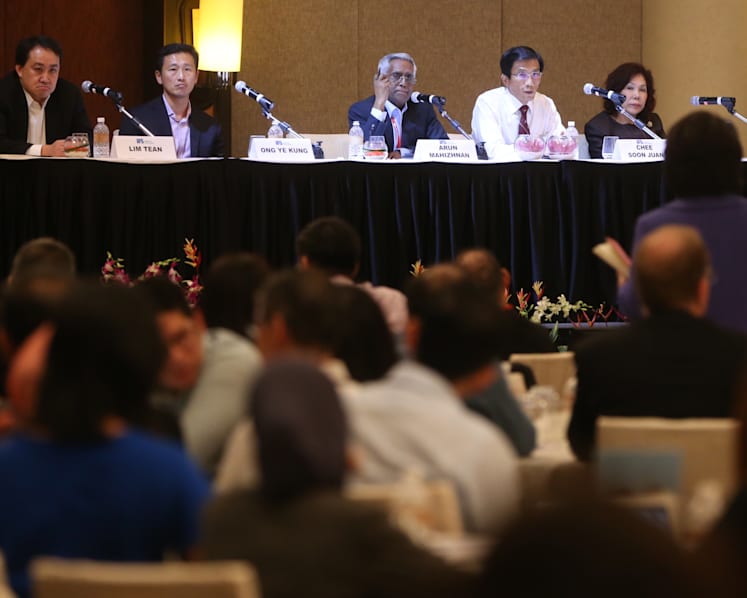
(From left) NSP Secretary-General Lim Tean, Acting Minister for Education (Higher Education and Skills) Ong Ye Kung from the PAP, Special Research Advisor from NUS Institute of Policy Studies Arun Mahizhnan, SDP Secretary-General Chee Soon Juan and SPP Chairman Lina Chiam at the concluding session of the Post-Election Conference 2015 held at the Orchard Hotel on Nov 4, 2015. Photo: Ooi Boon Keong


SINGAPORE — Electoral campaigns had little impact on the votes cast in the recent General Election, political analysts and researchers said today (Nov 4).
In his survey of 3,000 voters conducted before, during and after the nine-day campaign for the Sept 11 polls, National University of Singapore sociologist Tan Ern Ser found no significant shifts in satisfaction with government performance, and views on governance and the electoral system.
“I noticed there were no major shifts across the waves, although a slight decline (in satisfaction) was observed in later waves. I take it that there isn’t much change, people have already made up their minds (before the campaign) as to who they want to vote for. So the people who are generally satisfied vote for PAP (People’s Action Party), less so, vote for the non-PAP parties,” said Dr Tan, who shared his results at a post-election conference organised by the Institute of Policy Studies (IPS) today.
Only 557 respondents were willing to answer questions pertaining to their actual vote. For them, confidence in and reputation of the party were the top two vote pullers. This shows that Singaporeans have cast their votes with a future-oriented and long-term mindset, Dr Tan said.





The need for an Opposition presence in Parliament was the third most important vote-determining factor, but it influenced non-PAP voters to a larger extent than PAP voters.
The PAP’s “hard work” over the last four years reaped political returns among the electorate, said Singapore Management University law don Eugene Tan, and confirmed that “elections are won before the elections”.
“While the outcomes may not always be what they desired, people did recognise its (the PAP’s) effort ... it confirms that elections are not won during the hustings,” he said.
Associate Professor Tan urged the Opposition to up its game by increasing engagement with the ruling party in various forums beyond elections.
Based on analyses of the respective campaigns by PAP, Workers’ Party, Singapore Democratic Party, Singapore Progressive Party and National Solidarity Party this year, Associate Professor Randolph Tan from the SIM University found that the most important issues of concern centred on cost of living, foreign manpower, population and immigration, and the minimum wage.
However, he noted a lack of in-depth discussion on the issues, partly due to the short campaign period.
For instance, key issues like the minimum wage was excluded from most parties’ manifestos even though they may have advocated it during rallies, Assoc Prof Randolph Tan said. He called for a political climate that facilitates more “back and forth” discussion of policies.
Dr Tan Ern Ser’s study also found that the top five issues that influenced votes most are cost of living, housing affordability, healthcare affordability, meeting retirement needs and government transparency and accountability.
In particular, the lower-middle and lower classes, as well as voters aged between 30 and 39, are most affected by these issues. Cost of living and housing affordability are also among the areas voters are currently least satisfied with.
These findings illustrate that bugbears from the 2011 General Election still remain, said Dr Tan.
Least influential issues include rising birth rate, crisis management, relations between races, childcare, and civil rights and liberties.




