







Carter calls for a more cooperative China
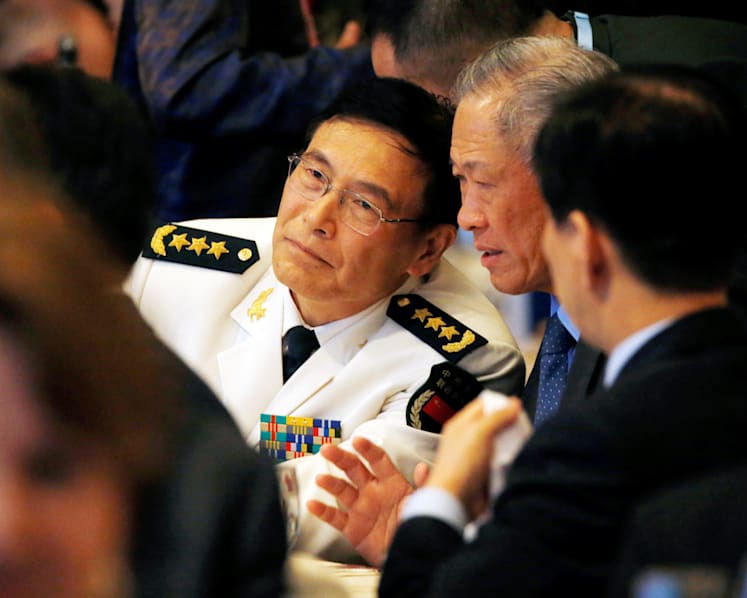
China's Joint Staff Department Deputy Chief Admiral Sun Jianguo speaks with Singapore's Defence Minister Ng Eng Hen during the keynote address at the IISS Shangri-La Dialogue in Singapore June 3, 2016. Photo: Reuters


SINGAPORE — Amid the recent trading of barbs between the United States and China over the latter’s actions in the South China Sea, US Defense Secretary Ashton Carter on Friday (June 3) urged Beijing to make a conscious decision to be “cooperative” and participate in an “inclusive and principled” security network that has served the region well.
In a joint doorstop interview with Defence Minister Ng Eng Hen at the Paya Lebar Airbase, Mr Carter noted that China, as with other countries, will make its own choices.
“Obviously, we hope that it makes a choice (of) one that is cooperative, with the system of security that has served this region so well for so long,” said Mr Carter, who is in Singapore for the Shangri-La Dialogue, a three-day, high-level security meeting which began on Friday.
Mr Carter had earlier drawn Beijing’s ire after he warned last week that China’s actions in the region — including in the disputed South China Sea — could erect “a Great Wall of self-isolation” as countries in the region expressed concerns over its behaviour.





Among other things, China had pressed “excessive maritime claims contrary to international law” by building — and subsequently militarising — artificial islands atop disputed features, Mr Carter had said at the US Naval Academy on May 27.
His comments had drawn a sharp riposte from China, which said that Mr Carter was stuck in a mentality that harked back to the “Cold War era”.
Weighing in on the issue of China, Dr Ng said on Friday that the question was how to accommodate both a resident power and a rising one — referring to the US and China respectively — within the security architecture.
This architecture has to be an “inclusive” one, with “clear rules of the role where all of us understand how we resolve disputes and whether we have the political will to resolve disputes”.
On Singapore’s role as a bridge to enhance cooperation between China and the US and the Association of Southeast Asian Nations (Asean), Dr Ng said that the Republic has “no fantasies or delusions” about the size of its influence.
“What we can do is try to speak truth to power, to say what we see as accommodating for both the interests of small and large countries and how we could continue to maintain stability in this region,” he said.
Singapore, added Dr Ng, does this through various forums such as the on-going Shangri-La Dialogue. Apart from Mr Carter and other US officials, Dr Ng on Friday also met ministers and senior officials from China, India, Malaysia, Japan and New Zealand.
During Dr Ng’s meeting with Chinese Deputy Chief of Joint Staff Admiral Sun Jianguo, the two men reaffirmed the warm and friendly defence relationship between Singapore and China. Those ties have been strengthened since the Four-Point Consensus was agreed upon during Dr Ng’s visit to China in November 2014.
They also had a candid and open exchange on regional security issues.
Dr Ng also met Malaysian Defence Minister Hishammuddin Hussein, where both ministers reaffirmed the close and long-standing defence relations and cooperation between their two countries, and their strong commitment to the Five Power Defence Arrangements.
Meanwhile, US Senator John McCain, speaking on the sidelines of the Shangri-La Dialogue on Friday, said he feared the consequences should China reject an impending United Nations (UN) court ruling on the South China Sea dispute and called on Asian nations to back US statements that the outcome should be binding.
The enforcement of the ruling of the Permanent Court of Arbitration at The Hague would be a major test for the region, said the Arizona senator.
The Philippines has gone to the court to contest China’s claim to an area of the sea stretching into the maritime heart of South-east Asia.
As Mr McCain urged China to shift from the coercion and intimidation of neighbours to cooperation, he also urged South-east Asian nations to re-state their support for a rules-based order.
“America and the world are counting on the nations of South-east Asia to recommit their power and resolve to upholding this system on which our shared security and prosperity depend,” he said. WITH REUTERS




