







Chinese New Year set to be muted as lion dance troupes see bookings plummet
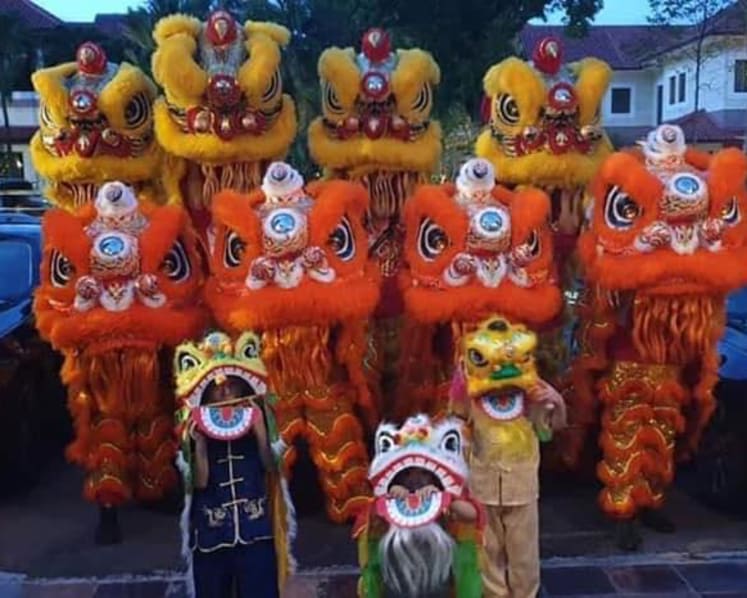
Yun Yang Dragon And Lion Dance Association, usually hired to do caiqing at about 100 places a year, received fewer than 10 bookings this year.


- Lion dance is not allowed at residential areas, hawker centres, food courts, coffee shops, among others, this year
- The limitation and a new approval requirement have caused bookings to fall drastically for lion dance troupes
- One troupe is offering virtual “caiqing” to get around the safety requirements
SINGAPORE — With the threat of Covid-19 still looming, lion dance troupes have seen bookings for traditional “caiqing” activities plummet by up to 90 per cent.
The troupes attributed this to the restrictions on where they can perform this year – essentially places where crowds wouldn’t typically gather – and safety requirements put in place to reduce the risks of infection.





Chinese families, organisations and business owners typically invite lion dance troupes to perform the ritual during the 15-day Chinese New Year period as it is believed to attract good luck and fortune to their homes, shops or offices for the year ahead.
During caiqing, literally translated as “pluck the greens”, the lion, animated by two performers, would approach an offering of lettuce to the sounds of drums, cymbals and gongs. It would then spit the greens to spread cheer and prosperity to the space.
The number of lion dance troupes that have applied for a permit to perform caiqing this Chinese New Year has dropped more than 30 per cent, from 187 to 127 this year.
Yun Yang Dragon And Lion Dance Association, usually hired to do caiqing at about 100 places a year, received fewer than 10 bookings this year.
Its schedule used to be jam-packed with bookings throughout all 15 days of the festival, but as it stands now, it is almost blank, said its co-owner, Mr Jason Ho, who is in his 40s.
With this, the troupe, which has 40 active members, is expected to make a loss as it spends at least S$2,000 a month to rent a space at an industrial park to store props and train performers, among other costs like transportation, he added.
“If we run out of money to rent, we will have to split the load and store the logistics at home, and hope for the best next year,” said Mr Ho, who has a day job as a school’s desktop support engineer.
WHY DID BOOKINGS DROP?
The Singapore Wushu Dragon and Lion Dance Federation, which issues caiqing permits, had announced on Jan 17 that it is not allowed at all residential areas, hawker centres, wet markets, food courts, as well as coffee shops and shops in housing estates.
It will only be allowed at offices, factories, hotels, temples and shops in large shopping centres.
Even so, no more than 50 people can gather, a safe distance of one metre “must be strictly observed”, and the troupes must perform in teams of up to eight members, including the musicians and their leader, it said.
There were also new requirements that made it less convenient to hire them, the troupes said.
The clients must get prior approval from the federation and the People’s Association by filling up a form undertaking that they will comply with safe management measures, which includes providing a demarcated area for the performance and providing manpower for crowd control.
The form also required them to get a representative of the property owner or management committee to sign their approval of the performance being conducted on their premises.
The deadline to submit this form was Thursday (Feb 4). In a notice on Wednesday, the federation had said that applications received after the deadline would not be accepted.
Chinese New Year is celebrated over 15 days, and begins on Feb 12 this year. The window during which caiqing is allowed is between Feb 11, its eve, and Feb 26, the 15th day.
THE IMPACT
These rules of not being allowed to perform at people's homes translated to a situation where many of the troupes received no bookings for the first three days of Chinese New Year. That’s when families typically gather.
And where they received bookings, they can only offer the cheaper packages since a maximum of eight of them can be dispatched.
Forget the dragon dance packages of S$888 and above, said Mr Ho.
His troupe’s biggest gigs this year are a basic engagement of two lions for S$200 odd, he said.
“Now they say, ‘very easy, you can perform at the industrial areas’, but buildings have their own management that might disallow that. You want to hire, but the management doesn’t allow, you also cannot do anything,” he added.
With the current spread of bookings – two to three performances at most a day, starting from the fourth day of Chinese New Year – Mr Ho said he could not justify the cost of renting a lorry for 15 days at a stretch to transport props and performers across the island as well. He would have to go for the less economical option of renting a lorry by the day.
Wei Eng Dragon & Lion Dance Training Centre, which saw the number of bookings fall by 80 to 90 per cent, is performing at fewer than 10 shops at shopping centres and some smaller-scale factories and offices this year, making it hard to cover costs.
Mr Joseph Lee, 24, a coach at the 30-men troupe, said recurring monthly expenses include close to S$2,500 in rent for its premises, where the troupe stores its bulky equipment, and another S$1,000 for its lorry.
“We did up team masks for our performers to wear and present a more coherent front during the performances this year, but we didn’t know that so many restrictions would be in place,” said Mr Lee, pointing out that the customised masks, which also act to raise team morale, cost S$600.
“We didn’t know that the response was going to be so bad.”
Nam Sieng Dragon & Lion Dance Activity Centre had close to 60 of their regular clients book its services in advance, only to cancel after finding out the new requirements. These include big corporations and schools.
Its manager Lim Chew Seng, 56, said the 50-men troupe had performed at 10 to 20 schools on Chinese New Year’s eve in previous years, but, while nine schools made their bookings earlier this year, eight have called to cancel, with the remaining one hanging in the balance.
In the end, Nam Sieng secured only 80 bookings this year, down from about 200 in a normal year.
To console themselves, Mr Lim said most members of his troupe – many of whom are youths – “can finally go bai nian (visiting)” and celebrate the season with their own families undisturbed.
EXPLORING ‘VIRTUAL' CAIQING
Wenyong Dragon and Lion Dance Troupe received only two to three bookings from day four to seven of Chinese New Year. Overall, bookings fell by 90 per cent, said Mr Devon Lim, a coach and leader at the troupe.
It used to perform at shopping centre atriums, but there are no such large scale jobs this year as crowds would likely gather to watch the live lion dance performance, putting parties at risk of breaching safe distancing measures, the 29-year-old pointed out.
To get around this, Wenyong partnered with event management firm Jamboree Events Concepts to offer remote caiqing services, where lion dancers would perform the ritual at a studio to be streamed live to an audience tuning in over video conferencing platforms like Zoom.
Two companies have engaged this service so far.
Mr Jonathan Foo, 33, the director of Jamboree, which helps firms organise corporate events including Chinese New Year parties, said he mooted the idea as he thought it would be “very weird” without the roving lion dance troupes making a splash at the celebrations.
“If the Mediacorp studio can broadcast their lion dance, why can’t we?” he added.
Asked what he thought of the idea, Nam Sieng’s Mr Lim said: “We have thought of this, but I find that there is no meaning to it… The ceremony is supposed to spread wealth and prosperity to the home or office. If it is online, where does the prosperity go?
“If customers want it online, they might as well get a DVD to watch. Isn’t it better?”




