







CNA Explains: What is 'tunnel squatting' and how does it affect MRT operations?
Underground tunnels serving three stations on the Circle Line will be partially closed early next year for strengthening works to address a phenomenon known as "tunnel squatting".

File photo of an underground railway tunnel. (Photo: iStock/agfit)

This audio is generated by an AI tool.


SINGAPORE: Sections of Circle Line tunnels serving Mountbatten, Dakota and Paya Lebar stations will be partially closed for nearly three months in early 2026 for strengthening works, following a phenomenon known as "tunnel squatting".
In a nutshell, this means longer waits of up to 30 minutes for commuters during peak periods.
The trains will arrive at 10-minute intervals - up from the usual three - at the affected stations which will use a single open tunnel. A new shuttle bus service will operate during weekday peak periods to take commuters to unaffected parts of the train network.
This will mark one of the longest scheduled MRT service disruptions to date.





But why does "tunnel squatting" happen in the first place, and what happens if it is left unchecked? To find out, CNA spoke to experts to understand all there is to know about this phenomenon, which is not unique to Singapore's underground MRT network.
What is "tunnel squatting" and why does it need to be fixed?
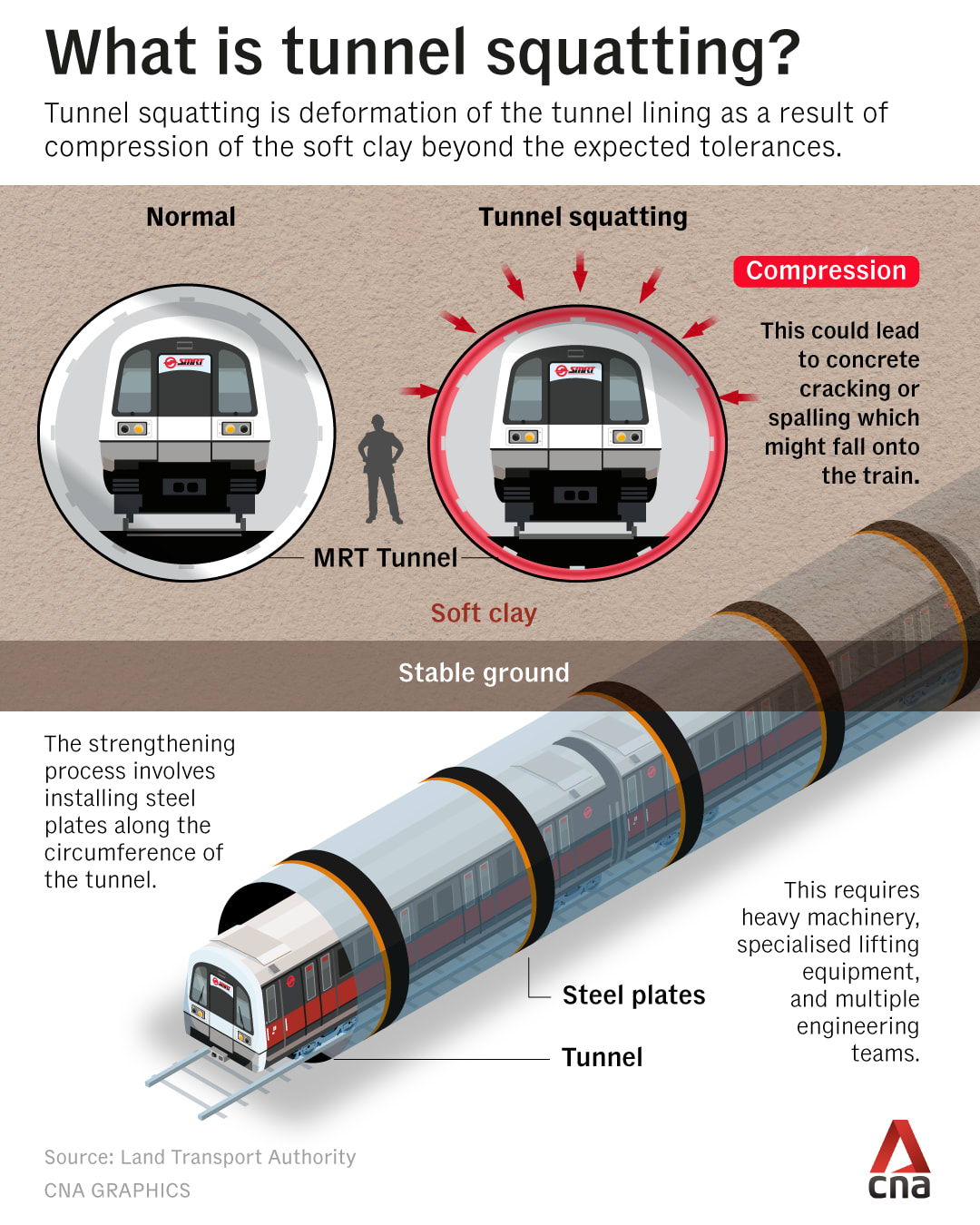
Some stretches of the Circle Line tunnels were built in soft soil, such as marine clay, which gradually compresses over time, making them more prone to deformation. This causes the tunnels to become more elliptical or oval-shaped - what is known as tunnel squatting.
Mr David Ng, chairman of the Civil & Structural Engineering Technical Committee at the Institution of Engineers, Singapore, likened soft clay to a sponge filled with water to maintain its shape.
"(When) the water is squeezed out, the sponge will be compressed," he told CNA on Monday (Dec 1).
He added that about 25 per cent of Singapore’s land area is built on marine clay, suggesting that a similar proportion of MRT tunnels is constructed in the same soil.
Singapore’s MRT tunnel design already factors in tolerances for marine clay, he said, but the stretch of the Circle Line near the coastline is built in "very soft" and "very sensitive" marine clay.
"(It) has actually exceeded the tolerance that we have actually designed for," said Mr Ng.
Tunnel squatting arises from geological processes, including changes in the surrounding environment and groundwater surrounding the marine clay.
If severe, it can cause concrete to crack or spall, with debris potentially falling onto passing trains and posing safety risks. The Land Transport Authority (LTA) said that if left unaddressed, the issue may lead to disruptions in train operations and long-term structural defects.
Minor defects, such as signs of water leakage, have already been observed in the more affected tunnel sections.
Where else can tunnel squatting occur?
Before the upcoming works, Mr Ng pointed to service adjustments on the Circle Line in 2023, when extra maintenance was carried out after a "small segment" of the tunnel between Promenade and Nicoll Highway stations was found to be under greater pressure.
He said this was also a case of tunnel squatting. Some tunnel stretches sat on reclaimed land made up of marine clay, which he described as still very soft and prone to compression when disturbed.
Beyond the Circle Line, parts of the East-West Line tunnels were also built in marine clay. But the material there is older and more consolidated, having been subjected to higher past stresses, which makes it stronger and stiffer.
While tunnel squatting is often associated with soft soil, particularly that undergoing compression, not all tunnels built in such conditions will be affected, said Mr Ng.
He added that other tunnels in Singapore, such as those for the Deep Tunnel Sewerage System and underground cable routes, are much deeper below the surface and lie in hard soil or rock rather than soft clay.
"In those conditions, these tunnels are usually free from the problem of squatting," he said.
Elsewhere in the world, cities such as Shanghai, Taipei, Busan, Barcelona and Lisbon have experienced similar challenges and adopted comparable strengthening measures.
Why do tunnel strengthening works take months to complete?
Strengthening the affected Circle Line tunnels involves installing steel plates along the tunnel’s circumference. This requires heavy machinery, specialised lifting equipment and multiple engineering teams.
More than 300 workers and engineers will be deployed to install these plates across 450m of tunnel segments, LTA said. Longer engineering hours are needed because of the scale and complexity of the works.
Associate Professor Raymond Ong from the National University of Singapore's civil and environmental engineering department called the process an "intensive job", as crews must also ensure that live equipment such as cables is not damaged.
"There’s a lot of work - in fact, precision work - required. And nothing should go wrong. Therefore, a lot of care is required," said Assoc Prof Ong, who is the department’s deputy head of research.
He added that LTA likely estimated the project duration after considering factors such as project management and sequencing of tasks. The timeline would also include buffer time and inspections to ensure the repaired tunnels are safe before reopening them to traffic.
Are there more works to come due to tunnel squatting?
Unlikely, according to the experts.
Mr David Ng pointed out that tunnel squatting was "not really a common problem" and said he did not see it as a recurring issue.
He added that it is unlikely that other stretches of the tunnel will experience the same deformation and require repair.
That said, he stressed the importance of being prepared not just for tunnel squatting, but other issues that may surface after regular inspections that involve the train systems, tracks and even cables.




