







Commemoration or glorification? Question raised over Mr Lee's death anniversary
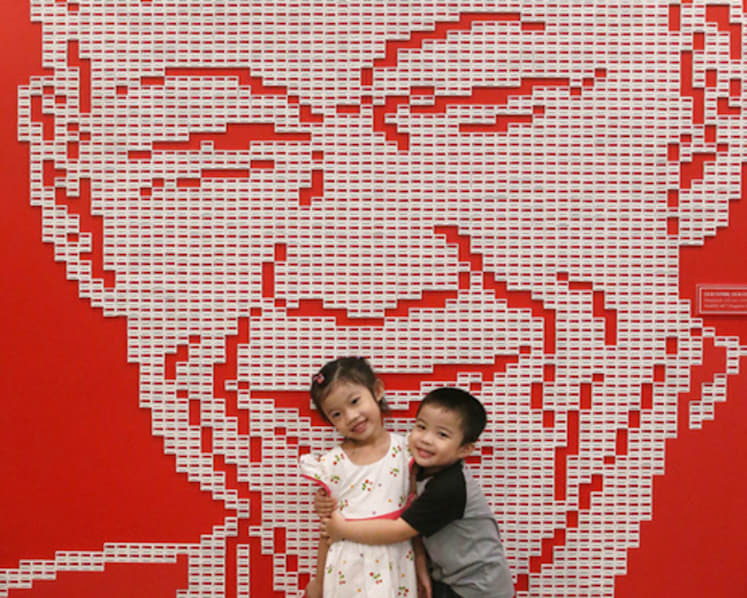
Siblings Genevieve Lim, 7 and Ignatius Lim, 4 hug for photos in front of a portrait of the late Mr Lee Kuan Yew that is made up of 4,877 Singapore flag erasers at The Red Box on March 20, 2016. Photo: Ooi Boon Keong/TODAY


SINGAPORE — The slew of events commemorating Mr Lee Kuan Yew’s death one year on ignited a debate over the weekend, with his daughter Lee Wei Ling, his successor Emeritus Senior Minister Goh Chok Tong and Speaker of Parliament Halimah Yacob offering varying views on the issue.
In a Facebook post on Friday (March 25) evening, which has since been shared by around 7,000 users of the social network, Dr Lee wrote that her father would have objected to the “hero worship” just a year after his death.
“In looking at acts of commemoration in general, I would ask how the time, effort, and resources used to prepare those would benefit Singapore and Singaporeans,” she wrote.
“I also question the need for a commemoration so close after Papa’s (death), when last year’s event still hangs heavy on the hearts and minds of some people.”





Unlike other leaders, Mr Lee was not one who endorsed cronyism and was “dead set against a personality cult”, Dr Lee said.
Individuals and community groups had planned more than 100 events, from tree-planting activities to multiple remembrance sites and family carnivals, to mark Mr Lee’s first death anniversary on March 23, some of which began at the start of the month.
Recalling Mr Lee’s reaction to the rousing welcome during her first visit with him to China in 1976 — when young children lined the streets and chanted loudly upon their arrival — Dr Lee wrote: “It was very contrived and my father was not impressed. We are Singaporeans, not prone to excessive, unnatural displays of emotion.”
Mr Goh agreed with Dr Lee: “I, too, have known Lee Kuan Yew for some 40 years. I know his sentiments ... He would prefer us to reflect on his values, what he had done for Singapore, as a foundation for building Singapore in the future.”
“I, too, won’t want to remember him in a very big way,” he said on the sidelines of the Lee Kuan Yew Remembrance Event at the Marine Parade Community Club. Mr Lee was always focused on the future, said Mr Goh, and would want life to carry on normally: “In fact, (he would want) life to be even better after him. That’s the best way to remember him.”
According to Madam Halimah, the point of the numerous anniversary events was not to glorify Mr Lee.
“This is the first anniversary of Mr Lee’s death, and considering the huge grief that was expressed on his passing, this helps in the healing process for the nation,” she said.
“It will indeed be too much if we do this every year, or if we do it to show our adulation, or put him on a pedestal. He never needed that when he was alive and would not have approved of it now. But he was a huge unifying figure when he was alive, and that remained true even after his death.
“In today’s world that is being torn asunder by conflicts and sectarianism, commemorating his death on his anniversary helps to remind us of the values that he held dear that have helped to keep us united.”
To that end, political analysts say the efforts of young Singaporeans would be better placed in studying Mr Lee’s legacies. “That would be a much more fitting tribute in the super long term because we Singaporeans need to write about our own leaders,” said Dr Alan Chong from the S Rajaratnam School of International Studies.
The “outpouring of retrospective adulation” this year, such as through the display of huge murals and numerous sentimental notes, can be “distracting” at a time when the Republic is facing “unprecedented pressures from globalisation”.
“All these were already done last year in relation to SG50. And I think that was already quite a lot. It touched everybody’s heart. So I think we should just leave the memory of the great man as it is,” said Dr Chong.
While the commemorative events were well-intentioned, Singaporeans will benefit more from reflecting more deeply on the values he stood for, added Assistant Professor Woo Jun Jie from Nanyang Technological University.
“In order that Mr Lee’s legacy, along with those of all our founding leaders, are preserved, we need to take an approach that emphasises values and belief systems over personalities,” said Asst Prof Woo, who cited ideals such as multiculturalism, meritocracy and justice.




