







Countries should collaborate to advance in space race: Former astronaut
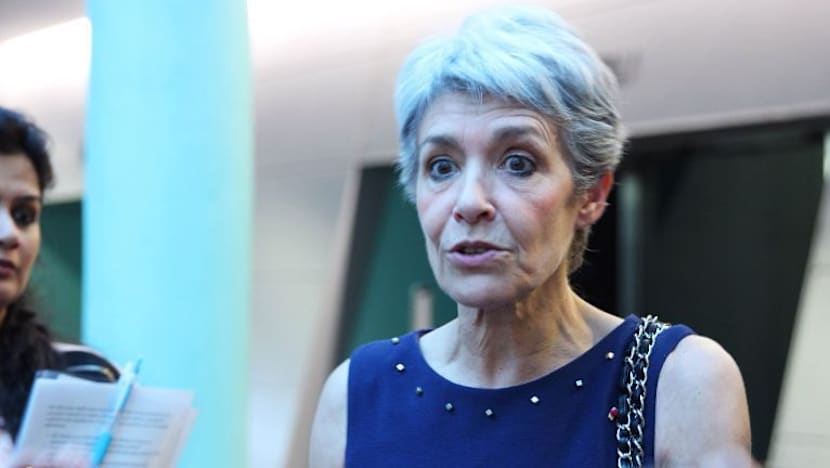
Claudie Haigneré was the first European woman to visit the International Space Station, and also Former French Minister for Research and New Technologies. Photo: Goh Chiew Tong/Channel NewsAsia


SINGAPORE — She is the first European woman to visit the International Space Station, and a former French Minister for Research and New Technologies, so ex-astronaut Claudie Haigneré is well-placed to talk about the giant leap Asian countries seek to make, in space exploration.
Speaking on the sidelines of the Conference On Space, held at Science Centre Singapore yesterday (May 5), Ms Haigneré told Channel NewsAsia that countries have to work together, before they can differentiate themselves and surge forth in the modern space race.
“There are technical and scientific elements that will be done in collaboration between different participating nations, where nations have to be good partners in collaboration. Only then they can have competition with innovation,” she said.
China was the first Asian country to launch human spaceflight in 2003, and ten years later, Singapore set up an Office for Space Technology and Industry with the mandate of developing Singapore’s space industry. Late last year, India moved closer to sending a man to space, with the launch of a rocket with an astronaut module.





Ms Haigneré expressed confidence in the active steps Singapore is taking in achieving scientific and technological advancements in space. “I am really convinced that the time Singapore will take (to launch its own human spaceflight) will be shorter and shorter compared to Europe with new developments.”
GOING INTO SPACE WAS “A DREAM BECOMING REALITY”
At the conference, Ms Haigneré shared with students her out-of-this-world experiences. She was involved in three space missions, with her last in 2001.
Her dreams of going to space started in childhood, even though she participated in her space mission only in 1993 when she was 36-years-old.
“When I was 12 years old, I was inspired by something so important – the first lunar landing on the moon in July 1969. For me, (being an astronaut) is really a dream becoming reality. The curiosity for space exploration was always in my mind,” she said.
There is one thing the 50-year-old regrets – not being able to look through the windows to enjoy the view, as her activities in space were “densely planned”.
After Ms Haigneré retired from the European Space Agency in 2002, she served as the Minister for Research and New Technologies till 2004. She spoke about the two main obstacles she faced during her term - “disinterest of the young” and “disbelief in science and technology”.
“Maybe it is not so true in Singapore, but in Europe and in France, the disinterest of the younger generation in science and tech was the scariest for researchers and engineers. They feared that science and engineering would be endangered.
“The world needs the young and their talent, in order for humanity to progress, she added. “The younger generation needs to project the future.”
Society’s distrust towards science and technology, Ms Haigneré believes, stems from the “acceleration of uncertainties”.
“In the 20th century, it was obvious that science and technology will give progress and answers to humanity,” she told Channel NewsAsia. “I think there is the view in the 21st century that every new development is very powerful – and our minds may not have completely adapted to this complexity.”
“Hence, the reaction of the individual is precaution. ‘I am not sure.’ We must continue to fight against this ‘excess of precaution’ through education,” she said. CHANNEL NEWSASIA




