







Covid-19: S$1.2b to be spent on heightened alert support measures won’t involve past reserves, says Lawrence Wong


- More support measures for first two heightened alert periods will cost S$1.2 billion
- Finance Minister Lawrence Wong said they will be funded by a reallocation of monies previously budgeted
- Half of it will come from underutilised development expenditure
- The other half will come from capitalisation of development expenditure under the recently passed Significant Infrastructure Government Loan Act
SINGAPORE — Additional support measures for businesses and workers affected by tightened Covid-19 restrictions during the Phase 2 and 3 periods of heightened alert will amount to S$1.2 billion, but the Government does not intend to draw on past reserves to fund them.
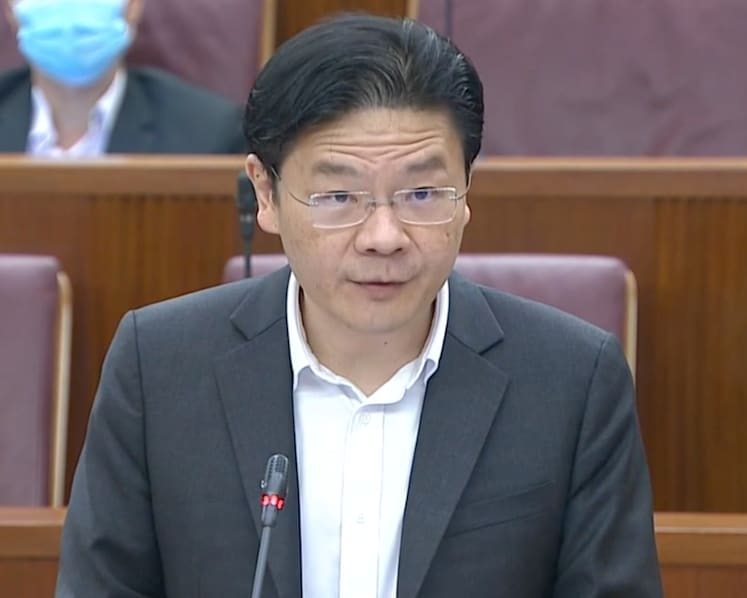
Finance Minister Lawrence Wong said in a ministerial statement in Parliament on Monday (July 5) that it will be funded through a reallocation of monies previously budgeted for, as he introduced a Supplementary Supply Bill to effect this reallocation.





The ministerial statement will be debated on July 26.
Mr Wong said half of the S$1.2 billion sum will be reallocated from development expenditure that came to be underutilised, mainly due to delays in projects arising from Covid-19.
The other half will come from development expenditure allocated for two projects: The Deep Tunnel Sewerage System, touted to be the superhighway for Singapore’s used water management, and the North-South Corridor, a 21.5km expressway to directly connect the northern region to the city centre.
There happened to be relocation space from these ongoing projects as the funds were set aside in this year’s Budget, before the Significant Infrastructure Government Loan Act was passed in May, Mr Wong, who is also co-chair of the multi-ministry taskforce on Covid-19, said.
With the Act, known as Singa in short, the Government can borrow for these two projects and capitalise their development expenditure from the fourth quarter of this year.
However, Mr Wong noted that this is a “one off”, as the amounts that will be capitalised under Singa will be incorporated as part of future annual Budget estimates going forward. “We will not have such relocation space in future,” he said.
In stating his rationale for the funding approach, Mr Wong said funding the support measures using available resources is the “responsible way to manage our finances”, while stressing that drawing on past reserves is a “major move” only to be done in exceptional circumstances.
Unlike last year when the economy shrank by 5.4 per cent — the largest fall since independence — and resident unemployment rose to nearly 5 per cent, he pointed out that the situation is different now, as the economy is recovering and the employment situation is steadily improving.
The country has also improved testing and tracing capabilities for Covid-19 and made good progress in vaccinations, with almost 40 per cent of the population fully vaccinated, he added.
Besides, the country is already expected to draw up to S$53.7 billion from its past reserves — an amount “which we are not likely to be able to put back anytime soon, if at all”, he said.
While stressing that the Government “will not hesitate to use the full measures of our fiscal firepower to protect the lives and livelihoods of Singaporeans”, Mr Wong said that Singapore needs to be careful about the state of its public finances, ensuring that they are sustainable.
He added: “In many countries, Covid-19 has led to massive increases in debt levels, which have not been seen since the end of the Second World War. Not many people are paying attention to how all of these debts will be serviced.
“They may look affordable now, but will not be so once interest rates increase to more normal levels. The day of reckoning will come, and the burden will surely fall on the young and future generations.”
On Monday, Mr Wong also announced that the Temporary Bridging Loan programme and the Enhanced Enterprise Financing Scheme — Trade Loan will be extended for six more months, from Oct 1 to March 31 next year.
The extension of the financing schemes recognises that access to credit is a “critical lifeline” for many small- and medium-sized enterprises (SMEs) to tide through the crisis, he said.
Through such schemes, which are overseen by Enterprise Singapore, the Government has supported over S$22 billion worth of loans to more than 25,000 enterprises — 99 per cent of them being SMEs — since the start of the year, he pointed out.




