







Surging fuel prices are hitting travel hard, but Singapore cruise operators are charting a steadier course
Despite these headwinds, demand for cruise holidays remains resilient, says the Singapore Tourism Board.
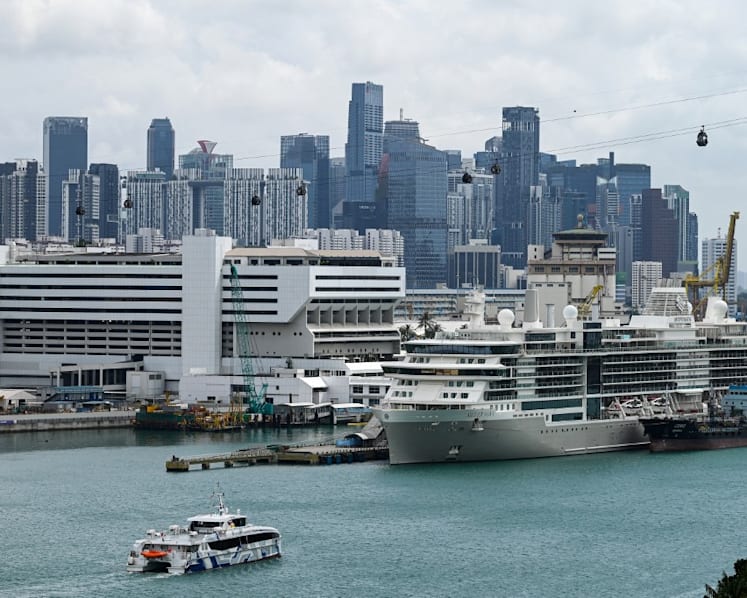
A cruise ship docked at Harbourfront Terminal in Singapore on Feb 25, 2025. (Photo: AFP/Roslan Rahman)

This audio is generated by an AI tool.


SINGAPORE: It may not be full steam ahead for the cruise industry amid the ongoing conflict in the Middle East, but those operating out of Singapore are finding strategic ways to stay afloat.
To navigate surging marine fuel prices, ship captains are actively reducing sailing speeds and rerouting vessels, while firms are quietly scaling back their usual promotions, cruise operators and industry watchers said.
While airlines and cargo firms grapple with fuel shortages and route disruptions, the cruise sector appears to be charting a much steadier course, they added.
For one, holidaymakers are still arriving at and embarking from Singapore's cruise terminals in droves.
In response to CNA’s queries on whether the Middle East crisis has affected demand in cruise vacations, the Singapore Tourism Board (STB) said international cruise arrivals to Singapore jumped by 10 per cent year-on-year in March this year.
STB’s director of cruises, Ms Chitra Rajesh Kumar, said Indonesia, mainland China and Malaysia were the top three source markets.
“Correspondingly, cruise passengers from these markets also increased during this period,” she said.
For vacationers like Ms Kristabel Quek, 40, the broader energy crisis hasn't dampened the appeal of the high seas.
The education consultant has booked two sailings for August and October. While she made the bookings after the start of the Middle East crisis, she said the prices "didn't really change" as compared to cruises she had gone on prior.
She said that conversely, taking a cruise has become more attractive than other modes of international travel as a result.
"The air fare increase, risk of cancellation, and political uncertainty make travelling (by air) a little more troublesome and worrisome," she said.
"Cruising may be easier when we want to bring old folks and kids together."
This steadfast passenger demand, coupled with the industry's ability to tweak itineraries and slow down to save fuel, has allowed operators to weather the storm through behind-the-scenes cost optimisations.
MANAGING COST PRESSURES WITHOUT IMPACTING GUESTS
While traveller demand remains firm, cruise operators said they are still feeling the strain of higher fuel costs and have imposed surcharges on passengers, though the increase is relatively small given the typical price of a cruise vacation, which can go into the thousands.
Very low sulphur fuel oil, the main type of marine fuel used by cruise ships, saw its global prices skyrocket from about US$550 per tonne in February to a peak of about US$1,060 a tonne in March, according to price-tracking platform Ship & Bunker.
As of May 5, the price per tonne of marine fuel is US$975.





StarDream Cruises, which operates three ships, said its operational costs have increased, particularly due to higher global fuel prices.
Its president Michael Goh said its Asia itineraries, including those calling at Singapore, have remained largely stable. However, the cruise line has made “selective adjustments” across parts of its network “as part of ongoing operational optimisation”.
“These have been carefully managed and have not materially impacted the overall guest experience,” said Mr Goh.
The company has also implemented “cost optimisation measures” such as route and itinerary optimisation, speed management and energy efficiency initiatives across its fleet.
In March, StarDream Cruises announced that passengers would have to pay a S$15 surcharge per person due to rising fuel costs linked to the Middle East conflict.
Mr Goh said that the firm’s pricing remains “competitive and market-responsive”.
He cited targeted promotions, such as buy-one-get-one-free offers, which ensure its cruises remain “accessible and attractive despite broader cost pressures”.
CHANGES TO ITINERARIES
Other cruise operators have also adjusted routes in response to the geopolitical situation and the energy crisis.
Oceania Cruises, which has 14 scheduled sailings from Singapore between 2026 and 2028, said it has altered the course of its ship Oceania Vista, which sails from Singapore to Southampton in the United Kingdom.
A spokesperson said that instead of transiting the Suez Canal as originally planned, the vessel will now sail via Cape Town in South Africa and up the west coast of the continent.
“The safety and security of our guests and crew is our number one priority and given the current state of the conflict in the Gulf States, the most prudent course of action is to officially alter the itinerary at this time,” said the spokesperson.
Other cruise lines are taking similar steps.
Regent Seven Seas Cruises said its 20-night sailing from Bangkok earlier this month, originally scheduled to disembark in Doha, Qatar, will now end in Mumbai, India.
For StarDream Cruises, Mr Goh said its deployment remains focused on Southeast Asia and East Asia, “helping to minimise exposure to affected regions”.
CNA has also reached out to Royal Caribbean International and Norwegian Cruise Line, both of which declined comment.
DEMAND FOR CRUISE VACATIONS REMAINS STRONG: STB
Despite these headwinds, demand for cruise holidays remains resilient, said Ms Chitra.
“The cruise industry has demonstrated resilience, with cruise lines seeing steady bookings in the months ahead,” she said.
“This is supported by sustained global interest in cruising, the strength of regional source markets, and our excellent air connectivity.”
Mr Goh said StarDream Cruises has not observed any significant decline in demand for its Asia sailings, which continue to benefit from strong regional and fly-cruise demand.
“Demand trends remain stable and encouraging, with more travellers also exploring cruising as a convenient and value-driven option, offering greater pricing certainty compared to land-based travel where costs can be more variable,” he said.
He added that while it is still early to draw direct correlations, the company is seeing sustained interest in Asia-based cruise options, particularly from travellers prioritising destinations that are “perceived as stable and accessible”.
Still, challenges remain.
On top of the elevated cost pressures, Ms Chitra noted that flight disruptions have affected accessibility for some passengers.
“Cruise lines are monitoring these developments closely,” she said.
Looking ahead, STB will continue working with cruise operators to explore opportunities for more “year-round deployments” in Asia.
“This includes encouraging an ‘Asia for Asia’ approach, where vessels are anchored within the region to serve growing regional demand,” said Ms Chitra.
She added that Singapore continues to see steady forward bookings, reflecting sustained consumer demand.
This is supported by strong global growth projections, with cruise passenger numbers expected to reach 42.1 million in 2029 - a 13 per cent increase from 37.2 million in 2025.
“We will continue to work with our cruise partners to anchor world-class cruising experiences that meet the varied needs of our target segments,” she said.
A frequent cruise passenger, who only wanted to be known as Mr Zheng, told CNA that getting on a cruise is still considered a "pretty budget-friendly vacation option", especially if bookings are made well in advance.
The man in his 40s said that he had booked a cruise trip at the end of March that sets sail in 2028, and did not notice any surcharges.
"The price was still within my expectation," he said.
"Cruises are generally popular in Singapore with retirees and families with children because it is relatively hassle-free compared to a traditional overseas vacation," he said.
WHY THE CRUISE SECTOR IS RESILIENT TO FUEL PRICE VOLATILITY
Industry observers say the cruise sector is more resilient than aviation and commercial shipping, as it has greater flexibility to adjust itineraries and sailing speeds.
Mr Christopher Khoo, managing director of tourism consultancy MasterConsult Services, said the cruise industry is “less exposed” to fuel costs compared to airlines.
Fuel typically accounts for about 10 to 20 per cent of a cruise line’s operating costs, compared to 25 to 35 per cent for airlines.
“(Cruise companies) are able to deploy strategies like slow steaming to reduce sailing speed to cut fuel consumption,” he added.
He noted that while cruise operators are raising fares, they are doing so “selectively and often quietly”.
“Cruise pricing is very dynamic; base fares may rise modestly but more often, the increases come via fuel surcharges, higher excursion prices, or reduced promotions,” he said.
Mr Kevin Phun, director at the Centre for Responsible Tourism Singapore, said disruptions in the Middle East could even boost Asia’s cruise market.
“New routes and cruise packages could emerge, focusing on Asia, and this might signal a growth in business for even luxury players,” he said.
A poll reported by industry site Seatrade Cruise News found that 39 per cent of travel agencies cited North and Southeast Asia as alternative cruising regions amid the conflict.
Could the crisis accelerate eco-friendly changes in the industry?
Mr Phun said operators may adopt measures to reduce fuel and energy consumption.
“This crisis could represent the opportunity to change the way certain things have always been done and the conflict can be a very good reason for cruise operators to shift to more eco-friendly operations.
But these initiatives will likely take place if they could save the cruise companies money in the short term.
“Unfortunately, operators might feel that sustainability could be something seen as “sacrificeable” during this period,” said Mr Phun.
“I don’t think many cruise companies will now rush into energy efficiency investments, as these things take time.”




