







Day 3 of Budget debate: MPs call for S’pore to remain committed to security needs, anticipate new threats
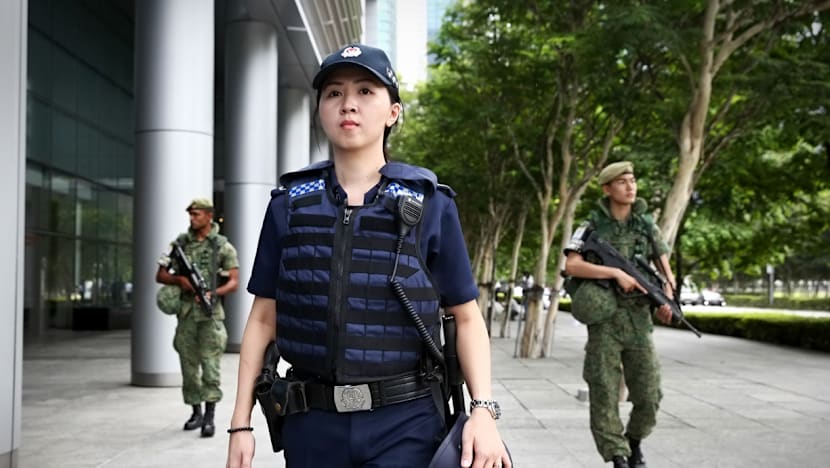


SINGAPORE — With the nation facing global tensions and “insidious” cyber threats, Members of Parliament (MPs) called for continued investments in security and defence on the final day of the Budget debate on Thursday (Feb 28).
Mr Christopher de Souza, MP for Holland-Bukit Timah Group Representation Constituency (GRC), also cautioned against an environment of political extremes, which inevitably creates conflict, as he said that elected MPs should not be “pigeon-holed” as left or right-leaning.
Mr de Souza, Sembawang GRC MP Vikram Nair and Macpherson MP Tin Pei Ling wrapped up the string of Budget debate speeches which began on Tuesday.
READ ALSO





Auditor-general is wife of political office-holder, but there’s no conflict of interest: Chan Chun Sing
Exact timing of GST hike not set yet, various factors to consider: Heng Swee Keat
Over three days, 55 MPs spoke on the Budget statement delivered by Finance Minister Heng Swee Keat last Monday, raising wide-ranging concerns and suggestions about rising inequality and ways to help workers, among others.
On Thursday, Mr Nair said that it was important for Singapore to remain committed to security needs and anticipate “new threats” to the country.
Multilateralism is under “unprecedented challenge” and nationalism is on the rise, he added.
Institutions such as the United Nations (UN), the World Bank and the World Trade Organisation — which were set up in the post-World War Two era to facilitate multilateral co-operation on security, trade and financial systems — are beginning to lose their support, said Mr Nair.
“The US has pulled back from multilateral treaties such as the Trans-Pacific Partnership and is cutting back on its financial support for the UN,” he added.
Citing the recent SingHealth cyberattack, in which hackers stole the personal particulars of 1.5 million patients, Mr Nair said that there are more “insidious” threats “lurking beneath the surface”.
“The cyber-hacking on SingHealth by a foreign state actor still leaves me with a feeling of unease as it is clear there are sophisticated, well-funded entities out there operating covertly against us,” said Mr Nair.
There is also growing evidence of “foreign interference” in elections, as he referred to reports of fake news originating from foreign sources circulating virally during the US presidential election.
While such threats are not “foremost” on Singaporeans’ minds, Mr Nair said it is still important to “imagine these scenarios and to be able to deal with them, both as a Government and as a people”.
POLITICAL AMBIDEXTERITY
In light of the rapidly changing world, Mr de Souza also said it was important for Singapore’s governing party to draw from a “broad slate of policies and reflect a range of views to decide on the best course for the country”.
He added that it was important for elected MPs to possess “political ambidexterity” and they must use “right or left leaning policies in accordance with what Singapore needs for the long term”.
“A person should not be pigeon-holed left or right,” he said.
For example, he said that his “hard stance” against recreational drug use can be characterised as right-leaning, while his stance against human trafficking is “more left”.
Over the course of the debates, “there will be times when we debate morality and our interpretation of it”, added the MP.
“Politics in Singapore should remain about possibilities and persuasion, always with a view on what is best for Singapore long term. It should be carried out under a broad umbrella where differing views can flourish and consensus built on a foundation of ethics, stewardship and values.”
This should never lead to “brinkmanship, single-issue politics or hollow short-term compromise”, he added. While the issues debated will have wide-ranging impact on many different sectors, the running of a country “cannot be reduced to a single issue”.
Citing examples of political spheres in the United Kingdom (UK) and Germany, he said that those who push single-issue politics “focus on polarising fault lines” such as by stoking inter-racial and inter-religious tensions, exploiting them for a political purpose and deepening divisions in society.
READ ALSO
Overheard in Parliament: The best and the more forgettable quotes from Budget, COS debates (Feb 28)
Electoral Boundaries Review Committee ‘not formed yet’
Mr de Souza cited the example of UK’s Britain First political party that ran on an anti-immigration and openly nationalist agenda.
“Irreconcilable division breeds an environment of politics of extremes. This inevitably creates conflict. Policies become political bargains that compromise on effectiveness,” he said.
Ms Tin also said there was a need for strong and united communities in the face of challenges such as religious radicalism and the potential of social media to aggravate fractures within society through fake news and fear mongering.
To that end, she said that it was important to invest more in public education to protect people “from the poison of fake news and radicalism".




