







Debris, failure to switch pumps back to ‘automatic’ possible causes behind Oct 7 flooding: LTA
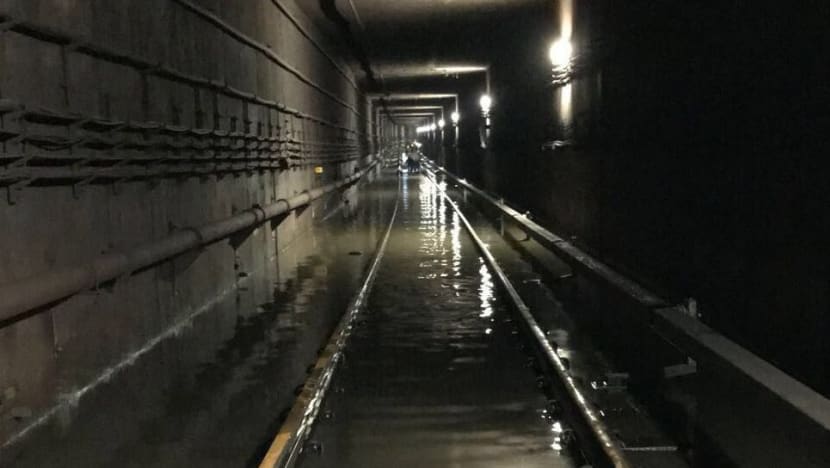
The flooded tunnel during the Oct 7 flooding incident. Photo: LTA


SINGAPORE — Three problems, all owing to negligence by maintenance workers, have been found as possible causes of anti-flooding pumps near Bishan MRT Station — which were in working order — not being activated on Oct 7, leading to the unprecedented tunnel flooding that downed train services.
Whether it was one or more of these failings that allowed a massive stormwater tank to overflow, however, cannot be determined, said the Land Transport Authority (LTA), as it concluded its investigations into the incident that affected about 231,000 commuters along a section of the North-South Line over two days.
This is because remedial actions were taken immediately after the tunnel flooding, which made it impossible to recreate the exact conditions preceding the incident, it added, in its investigation report released on Tuesday (Dec 5), nearly two months on.
Two of the problems had to do with a lack of cleaning of the tank, called a sump pit.





First, there was sludge or silt buildup at the bottom of the massive tank with a capacity of more than 5,000 cubic metres, far above the rainfall recorded that day.
The sludge and other materials that collected in the pit could have “impeded the proper functioning of the float switches, and hampered the efficiency of the pumps, one-way non-return valves and the piping system along which the extracted water would flow to the surface drainage”, the LTA said in its report.
The float switches, which are pitched at different heights, activate the water pumps when water reaches certain levels.
Per laboratory tests done by testing and inspection provider Singapore Test Services (STS), the lowest float switch could have been lodged in the sludge that gathered in the sump pit.
The tests showed that a switch with more than a quarter of its surface submerged in sludge could have been prevented from floating and working properly.
Second, debris and plant detritus were found floating in the tank, which could have tripped up the float switches, particularly an “alarm” switch that alerts the SMRT’s operations control centre to high water levels.
The third possible cause identified had to do with the erroneous setting of pump controls by maintenance workers.
Responding to reports of frequent pump trips, SMRT’s maintenance team had carried out corrective maintenance on the pumps on July 13.
This entailed toggling the pumps between automatic and manual modes via a pump control panel to test their functionality, which was registered in the pump event logs.
However, the logs showed no further activations of the pumps between that night and Oct 7, when they were activated manually in the aftermath of the incident, indicating they were not returned to “automatic” mode after maintenance work was done.
The alarm switch, which is wired independently from the other switches, should have been activated, even if the pump control panel was left in the manual mode. It did not.
Noting that SMRT had taken full responsibility for the incident, the LTA report gave a scathing assessment of the beleaguered rail operator’s “long-term neglect or improper upkeep” of the stormwater sump pit, after debris, plant detritus and sludge were discovered in areas up to about 40cm deep.
SMRT’s maintenance staff members could, through the gratings above the pumps, have easily evaluated water levels during non-service hours without entering the pit, the LTA noted.
The report also revealed that all three water pumps in the stormwater sump pit, while functional, had failed to activate for nearly three months in the lead-up to Oct 7, according to SMRT’s pump event records.
This meant that from July 14 until the pumps were manually activated on the night of Oct 7, the pit could already have been at least 87 per cent full on the day of the incident, rainfall data suggested.
The LTA and SMRT have since improved the anti-flooding measures at the Bishan sump pit to prevent a repeat of the incident, including replacing all the float switches and repositioning the pump control panel away from the tracks to allow swifter access to controls during operation hours.
The operator also fired eight staff members over the incident and could pursue legal action against two former executives. Three others were disciplined.
The LTA concluded that the flooding incident was “preventable” if SMRT’s maintenance team had maintained the pit and the pump system diligently, and kept them in “good and efficient working condition”.
“If regular preventive maintenance had been carried out by SMRT’s maintenance team, as stipulated under the maintenance protocol, the abnormalities with the pump system could have been detected and rectified before the flooding occurred,” the authority said.




