







CNA Explains: Why the Singdollar is hitting record highs against some Asian currencies amid Iran war
The Singapore dollar is seen as a safe haven during uncertain times.
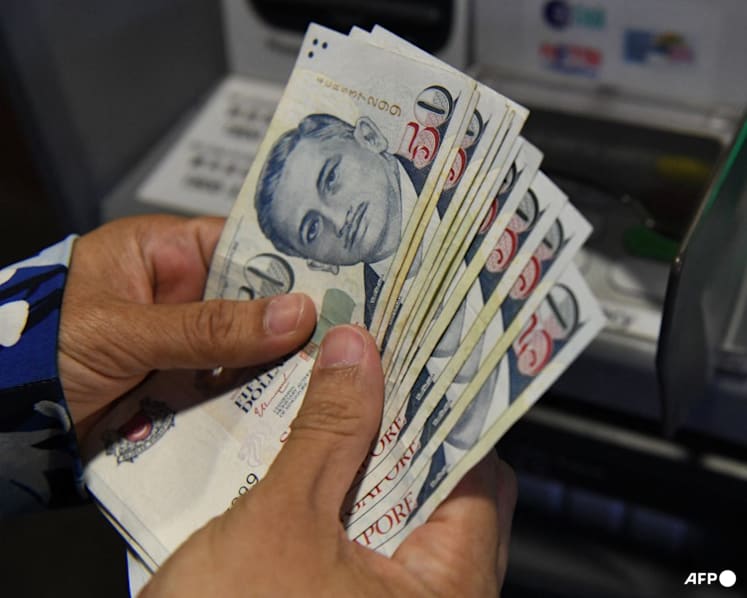
A man withdrawing Singapore dollars from a bank teller machine. (Photo: AFP)

This audio is generated by an AI tool.


SINGAPORE: The Singapore dollar has hit record highs against several Asian currencies this month. This is despite currencies of energy-importing countries mostly declining amid the ongoing Middle East conflict.
At its peak on Thursday (Apr 16), S$1 could buy 13,562 Indonesian rupiah, according to data provider LSEG. That figure was less than 13,000 rupiah at the start of the year.
Similarly, S$1 was able to buy 125.34 Japanese yen on Sunday, compared with 121.93 yen per Singapore dollar on Jan 1.
The local currency also has been able to buy record amounts of South Korean won and New Taiwan dollars in recent weeks.
Last week, the Monetary Authority of Singapore (MAS) said it expected inflation to rise, and announced that it would allow the Singapore dollar to strengthen more quickly than before.
“Singapore’s imported energy costs have already risen. Prices of a wider range of imported goods and services are expected to increase in the quarters ahead,” the central bank said.
Why is the Singapore dollar strengthening?
Singapore’s reputation is one of safety and stability, and that is attractive to investors in an uncertain world.
As a result, the Singapore dollar continues to benefit from its safe-haven appeal, said Peter Chia, a senior foreign exchange strategist at UOB.
Maybank’s head of foreign exchange research Saktiandi Supaat echoed the sentiment, pointing to Singapore’s AAA credit rating and safe-haven characteristics.
He said the local currency has been relatively more resilient, and global factors such as the Middle East conflict have played a large part.
The yen has underperformed because there has been less demand for the currency as a safe haven, and Japan is a major energy importer. Other currencies are facing domestic headwinds.
“Overall, this is best seen as a broad-based resilience of Singdollar rather than weakness in any one currency,” he said.
As a major financial centre, Singapore may have attracted capital flows redirected from the Middle East, said Ms Carol Lye of Brandywine Global Investment Management.
The portfolio manager and senior research analyst said Singapore was seeing robust growth driven by artificial intelligence-related products and services-related sectors before the war, which would have boosted demand for the currency.
Analysts also pointed to policy support for the Singapore dollar, with the MAS tightening policy last week.
How is the Singdollar managed?
Unlike most currencies that control monetary policy through interest rates, Singapore manages inflation through the exchange rate.
It lets the Singapore dollar strengthen or weaken against currencies of the country's main trading partners within an undisclosed band.
The MAS controls the strength or weakness of the Singapore dollar by buying and selling US dollars.
Its aim is to keep a trade-weighted exchange rate within an undisclosed policy band, which the central bank can control by adjusting the slope of the band, shifting the mid-point up or down, and widening or narrowing the range in which the Singapore dollar can fluctuate.
The trade-weighted exchange rate is known as the Singapore dollar nominal effective exchange rate (S$NEER).
Last week, MAS said it would "increase slightly" the rate of appreciation of the policy band, which means it would allow the Singapore dollar to strengthen more quickly than before.
“That naturally lends relative support to (the) SGD,” said Mr Christopher Wong, a foreign exchange strategist at OCBC.
UOB’s Mr Chia also said the resilience in the Singapore dollar has been supported by expectations that monetary policy would be tightened further.
The bank expects the MAS to make the slope steeper again in October, with the possibility of the central bank making the move in July.
What about the Singdollar versus the US dollar?
The US dollar to Singapore dollar exchange rate has been more balanced, with risks of the exchange rate going either way in the near term, said Mr Saktiandi.
He said the greenback has been supported by heightened geopolitical uncertainty because demand for stable currencies has increased. The US dollar has also been supported by oil-driven inflation risks and a delay in the central bank easing monetary policy, while the Singapore dollar has been resilient as well.
UOB’s Mr Chia also said the Singapore dollar has been more resilient among Asian currencies. He said it has declined “a modest 0.6 per cent” against the US dollar since the Middle East conflict started.
What does a stronger Singdollar mean for consumers?
Singapore relies heavily on imports, which means that Singapore dollars have to be exchanged for foreign currency when making purchases.
A stronger currency means that the same amount of Singapore dollars would be able to pay for a bigger amount of goods or services. That can help to keep costs in Singapore lower than they would be if the currency was weak.
On the other hand, foreign visitors may find Singapore more expensive, as the same amount of foreign currency would be worth fewer Singapore dollars.
“For Singapore consumers, a stronger currency is generally positive because it partially helps cushion imported inflation and supports purchasing power, especially for travelling and imported goods,” said Mr Wong.
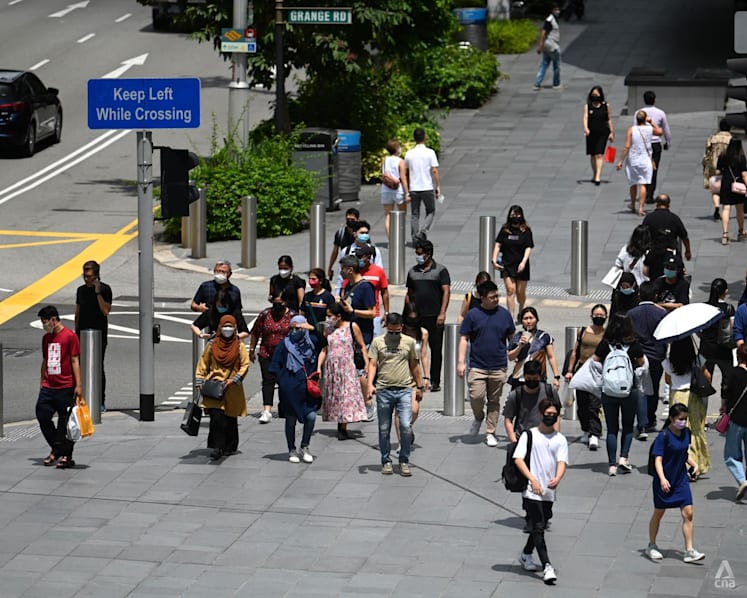
Consumers in Singapore are likely to face sharply rising costs in the coming months because of energy disruptions from the Middle East conflict.
“While global food price pressures remain relatively contained currently, the concern is that higher fertiliser costs resulting from the Middle East supply shock could translate into increased agricultural prices, with lower crop yields exerting upside pressure on both global and Singapore’s food inflation with a lag,” DBS analysts wrote in a research note last week.
The MAS has positioned its exchange rate policy to allow the Singapore dollar to appreciate, to balance such imported inflation risks, they wrote.





How will businesses be affected by a strong Singdollar?
A stronger currency means that products exported from Singapore will be more expensive in foreign markets. Demand could fall if the goods are unaffordable to buyers.
For now, that has not happened. In March, non-oil domestic exports rose 15.3 per cent, as strong AI-related demand boosted electronics shipments.
That suggests that external demand, especially in electronics, has remained strong enough to offset the effect of the stronger currency on prices, said Mr Wong.
Mr Saktiandi also said March’s data reflects what happened before the MAS increased the pace of the Singapore dollar appreciation, and the strong performance may reflect sector-specific factors.
While some exports will still be in high demand even when prices rise, a stronger Singapore dollar can still make the products slightly less attractive over time, he said.
The effect of a stronger currency also tends to make an impact only after some time, he added, so if the Singapore dollar continues to be strong, it could be a headwind to exports going forward.
Brandywine's Ms Lye said demand for AI-related chips and electronics may still be high despite increased prices because AI is in its growth phase.
"At some point, however, if the AI cycle wanes, exports will be affected by the strong Singapore dollar," she said.
Want an issue or topic explained? Email us at digitalnews [at] mediacorp.com.sg. Your question might become a story on our site.




