







Downtown Line falls just short of 500,000 daily weekday ridership forecast
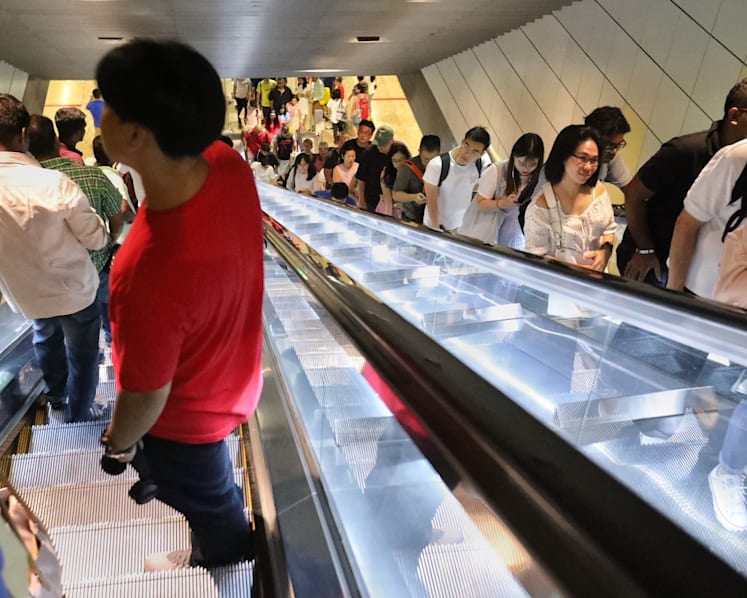
The Downtown Line's daily weekday ridership is set to reach 500,000 by the end of 2018. Photo: Raj Nadarajan/TODAY


SINGAPORE — More than four years after the first stage of the Downtown Line (DTL) opened and despite the boost from the opening of Stage 3 last October, daily weekday ridership is still short of the initial forecast of 500,000.
Based on data released last month, the DTL’s daily weekday ridership stands at 470,000, 57 per cent higher than the 300,000 before the third phase – a 21km stretch from Fort Canning to Expo MRT stations – opened last October.
The Land Transport Authority (LTA) now expects the 500,000 weekday ridership figure to be reached by the end of this year.
Although commuters’ habits take time to change, the rail line is “well on track” to meet forecasted demand, said transport analyst Terence Fan from the Singapore Management University.





“People might have previously adopted other means of transport before the opening of the DTL and prefer sticking to them,” said Assistant Professor Fan. “I do expect those used to driving to switch more slowly, only considering public transport when it is time to replace their cars.”
Operations manager Cynthia Chua, 25, said she still prefers taking the bus to work in one-north, despite having Bukit Panjang MRT station near her home. Taking the train would cut her commute by 15 to 20 minutes, but Ms Chua said: “It’s more out of habit… I like (taking) the bus because the bus stop is slightly closer to my home. Mostly I think I have a bit more personal space on the bus, I get to sit and I can lean on the bus windows throughout the journey.”
Broader population and mobility trends affecting public transport ridership may also be seen for the DTL.
“We have to keep in mind the broader context that public transport ridership growth has also plateaued last year because of stagnant population growth,” said Singapore University of Social Sciences transport analyst Walter Theseira.
Singapore’s total population grew 0.09 per cent from 2016 to 2017 to reach 5.61 million as of June 2017.
The proportion of commuters who took taxis or private-hire cars also grew last year, according to the Public Transport Council’s findings released last month.
According to its survey, about three in 10 people surveyed in 2016 had taken a point-to-point ride in the last seven days, but the proportion increased to just over four in 10 last year.
Some commuters said they enjoy the enhanced connectivity and more pleasant rides offered by the DTL, which is operated by SBS Transit.
“In the past, I would have to alight at City Hall (station, on the North-South and East-West lines) and walk at least 10 minutes. Now, when I alight, I am right outside my office,” said recruitment consultant Melvin Chang, 26, who works near the Downtown station.
Portfolio manager Gary Tan, 37, takes the DTL from MacPherson to Telok Ayer for work. While he gets a seat roughly twice in every 10 commutes, Mr Tan said: “Compared to the East-West Line, I think that there is more ‘breathing space’ on the train, making it a more comfortable ride overall.”
The DTL’s current daily weekday ridership of 470,000 is “pretty close” to the forecast of 500,000 and growth in ridership does not show signs of plateauing, said Asst Prof Fan.
“The operator also does not want an event where the line is fully packed in the immediate months after opening, for it means that they have completely underestimated demand,” he said.
The first stage of the DTL, with six stations from Chinatown to Bugis, opened in December 2013 and its second phase, with 12 stations from Bukit Panjang to Rochor, opened two years later.
An extension of 2.2km from Expo to Sungei Bedok will open in 2024.




