







Economic Strategy Review committees release final recommendations to set direction of Singapore’s future growth
The committees have released 32 recommendations following engagements with over 7,700 stakeholders, including businesses, unions and workers.
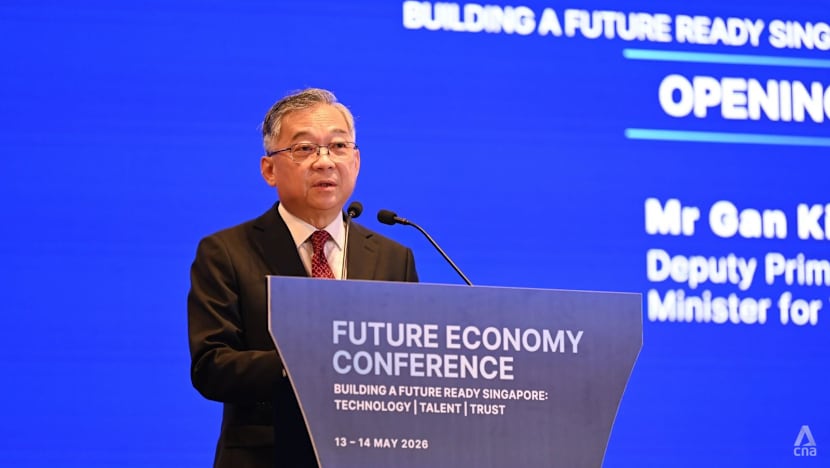
Deputy Prime Minister and Minister for Trade and Industry Gan Kim Yong giving the keynote address at the SBF Future Economy Conference on May 13, 2026. (Photo: CNA/Liew Zhi Xin)

This audio is generated by an AI tool.


SINGAPORE: After around nine months of deliberations, the Economic Strategy Review (ESR) committees on Wednesday (May 13) released its final recommendations – with Deputy Prime Minister Gan Kim Yong stating that it is not simply a response to immediate challenges.
"It is about how Singapore positions itself for the longer term to stay competitive, create good jobs, and remain relevant in a more fragmented, contested and fast-changing world," he said.
The five ESR committees, which convened in August last year, have submitted the 32 recommendations to the government following engagements and consultations with trade associations and chambers, unions, businesses and workers.
More than 7,700 stakeholders participated in the process.
Speaking during the Singapore Business Federation’s Future Economy Conference, Mr Gan said recent disruptions to energy markets, shipping routes, inflation and business confidence are not distant events for Singapore.
"We are deeply connected to the global economy. That connectivity gives us opportunities, but it also exposes us to volatility," he said.
Because Singapore does not have a large domestic market, abundant land or natural resources, the country has never competed on size, said Mr Gan, who is also Minister for Trade and Industry.
"We cannot try to do everything," he said.
Hence, the ESR asks a "fundamental" question of how Singapore should respond to the new global environment, he said.





Mr Gan chairs the Singapore Economic Resilience Taskforce, which oversaw the economic review. The report is expected to be ready by end-May.
In an executive summary of the full report, the committees set out the broad strokes for the direction that Singapore should take in order to secure future economic growth for Singapore while creating good jobs.
It did so through three “imperatives” aimed at guiding how Singapore should respond to a changing world with growing geopolitical tensions, rapid advances in technology and other challenges.
“The challenges ahead are significant. But Singapore starts from a position of strength,” the summary said.
“The ESR’s recommendations will enable Singapore not only to withstand the changes around us, but also seize new opportunities and strengthen prospects for Singaporeans.”
In a Facebook post on Thursday evening, Prime Minister Lawrence Wong said the government supports the ESR's broad strategies and direction.
"The task ahead is to translate these directions into concrete actions," he wrote.
The recommendations come after Mr Gan gave a mid-term update on the ESR in January this year, when he outlined seven proposals on how Singapore can navigate a volatile global environment and technological shifts.
The latest recommendations build on the mid-term update, as well as the government’s responses during this year’s Budget and the subsequent debates on the ministries’ spending plans.
THREE IMPERATIVES
The first imperative is for Singapore to sharpen its value proposition and focus on where it can create the most “hard-to-replicate” advantages.
"Our strategy has always been to focus on areas that matter and to do them well," said Mr Gan.
Singapore should continue to attract high-quality investments and frontier activities in sectors where there are strong foundations, such as advanced manufacturing, modern services, logistics, finance and technology.
Second, Singapore should enhance its agility and adaptability as the pace of change accelerates. This will help the country reinvent itself.
"In a world of rapid change, competitiveness will depend not only on the strengths we have today, but on how quickly we can respond, renew and redeploy," said Mr Gan.
Firms must be able to seize new opportunities, workers must be able to acquire new skills, and capital and talent must move to more productive areas, he added.
Third, Singapore has to build resilience along with efficiency because it will always be exposed to external shocks.
Singapore's role as a hub remains important, but must evolve, said Mr Gan.
"Our resilience must come from being competitive and connected, but connected in a more trusted, reliable and diversified way," he said.
To this end, the review committees said Singapore should secure economic growth through four “thrusts”, and create good jobs and opportunities through another four thrusts. The 32 recommendations are grouped within these eight prongs.
Each thrust has between three to five recommendations on the direction Singapore should take, and the government will work together with partners to translate the recommendations into action, the ESR secretariat said in a press release.
BUILDING GLOBAL LEADERSHIP, BECOMING AN AI HUB
The first four thrusts on securing Singapore’s economic growth include a recommendation for Singapore to refresh its investment promotion approach to attract cutting-edge activities and capabilities.
Singapore has built a position of global leadership in the semiconductor value chain, and should aim to do the same in other industries, according to the executive summary.
Firms that are already here should also be supported to upgrade and transform so that they remain competitive even when costs rise.
"The aim is simple. We don’t want to just be in the supply chain. We want to be the part of the supply chain that nobody can afford to take out," said Acting Minister for Transport and Senior Minister of State for Finance Jeffrey Siow at the same event. Mr Siow co-chairs the ESR committee on global competitiveness.
On artificial intelligence, the review had three recommendations on positioning Singapore as a trusted hub for AI solutions.
Singapore cannot compete to build the biggest frontier AI model or host the largest AI data centres, but can bring the government, industry and research institutions together to create “the most enabling environment” for breakthrough innovation, the report said.
Singapore should develop leading firms as “Champions of AI” and accelerate AI adoption throughout the economy.
Deploying AI, using Singapore as a base
Together with the final recommendations, the ESR committees also sought to highlight some companies in Singapore that have taken steps in the right direction.
One of these is Yong Kang TCM Clinic, which has 18 outlets in Singapore, Malaysia and Indonesia.
In a bid to improve its customer service operations, the company started exploring using AI more than a year ago.
At the time, it relied primarily on a traditional call centre to handle enquiries.
"While the system was functional, we found that training agents to maintain a consistently high standard was both time intensive and costly," a company spokesperson told CNA, adding that response quality and speed differed between agents.
Yong Kang TCM Clinic tapped on a government grant and started using a GenAI chatbot for customer engagement.
That meant customers could engage with the chatbot any day and any time, and response time improved from around 30 minutes to under 5 minutes. Bookings then increased by 20 per cent, while the customer service team focused on higher-value tasks.
The company is evaluating other ways to use AI in its operations.
Another company, AvePoint, is an example of how having a dynamic enterprise ecosystem means Singapore can serve as a base for companies to grow.
The company was founded in the US, but was drawn by Singapore’s strong tech ecosystem, business-friendly environment and deep talent pool.
It set up an office in Singapore in 2009, and Singapore serves as its Asia headquarters, a major research and development base and a launchpad for new ventures.
Separately, beyond being a hub for physical goods, Singapore should move into activities such as supply chain management, global procurement, demand planning and standard-setting to govern and facilitate trusted flows.
Physical infrastructure alone is not a good enough differentiator anymore, said Mr Siow, adding that the movement of goods, people, capital and data is increasingly shaped by security, resilience and trust.
Next-generation air and sea hubs should integrate physical infrastructure with digital and AI-enabled systems, and Singapore should invest in specialised handling and logistics capabilities.
"Even when the cargo no longer passes through Singapore physically, the decisions about that cargo can still be made here," he said.
Strengthening data governance can also position Singapore as a trusted hub for data-driven economic activity.
The enterprise ecosystem in Singapore should be nurtured to be more dynamic by expanding access to growth capital for startups, helping local companies expand internationally and supporting companies who may need to restructure or offshore parts of their business.
The next generation of high-potential enterprises should also be supported, as new firms can scale quickly and disrupt incumbents.
"An economy is healthy not because firms never fail, but because new ones keep rising," said Mr Siow, adding that Singapore's work is to make sure capital, talent and second chances keep flowing.
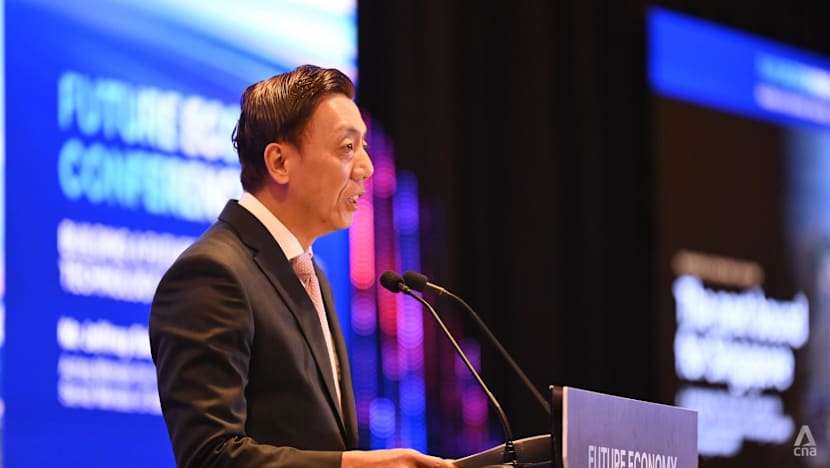
He said Singapore has restructured its economy through recessions, financial crises, SARS and the global financial crisis.
"Each time, we studied the situation, we made the changes, we came out stronger," he said during a ministerial dialogue at the Future Economy Conference.
He added that "the storms of 2017 are the weather of 2026", giving an analogy of a ship in rough weather.
"Singapore's answer has never been to wish for better weather. It has always been to build a better ship, for us to sail," he said.
Hence, the ESR recommendations are the latest set of plans for such a ship, with the government, businesses, unions and workers needing to work together to build the ship and sail it, said Mr Siow.
"If we work together, Singapore can continue to grow, create good jobs, and remain competitive in a changed world," he said.





