







Singapore cannot rely on more land, labour or carbon for next phase of growth: Tan See Leng
Asked how the government weighed the pros and cons for the proposed western island, Dr Tan See Leng said there are many uncertain development timelines involved, and that detailed environmental studies will be conducted.
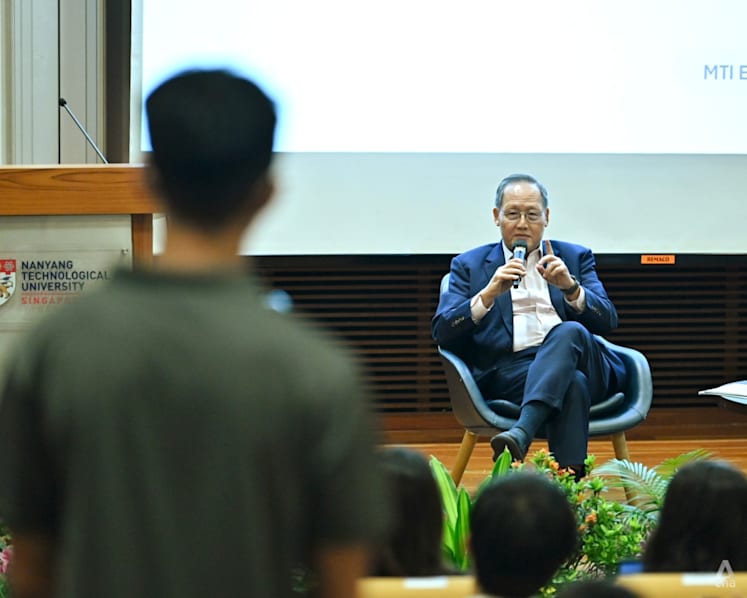
Minister for Trade and Industry (Energy and Industry) Tan See Leng answering a question during the MTI Economic Dialogue on Aug 26, 2026. (Photo: CNA/Raydza Rahman)

This audio is generated by an AI tool.


SINGAPORE: Singapore must raise productivity and move into more innovative activities to continue its economic growth, Minister for Trade and Industry (Energy and Industry) Tan See Leng said on Wednesday (Aug 26).
This is because Singapore is small and trade-dependent, and the world is becoming more fragmented and less predictable, he said.
“These realities point to a simple conclusion: Singapore’s next phase of growth cannot come from using more land, adding more workers or emitting more carbon,” said Dr Tan.
“It must come from scouring around the world … how do we scour and create more value from what we have.”
He was speaking at the Ministry of Trade and Industry Economic Dialogue 2026, where he answered questions from students and presented the Economist Service Undergraduate Scholarships to recipients.






Dr Tan said geopolitical tensions and economic fragmentation are reshaping trade and investment, while technology is transforming businesses and jobs.
AI and automation may allow companies to produce more with fewer workers, he noted. "As such, we can no longer assume that growth will automatically create the same number, the same type, or the same range of jobs as before."
The government will make sure that AI adoption is human-centric and that AI complements workers, he said.
Singapore has built a valuable foundation but must evolve as the world changes, he said.
To this end, Singapore launched the Economic Strategy Review, which published its final report in June.
It seeks to strengthen Singapore’s value proposition, enhance its agility and adaptability, and build resilience along with efficiency.
“But getting us there will require us to make difficult choices under all of these uncertainties,” Dr Tan said.
Singapore must also become better at making choices as decisions become harder and trade-offs become more stark, he said.
“Where should we place our bets? When should the government intervene? When should markets be allowed to develop and operate freely?” he asked, adding that Singapore also has to weigh how much to pay for greater resilience and whether to change course when conditions change.
“Addressing these questions requires analytical discipline, it requires evidence, it requires sound judgment,” he said.
WESTERN ISLAND
During the dialogue session, a student asked about the cost-benefit analysis that the government had to do regarding plans to merge several western islands to make space for a new generation of industries.
He noted that media reports mentioned coral reefs in the area being more than 8,000 years old.
In response, Dr Tan said Singapore will conduct detailed environmental studies before beginning any work in the area.
“Our heritage, our reefs, our environment – it’s not something that we will compromise,” he said.
At the same time, Singapore needs space for its airports and marine ports to continue to grow, so there are both aspirations and constraints.
Making space on the mainland would also have a high cost, as existing buildings may have to be torn down to make way for new ones.
“You also have to keep the same, if not more, greenery here,” he said, pointing to recent discussions over Maju Forest as an example of competing needs in Singapore.
Specifically for the potential new western island, Dr Tan noted that there has been speculation that it will be used for nuclear power plants.
He said the government has not made a decision, and noted that technology is constantly advancing.
“If I’ve cracked the code on geothermal, I may not even need to build that many of these extra facilities on reclaimed islands,” he said.
“There are many, many uncertain development timelines, new technology that is coming up, that today, we are still exploring.”




