







Epigram Books founder wants young children to ask about racial differences
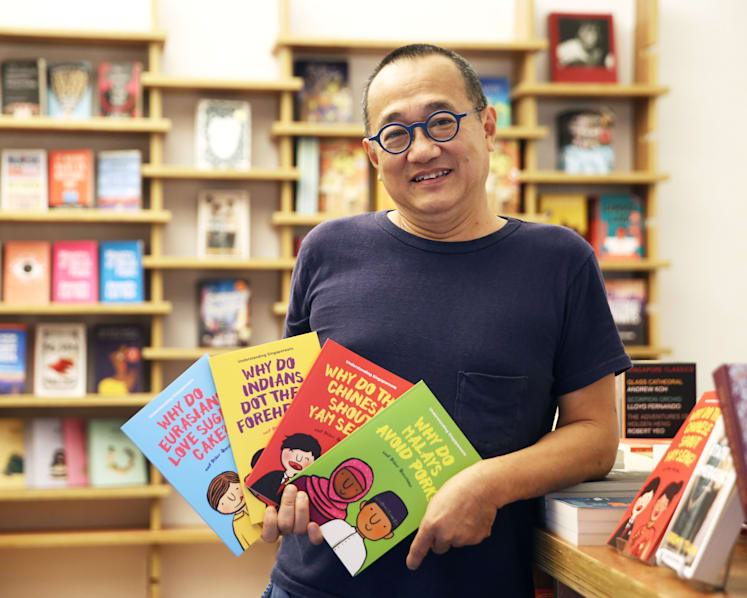
Edmund Wee is the founder and publisher of Epigram Books, which publishes fiction – novels, short stories, plays, graphic novels, chapter books, picture books – and non-fiction books from Singapore and Southeast Asia. (Photo: TODAY/Nuria Ling)


SINGAPORE — Why Do Malays Avoid Pork? Why Do Indians Dot Their Foreheads? — These may seem questionable titles for children’s books, but inviting young ones to ask about racial differences is exactly what local publisher Edmund Wee wants.
Putting himself into the shoes of five- to eight-year-olds, the Epigram Books founder attempted to answer questions they may have on the four major races in Singapore through a four-book series.
His Understanding Singaporeans series, two-and-a-half years in the making, created a small storm online when it was launched in May. Some netizens took umbrage at his definitions and explanations.
Among the accusations hurled at him as an “ignorant Chinese” was that he conflated ethnicity with religion and culture — for instance, non-Muslim Malays do not avoid pork.





Some discomfort was also felt at a public forum Mr Wee moderated called Can We Write About Race, where an audience member called the book titles “offensive”.
Instead of taking their criticism to heart, the 65-year-old, who was a former journalist with The Straits Times, told TODAY the series is meant to address the general principles rather than delve into specifics. He said: “I’d rather have people talk than shutting up and nobody understands anything.
“One or two question might irritate you and make you angry, but I hope that the rest would at least get you thinking about how not all Singaporeans are Chinese, and within the Chinese, there are differences too.”
While Singaporeans are “very very proud” of “our multi-cultural, multiracial, multi-ethnic, multi-religious society”, he feels there is very little understanding between races simply because people find the topic “touchy”.
“You can say we are multi-cultural, but if you ask a Chinese why a Malay person does something or why an Indian has a turban, he doesn’t know … How can we get on as a society if we don’t even know so many things about our minorities, the other races in Singapore?” he said.
His epiphany of his own “hollow” idea of multiracialism and multiculturalism came five years ago when he attended an Indian funeral of his former classmate’s relative. He was surprised to find the deceased placed on the living room floor while visitors sat around chanting in Sankrit.
So he decided to pen a series on racial differences, pitching it at the young in hopes that they would grow up more “enlightened”. With his staff members, he came up with 20 of the darndest questions such as “Can Muslims pet dogs?” and “Why do the Chinese hang blankets at a funeral wake?”
To ensure that any sensitivities are adequately addressed, Mr Wee said about 10 people from each racial group were consulted in the entire process. In fact, some of the questions — like “why do Indians shake their heads when they talk” — were proposed by the focus group members.
He told TODAY that some questions were left out because even the editorial team felt they were “too offensive”.
Working on this series has inspired him to start a second series entitled Understanding New Singaporeans.
Through it, he hopes to explain customs and practices of new citizens from China, India and the Philippines. “If you understand (where they are coming from), you won’t get so angry,” he said.
If he has resources, he is even toying with the idea of a series to understand different groups within a race. The Malays, for instance, consist of Javanese, Boyanese, Bugis, Middle Eastern/Arabs, and Minangkabau, but are often thought of as a homogenous group.
Aware that the subsequent book series “will probably be criticised again”, Mr Wee said: “It’s good to have diversity. But within diversity, you must have understanding so there is no conflict.”




