







Explainer: Why UN warns 'global boiling' era has arrived and what happens if firmer action isn't taken?
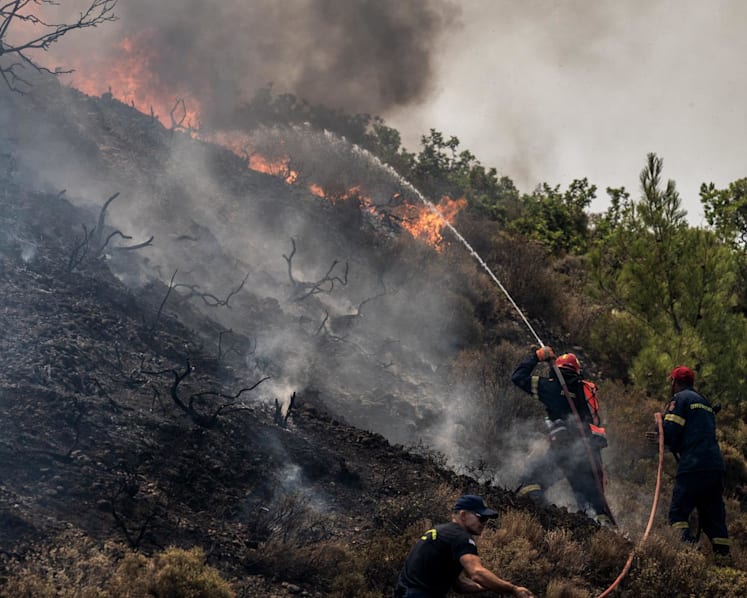
Firefighters use a hose as they take part in an operation against a fire near Vati, on the Greek island of Rhodes on July 26, 2023. Wildfires have been raging in Greece amid scorching temperatures, forcing mass evacuations in several tourist spots including on the islands of Rhodes and Corfu.


SINGAPORE — The world has moved past global warming and entered an era of “global boiling”, United Nations chief António Guterres warned on Thursday (July 27), as scientists confirmed that July is set to be the world’s hottest month on record.
Speaking at a press conference, the UN secretary-general warned: “Climate change is here. It is terrifying. And it is just the beginning.”
“The era of global warming has ended; the era of global boiling has arrived,” Mr Guterres said.
“The air is unbreathable. The heat is unbearable. And the level of fossil-fuel profits and climate inaction is unacceptable. Leaders must lead. No more hesitancy. No more excuses. No more waiting for others to move first.”





Despite his most dire warning yet on climate change, Mr Guterres added that it is “still possible” to limit the average global temperature rise to 1.5°C above pre-industrial levels and “avoid the very worst” of climate change — but only if “dramatic, immediate climate action” is taken.
TODAY takes a closer look at what prompted this warning, how the weather phenomenon El Nino has exacerbated this state of affairs, what the new era could mean for Singapore and the world, and what needs to be done urgently.
WHAT IS HAPPENING?
Reports from across the globe on extreme climate change and record temperatures have increasingly dominated headlines in recent months.
Thousands of tourists recently fled wildfires fanned by a sweltering heat wave on the Greek island of Rhodes. The fires are still burning out of control.
Thousands of kilometres away, temperatures in a northwest China township broke the national record by soaring as high as 52.2°C in mid July.
Just this week, the surface ocean temperature near southern Florida hit 38.44°C, a temperature often associated with hot tubs, as many parts of North America suffer through a scorching hot summer.
Amid such news, scientists are warning that July 2023 is on track to being the world’s hottest month on record, upending even very warm previous benchmarks.
Fossil fuels such as coal, oil and gas are “by far the largest contributor” to global climate change, accounting for over 75 per cent of global greenhouse gas emissions and nearly 90 per cent of all carbon dioxide emissions, said UN on its website.
While such human activity has been cited as the main climate change driver, global climate pattern El Nino is further exacerbating extreme weather conditions including global warming.
WHAT IS EL NINO AND HOW HAS IT EXACERBATED RISING TEMPERATURES?
This month, the World Meteorological Organisation (WMO) said that global temperatures were expected to further soar across large parts of the world, after the El Nino weather pattern emerged in the tropical Pacific for the first time in seven years.
El Nino is part of a natural climate phenomenon known as the El Nino southern oscillation, which swings between the El Nino and La Nina patterns.
It is marked by a warming of water surface temperatures in the eastern and central Pacific Ocean, and is linked to extreme weather conditions from tropical cyclones to heavy rainfall to severe droughts.
The phenomenon occurs every two to seven years on average, and can last nine to 12 months, said the WMO.
Speaking to TODAY, Professor Benjamin Horton, director of the Earth Observatory of Singapore at Nanyang Technological University, said: “The El Nino southern oscillation controls atmosphere and ocean heat in the Pacific, and a large part of the Indian Ocean.
He added: “The Pacific being the biggest ocean on our planet, (if) you control the heat in the Pacific, you control the heat of the whole of planet Earth.”
Prof Horton said over the last seven years, this phenomenon has either been neutral or in the La Nina phase which meant the “Pacific has been relatively cold, mitigating the influence of human-induced climate change”.
All that has changed with the arrival of the latest El Nino event, he added.
On the UN chief’s use of the term “global boiling”, Prof Horton said he wouldn’t “read too much” into the word “boiling” except that it’s another way for the UN to try to convey the urgency of the situation.
WHAT IS BEING DONE IN SINGAPORE AND INTERNATIONALLY?
In February 2021, the Government launched the Singapore Green Plan 2030, a multi-ministry roadmap aimed at making Singapore more environmentally sustainable over the next 10 years.
The movement consists of five key pillars, with concrete targets set on reducing net carbon emissions, doubling annual tree planting rate, and reducing household water consumption — among other goals.
Singapore is also part of the Paris Climate Agreement, a legally binding international treaty on climate change that effectively superseded the previous Kyoto Protocol.
The Paris Agreement was adopted by 196 parties at the UN Climate Change Conference in Paris in December 2015, said the United Nations Framework Convention on Climate Change on its website.
Under the agreement, signatory countries agree to “pursue efforts” to hold global warming to 1.5°C above pre-industrial levels.
HOW WILL SINGAPORE AND THE WORLD BE AFFECTED?
While scientists have pointed out that surpassing the 1.5°C threshold does not mean that humanity is definitively doomed, they caution that every fraction of a degree of additional warming is expected to increase the severity of dangers that people around the world face.
They also warn that — beyond this point — the impacts of catastrophic heat waves, flooding, drought, crop failures and species extinction would become significantly harder for humanity to handle.
In Singapore, climate change could also cause mean sea level rise of up to 1m by 2100, said the Government on the Singapore Green Plan 2030 website.
“If there is a confluence of extreme high tides and storm surges, some projections suggest that sea levels could be as high as 4 to 5m. This is high enough to potentially flood one-third of Singapore,” it added.
In August 2019, Prime Minister Lee Hsien Loong highlighted Singapore’s particular vulnerability to rising sea levels, given it is a low-lying island nation.
Citing research done by the Government, Mr Lee said that a stretch of land between East Coast and the city, and Jurong Island, were among the most vulnerable segments of the country.
He added that rising sea levels would not only affect property values in these areas, but also its safety and livability.
Regardless, the impact would be felt across the island, since roads and trains run through these low-lying areas, which also contain hospitals, schools and workplaces.
“We cannot lose a big chunk of our city and expect the rest of Singapore to carry on as usual,” Mr Lee had said in 2019, as he outlined the nation’s plan to spend S$100 billion on efforts to protect the nation from rising waters.
Warning of its urgency, Prof Horton of the Earth Observatory of Singapore said: “Climate change is the most important problem society will ever face. You don’t solve climate change, we don’t have a future.”
WHAT’S NEXT?
To make a meaningful difference, Prof Horton said that governments around the world must declare the climate problem an emergency, and treat it with the same urgency as the recent Covid-19 pandemic or civil unrest.
“All governmental and business efforts need to be immediately tuned to how we reduce greenhouse gases.”
“If you go above 1.5°C, then you cross the tipping point in systems that affect the air that we breathe, the water that we drink, and the food that we eat. You go above those thresholds, we can’t survive,” Prof Horton said.
Last year, Senior Minister and Coordinating Minister for National Security Teo Chee Hean said the private sector and private finance would also play an important role in the shift towards the green economy, by providing investments to plug the financing gap, or taking the lead in adopting greener business models.
Mr Teo also stressed the need to continue exploring emerging technologies that could bring about more sustainable solutions in the longer term — a sentiment echoed by Prof Horton, who called on businesses to innovate.
Beyond this, education would be key, Prof Horton added. “People in Singapore are aware of climate change, but they don’t understand how urgent.”
“The population here in Singapore needs to realise that this is an emergency that’s going to affect every single person living in Singapore — and significantly,” he said.
“We need people to think about how they use energy in Singapore, where every time they switch on their air conditioning, they are causing disruptions to the planet and their very livelihood.”




