







Explainer: What does the landmark UN report on climate change predict for Southeast Asia?
The latest UN report on climate change predicts many more days above 35°C, wetter monsoons and rising sea levels.
- The report by the Intergovernmental Panel on Climate Change is the first since 2013
- The latest report says it is unequivocal that humans are to blame for climate change
- The last decade has been the hottest so far, but temperatures are expected to climb further
- If carbon emissions are not reined in, Southeast Asia will experience temperatures above 35°C more frequently
SINGAPORE — With the coming decades expected to be hotter than ever, Southeast Asia will see many more days with the temperature soaring above 35°C and wetter monsoons, as climate change intensifies, according to a landmark report by the United Nations (UN).





The latest report from the UN’s Intergovernmental Panel on Climate Change (IPCC) was also more definitive in its attribution of climate change to human activity.
Launching the report on Monday (Aug 9), UN Secretary General António Guterres said its contents were “a code red for humanity”, adding that there was no time for governments around the world to delay to avert climate catastrophe.
The AR6 Climate Change 2021: The Physical Science Basis is the first report released by the IPCC’s first working group in eight years explaining the science on how and why the Earth’s climate is changing. (AR6 refers to the fact that it is the IPCC’s sixth assessment report.)
The 12-chapter report which runs to more than 3,000 pages is part of the sixth assessment cycle of the IPCC and sets the basis for the next annual UN climate change conference in Glasgow this November.
It is based on more than 14,000 scientific studies and approved by 195 governments.
A shorter summary for policymakers was released the same day.
The report, which is released every six to seven years, will be combined with reports from two other IPCC working groups next year.
TODAY takes a closer look at the key takeaways from the report.
WHAT IS TO BLAME FOR CLIMATE CHANGE?
The latest report concludes that it is “unequivocal” and “an established fact” that humans are the cause for warming in the atmosphere, ocean and land.
It uses stronger language than in the last report which said that it was “extremely likely” that humans have been the dominant cause for global warming since the mid-20th century.
The latest report also said that the link between humans and extreme weather events such as heatwaves, heavy rainfall and droughts has increased since the last report in 2013.
With improvements in science modelling, the report's authors were able to establish with “virtual certainty” that human-induced greenhouse gases have been the main drivers of weather extremities, compared to other factors such as natural causes.
HOW HOT WILL THE WORLD GET?
The report states the most recent decade from 2011 to 2020 is “more likely than not” the hottest decade since 1850.
The global mean surface temperature has increased by 1.09°C during this period compared to 1850 to 1900, with temperatures increasing more over land than ocean.
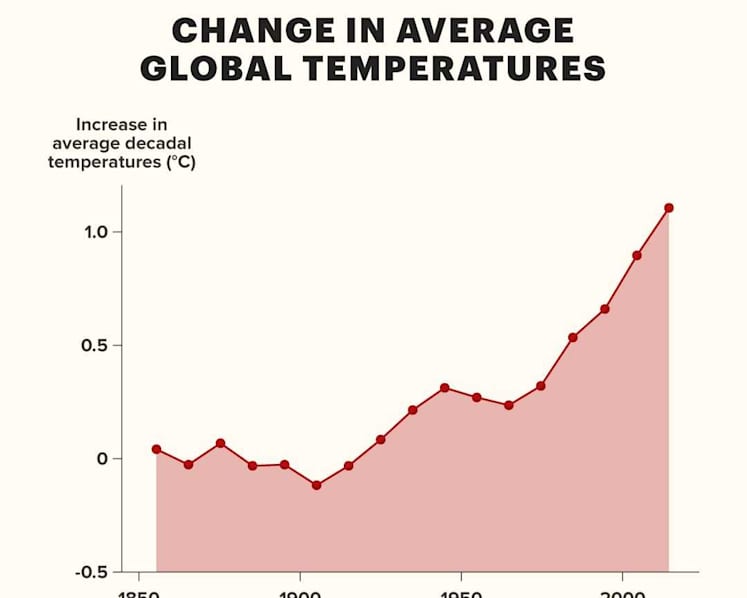
However, it is only going to get hotter in the coming decades.
The report models five climate change scenarios depending on the level of greenhouse gas emissions by the end of this century.
The most severe scenario assumes rapid development in non-green technology and economic development driven by fossil fuels, while the least severe scenario assumes environmentally sustainable economic growth worldwide.
The report showed that global surface temperatures will be higher than today by 2050 under all climate change emission scenarios.
Global average surface temperatures from 2081 to 2100 are expected to increase by 3.3°C to 5.7°C under the most severe emissions scenario.
Every 0.5°C increase will also have “clearly discernible” increases in the intensity and frequency of heatwaves, heavy rainfall and agricultural droughts in some regions.
While the impact of Covid-19 led to a reduction in carbon emissions last year, this appears unlikely to have a significant bearing on climate change, with the report noting that there was “no detectable decrease” in atmospheric carbon dioxide concentrations.
HOW FAR WILL SEA LEVELS RISE?
The projections for sea level rise in the latest report is similar to the last one.
Under the lowest emission scenario, sea levels could rise between 0.28m and 0.55m. Under the highest emission scenario, this figure could be between 0.63m and 1.01m by the end of the century.
For the first time though, the report offers predictions on sea level rise beyond the end of this century, taking into account the different carbon emission scenarios.
If emissions were halted today, sea levels are likely to rise by 0.7m to 1.1m by the year 2300, predicted the report.
If countries stick to their pledged carbon emissions by 2030, the rise will be between 0.8m and 1.4m.
However, if carbon emissions continue beyond 2030, sea levels could rise by as much as 6.8m under the worst case scenario.
WHAT WILL HAPPEN TO SOUTHEAST ASIA?
For the first time, the report also includes a section on the impact that climate change will have on different regions around the world.
A section on Asia, with elaboration on the different sub-regions, was also detailed in the report.
Temperatures in Southeast Asia are expected to rise, although this is expected to be under 5°C by the end of this century under the highest emissions scenario, lower than other regions like Western Central Asia and the Arabian Peninsula.
The region is also very likely to see extreme heat events by 2100.
The region will see an increase in the number of days exceeding 35°C by more than 60 days a year if emissions are not reined in and the worst-case scenario unfolds.
Rainfall during the region’s monsoon seasons will also increase, said the report.
In the near future, total flood damage will increase greatly in Southeast Asian river basins due to climate change conditions and rapid urbanisation.




