







Explainer: Why you should care about Singapore's latest national climate study


SINGAPORE — A new climate report on Friday (Jan 5) sounded warning bells about dire environmental changes that would require Singapore to adapt and prepare for the worst-case carbon emissions scenario.
Unlike past reports issued by global bodies like the United Nation's Intergovernmental Panel on Climate Change (IPCC) that also warned about climate effects, the latest report from Singapore bears greater scrutiny as it is a deeper dive into how the country's weather will become more extreme in the coming years.
The findings include predictions on specific shifts in temperature, sea level rise, rainfall and wind by the end of the century and beyond, based off a more "accurate simulation" of regional climate changes on a finer scale, said the agencies behind the report.
Should global emissions almost double by 2050 under the worst-case scenario, for example, Singapore's average temperatures could shoot up by 0.55°C per decade, among other possible impacts.





This would be a faster pace of increase than the 0.24°C per decade observed in the past 40 years, according to Singapore's third national climate change study, also known as V3.
Conducted by the Centre for Climate Research Singapore, which is under the Meteorological Service Singapore (MSS), V3 provides updates on the national climate change projects over V2, the previous study done in 2015.
Three governmental bodies including the Ministry of Sustainability and the Environment (MSE) said in a joint press release on Friday that the latest study was based on several global climate models taken from the sixth assessment report published last March by the IPCC.
The bodies said that these findings will be taken into account by the Government in Singapore's adaptation plans to ensure the country remains climate resilient.
Experts told TODAY that the findings were concerning, with possible impacts on physical health and infrastructure, among other things.
Read on as TODAY delves into V3's findings, why people living here should be concerned and what actions the authorities here are taking in light of the findings.
HOW FINDINGS WERE CUSTOMISED TO SINGAPORE
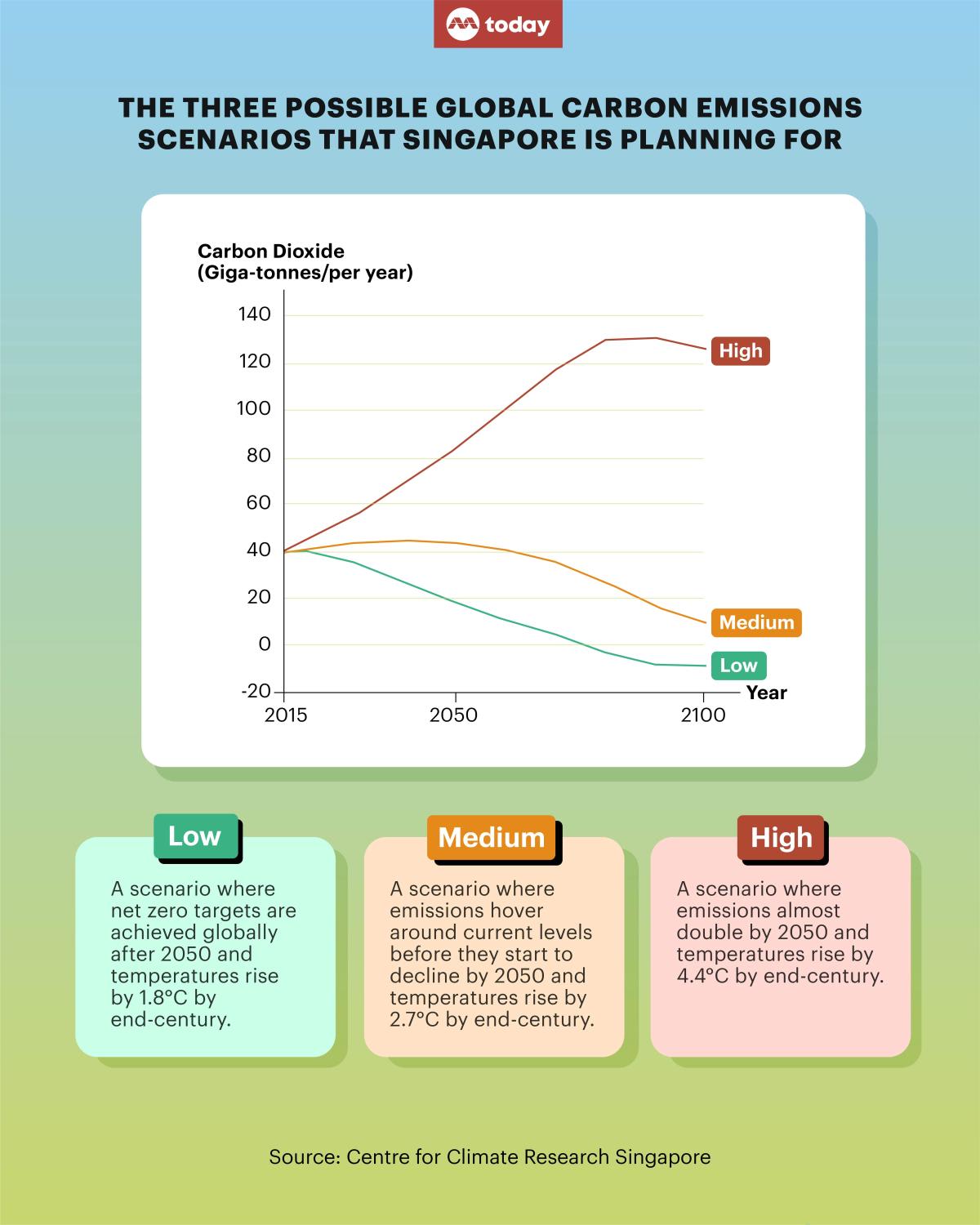
In exploring the possible range of outcomes for Singapore and the surrounding region by the year 2100, V3's projections are:
- A low-emissions scenario where net zero targets are achieved globally after 2050 and temperatures rise by 1.8°C by end-century
- A middle-of-the-road scenario where emissions hover around current levels before they start to decline by 2050 and temperatures rise by 2.7°C by end-century
- A high-emissions scenario where emissions almost double by 2050 and temperatures rise by 4.4°C by end-century
It does not offer IPCC's best-case scenario, where net zero targets are achieved globally by 2050 to meet the Paris Agreement goal, and temperatures rise by 1.5°C.
V3's study selected six global climate models and downscaled them.
Then, taking a modelling system used here to generate weather forecasts, the Centre for Climate Research Singapore created a customised modelling system to run its studies.
Through this customised system, the scenarios are then simulated based on an 8km domain for the region, and a 2km domain for Singapore.
This means that the V3 study had a much clearer projection over a larger area than the V2 study in 2015, and it is also more accurate.
WHY SHOULD YOU CARE?
Experts told TODAY that the V3 report findings are a stark reminder that Singapore and the world need to act swiftly to reduce carbon emissions and act on climate change.
Associate Professor Jason Lee from the Yong Loo Lin School of Medicine at the National University of Singapore (NUS) said that the most concerning part was the report's findings that hotter days and nights were on the horizon in all three scenarios.
"We'd better be alarmed and this alarm should trigger a sense of urgency to take actions at all levels proactively and not reactively," he said.
"(More warm nights) means that we will reach a point in time that we will progressively feel the heat even while resting without no cooling aids."
Professor Winston Chow of Singapore Management University whose research is on urban climate said that the warm nights could lead to health problems as people get poor sleep, and it could also start a vicious circle of producing more emissions as people use air-conditioners more often.
With more periods of dry spells and rainy days predicted based on V3's findings, the extreme weather may also affect biodiversity.
Prof Chow, who is also the co-chair of the IPCC Working Group II on Impacts, Adaptation and Vulnerability, said: "With more extremes of rainfall and heat, the question is whether existing biodiversity can adapt.
"Some (species) can adapt better than others, such as mosquitoes that are likely to thrive in such conditions.
"But our trees that are used to tropical habitats might not be used to more episodes of dry spells."
Singapore relies on nature-based solutions to regulate temperatures — such as trees to mitigate urban heat and green walls to reduce buildings' absorption of heat — so the extreme weather could negate the effect of these green spaces, Prof Chow added.
The rising temperatures will not just be uncomfortable, it will also bring about more pressure on the country's healthcare system.
Assistant Professor Borame L Dickens from the NUS Saw Swee Hock School of Public Health said that the increased extreme and frequent heatwaves will worsen heat stress on human bodies.
Asst Prof Dickens said: "Vulnerable groups — especially children, the elderly and those who are suffering from chronic conditions or diseases such as hypertension, diabetes and obesity — will be especially susceptible to having complications because of these heatwaves."
This could add strain to healthcare demands, with more hospital admissions for people who have existing cardiovascular and respiratory disorders.
"Mental health conditions are also made worse because of distress resulting from the heat, which can compromise decision-making, leading to more accidents, more incidents of aggression and even suicides," Assoc Prof Lee added.
Rising sea levels and higher temperatures could also affect crucial infrastructure such as Changi Airport and Tuas port, Prof Chow said.
HOW HOT WILL IT BE, WHAT CHANGES LIE AHEAD
1. TEMPERATURE
Currently, Singapore's average daily mean temperature is 27.9°C.
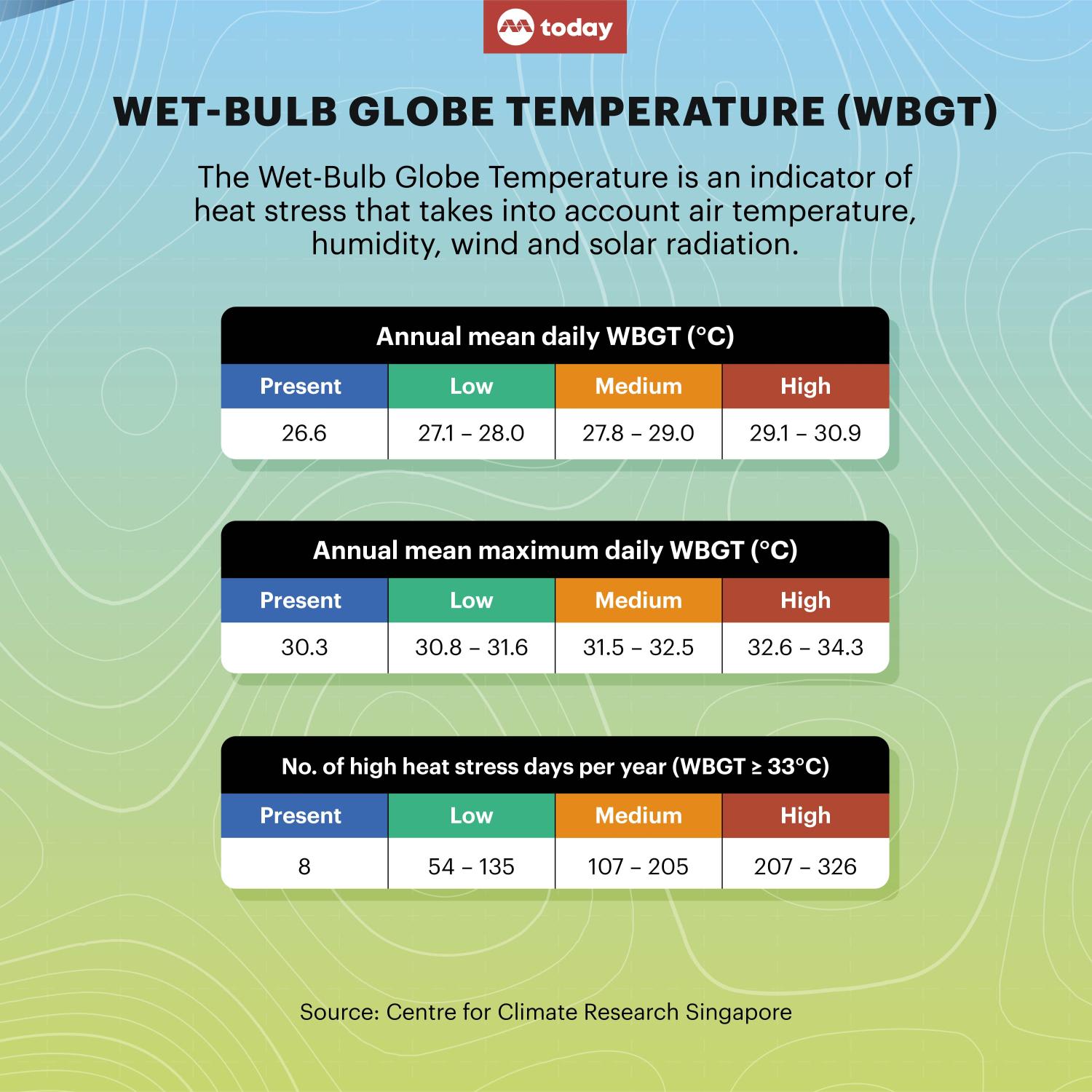
In all of V3's three projected scenarios, the average daily mean temperature and the Wet Bulb Global Temperature (WBGT) will increase by end-century.
WBGT is heat stress in direct sunlight, taking into account other environmental factors such as humidity, wind speed and cloud cover. For now, it is 26.6°C.
- In the best-case scenario, the average mean daily temperature would rise between 0.6°C and 1.6°C, while WBGT would increase by 0.5°C to 1.4°C
- In the worst-case scenario, the average mean daily temperature would go up by 2.8°C to 5.0°C, while WBGT would go up by 2.5°C to 4.3°C
This means that WBGT would be around 30°C on average daily by end-century.
With WBGT at 33°C or higher, the risk of heat stress and related illnesses such as heat cramps, heat exhaustion and heat stroke will be higher.
And should emissions increase rapidly, there could be between 207 and 326 of such high heat stress days yearly by end-century.
V3's study threw up possible scenarios and one is that there may be more warm nights of between 312 and 316 days in the best scenario — or warm nights all year round at the worst.
Warm nights are when daily minimum temperatures equal or exceed 26.3°C.
2. RAINFALL
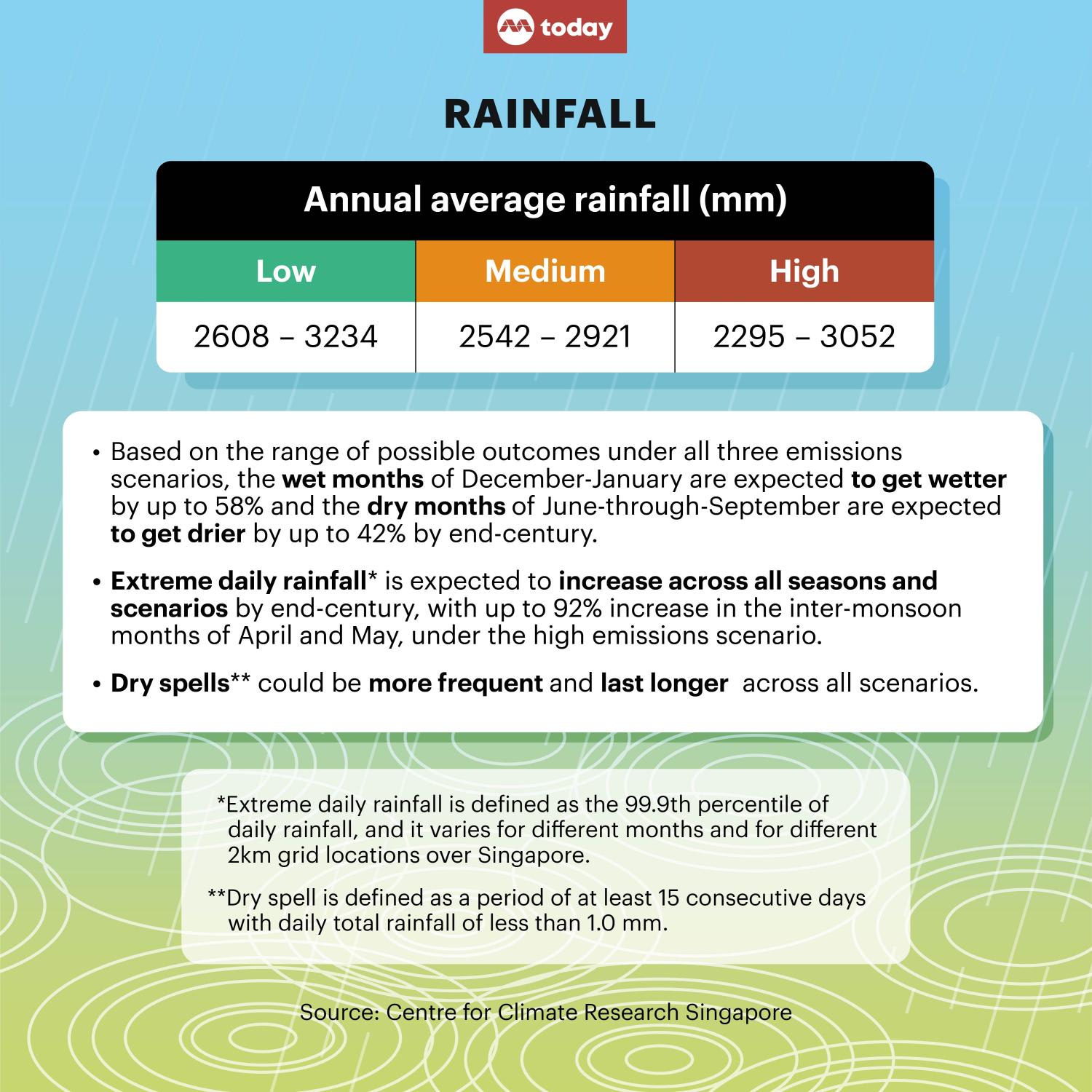
Singapore will see much more rainfall during rainy monsoon seasons.
By 2100, rainfall during the December-January period will increase by up to 58 per cent in the best scenario, and by up to 44 per cent in the worst scenario.
The dry months from June to September will also be hotter, with a 10 per cent drop in rainfall in the best case, and a 42 per cent decline in the worst case.
The study also found that in the worst-case scenario, there will be one dry spell of up to around 21 days for every 10 months. Dry spells are periods of at least 15 consecutive days where the island-wide average of rainfall is less than 1.0mm on each day.
3. WINDS
Overall, the study predicted wind speeds to increase by up to around 6 to 20 per cent during the northeast monsoon and southwest monsoon seasons in each projected scenario.
The inter-monsoon months of April and May will see an increase in wind speeds of up to 6 to 11 per cent by the end of the century.
Daily maximum wind gusts are expected to increase by up to 10 per cent come 2100, which can potentially cause damage to Singapore's infrastructure and uproot trees.
4. SEA LEVELS
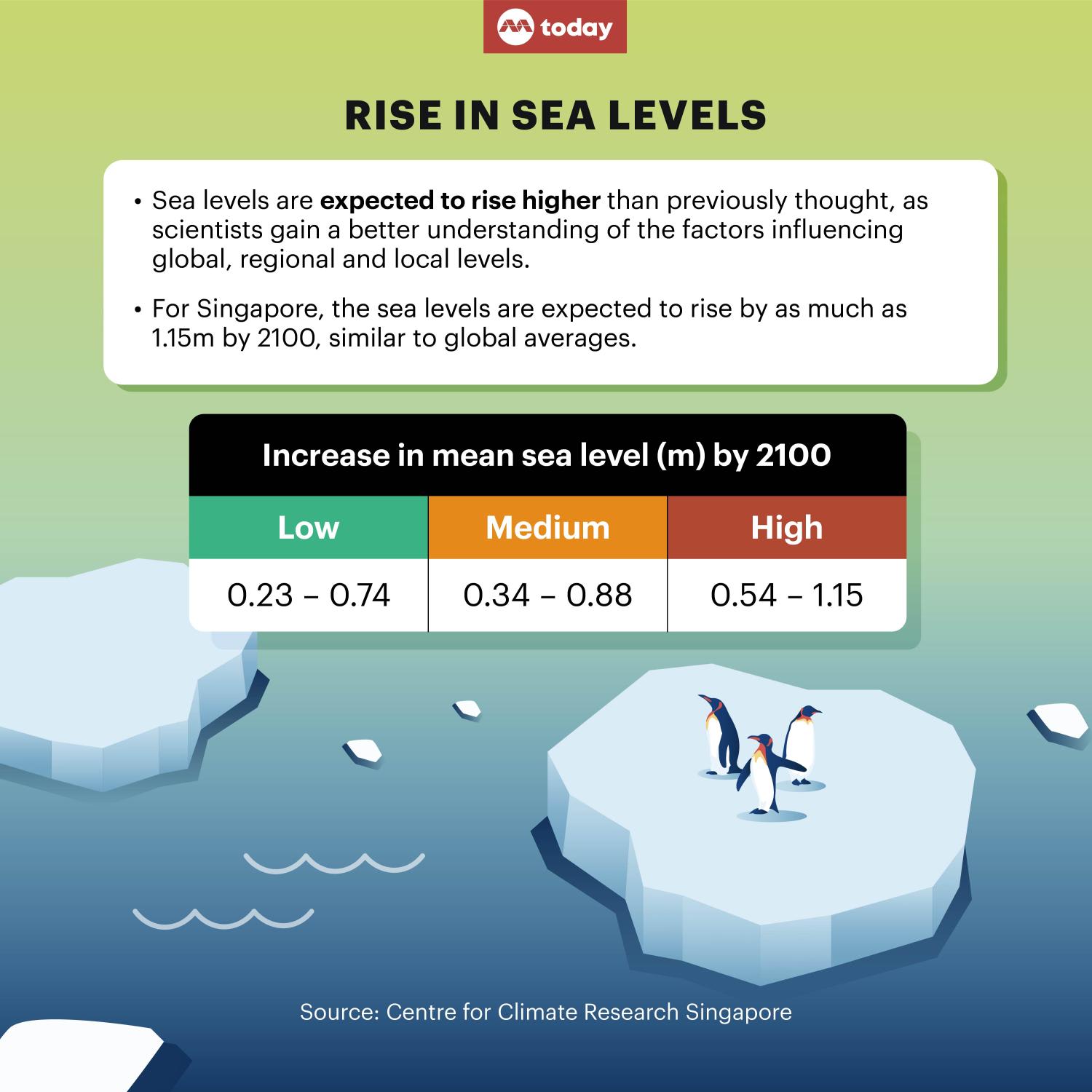
In all projected scenarios, the sea levels will rise.
In V3's study, there is better research than V2's study in 2015 into the melting Antarctic ice sheets and their contribution to global sea levels.
- In the best case, Singapore's mean sea level will go up between 0.23m and 0.74m
- In the worst case, the mean sea level will rise by 0.54m to 1.15m
By 2150, sea levels here could rise by 1.37m in the worst-case scenario.
About a third of Singapore's land area is less than 5m above mean sea level, so a 1m increase in sea levels could result in several plots of land being lost if nothing is done.
WHAT IS BEING DONE TO MANAGE PROJECTED CHANGES?
In Friday's joint press release, MSE, MSS and the National Environment Agency (NEA) said that Singapore's future climate depends on all countries acting collectively to fulfil their net zero commitments.
MSS will be sharing the data from V3 with member states of the Association of Southeast Asian Nations (Asean) "at a later stage".
MSS will also be collaborating with international entities and the scientific community to undertake joint research using V3's data.
Beyond research, the Government "takes a proactive approach not just in mitigation, but also in adaptation planning to ensure that we are prepared for the impacts of climate change", the three governmental bodies said.
"The Government will take into account the range of possible climate outcomes, including the high emissions pathway, in Singapore’s adaptation plans to ensure that we remain climate-resilient."
Some key things that the Government would be doing include reviewing building codes to ensure the structural integrity of infrastructure, as well as climate-proofing network infrastructure such as transport, telecommunications and energy in the face of projected higher temperatures and wind speeds, for instance.
There are plans to cool urban spaces in more ways, by using modelling in district and estate planning to preserve wind corridors, and deploying cool paint to reduce heat absorption, for example.
The Government already announced plans for the "Long Island" reclamation project off the country's eastern coast in 2019 to "project coastal projection seawards".
"Government action alone will not be sufficient. Everyone — individuals, communities and corporates — has a role to play to promote sustainability and mitigate climate change," MSE, NEA and MSS said.
Some things that individuals can do include saving electricity by adopting energy-efficient appliances, reducing water usage and buying domestic produce that has a lower carbon footprint.




