







Faces on the Subway: Former mini-mart owner, 86, finds greater freedom of movement
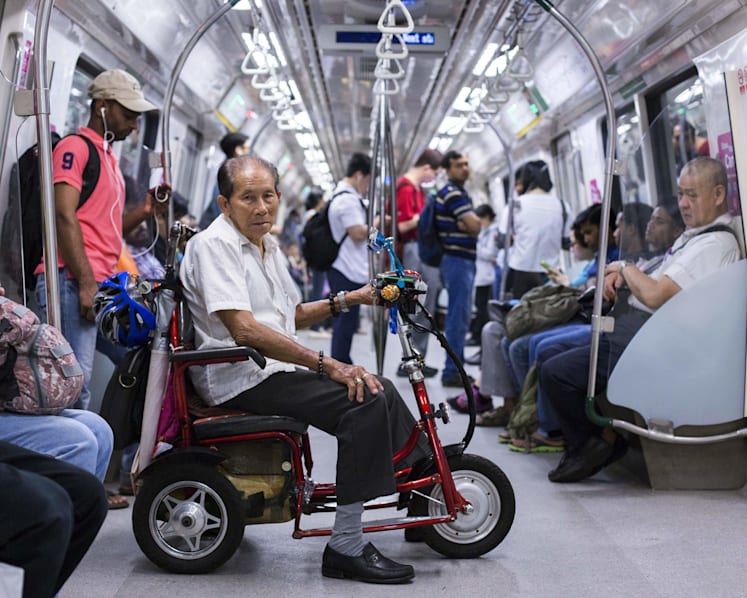
At least twice a month, Mr Koh will catch the first train at 5.40am from Punggol MRT Station on the North-East Line — a five-minute ride from his home by e-scooter. Photo: Koh Mui Fong/TODAY


Every day, hundreds of thousands of passengers take the MRT, traversing across the island for work, school and leisure. The spate of disruptions and incidents, which the operators and authorities are looking to resolve, and the inconvenience caused to commuters, have brought into focus how the rail network has become a big part of our lives. So, too, are the countless faces we meet on the subway, some growing familiar over time and each with a story to tell.
In our Faces on the Subway weekly series, we speak to commuters who start their day while it is still dark, or call it a night when others are already fast asleep — people on the first or last train.
SINGAPORE — He was a rubber tapper working in a plantation in Johor, Malaysia, worked as a quarry supervisor in Pulau Ubin, sold prawn crackers in his kampung in Woodlands, and started a mini-mart business in Ang Mo Kio.





Now at 86 years old, Mr Koh Seong Lye is not on his feet so much and walks with a limp, but he managed to find a way to still move around with ease and keep active.
Seated on his electronic scooter, his hand resting near the buzzer to alert people to his presence, he made his way around confidently while transiting between MRT lines on a Saturday morning when TODAY met him.
At least twice a month, Mr Koh will catch the first train at 5.40am from Punggol MRT Station on the North-East Line — a five-minute ride from his home by e-scooter.
He is very particular about reaching the Kwan Im Thong Hood Cho Temple on Waterloo Street at the earliest possible time. He visits the temple on the first and 15th day of the Chinese calendar month to offer prayers to Guan Yin, or the Goddess of Mercy.
“The crowd builds up from 8am, and by 10am, it is impossible to enter (the temple),” he said, relating the few instances he almost fell over when devotees brushed past him.
His mother, who died at 93 in 2002, started the tradition, believing that there was divine intervention after he “escaped” death a couple of times.
Mr Koh recounted that his parents, who were originally from Xiamen, China, had a harrowing sea journey to Singapore. He was four years old then. Their boat capsized in the waters near Hong Kong and many onboard were killed, but the three of them survived.
Then, when he was 12 and Singapore was occupied by the Japanese during World War II, a soldier wanted a duck he had but he refused to give it away. The soldier fired a gunshot and the bullet missed him by mere centimetres above his head. Another soldier who witnessed the incident gave him a coin to stop him from crying and let him go.
.embed-container { position: relative; padding-bottom: 56.25%; height: 0; overflow: hidden; max-width: 100%; } .embed-container iframe, .embed-container object, .embed-container embed { position: absolute; top: 0; left: 0; width: 100%; height: 100%; }These days, though, what Mr Koh finds most nerve-racking is getting through heavy human traffic. That, and the thought that he will no longer be able to go to the bathroom on his own one day. The father of nine lives alone in a two-room government-built flat in Punggol.
Asked about his limp, Mr Koh said that when he was 40, he strained his left knee while handling a 50kg boulder at a granite quarry in Pulau Ubin in 1972.
The problem with the weak knee persisted and over the past five years, it has become so pronounced that he began using a walking stick.
“Without surgery, I can still walk a little. With surgery, I will have to pay more, and might not be able to walk again. My biggest fear is to have to rely on someone else when I move my bowels,” he said.
TWO LEGS UNSTEADY, THREE WHEELS BETTER
Three years ago, Mr Koh discovered the wonder that is an e-scooter, which empowered him such that he could “go everywhere by myself”.
He spent S$2,000 on the first mobility device and it could cover up to 10km per battery charge. He quipped that the price more or less matched what he paid for his first vehicle, a lorry, in the 1960s.
About two years ago, he switched model and paid S$800 for the e-scooter he now uses. This one can cover up to 30km per charge. A sports helmet is secured to the back of the scooter, along with a walking cane, an umbrella-cum-walking stick, a back scratcher, and a red tail-light.
Mr Koh will not go anywhere without his e-scooter, and is familiar with using park connectors to get to Ang Mo Kio, where his oldest son, Mr Koh Kok Hwa, 53, runs Song Hoe Mini-Market. He started the business before handing it over to his son in the 1990s.
Mr Koh said that after his Pulau Ubin job, he ran a cottage business from his kampung. In four years, it grew to become a wholesale supplier of prawn crackers and tapioca chips. The snacks were made from a recipe he picked up from a Malay family.
It was when the authorities served him a warning that he needed a licence to operate the business that he opened a provision shop, which became the mini-mart today.
On most days, when he does not head to the temple, Mr Koh “reports to work” at about 6am and helps to pack onions, potatoes, flour, fruits and other assorted dried goods for sale.
His son is there earlier by 5am to serve the regular customers — mostly older residents starting their day early, snapping up newspapers and buying groceries.
Talking about the fate of small businesses like theirs, the older Mr Koh said that the shop was double its size from 1979 to 1996, and rent was S$1,610 a month.
Now, half the space is shared with a bubble tea stall, and rent is higher at S$2,250 monthly.
Profits are dwindling with bigger competitors such as NTUC FairPrice and Sheng Siong supermarkets around, father and son said.
Consumers go to their mini-mart for what supermarket chains do not offer. For instance, they get 50 cents off the price of a 5L bottle of dishwashing liquid that costs S$4.80, or a 3.4L bottle of bleach that costs S$2.80. The discount applies only if they return the empty bottles of these cleaning products that they previously bought from the shop.
The supplier would give 60 cents for every container collected, so the mini-mart earns 10 cents from the exchange.
“We just earn a little bit. Now the big players like NTUC, Sheng Siong and Giant... they have everything. They sell something at S$1, while our shop sells S$1.20. Who would want to buy from you?” the elder asked.
These concerns, however, are now more for his son to handle. Removed from such stresses, Mr Koh would head off by about noon to start winding down his day with an afternoon nap.




