







2 female NTU scientists join expedition to Arctic, discover new volcano in Norwegian depths
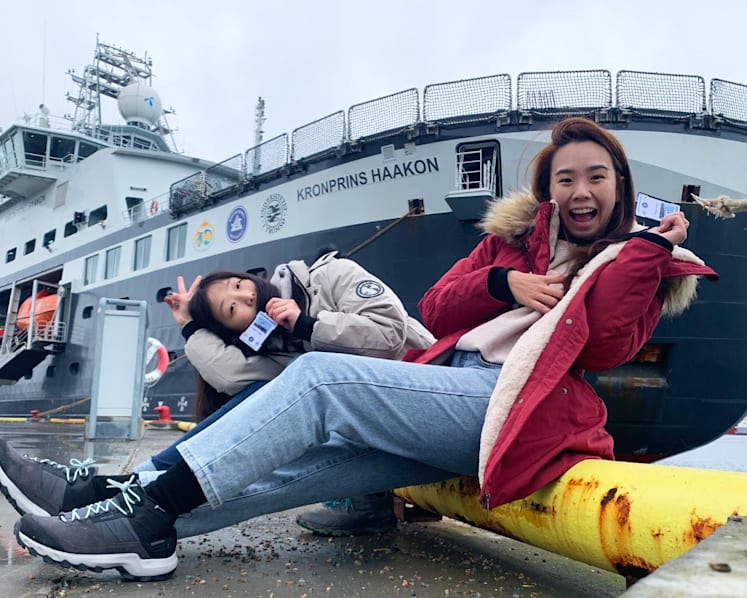
Ms Yan Yu Ting (right) and Ms Toh Yun Fann, both 28, posing with the Norwegian research vessel Kronprins Haakon.
SINGAPORE — It was an opportunity of a lifetime for two 28-year-old Singaporean scientists to be invited on a research expedition to the Arctic Circle last month, joining a group of other international scientists on board an icebreaker in a geeky cruise of sorts in the Barents Sea.
For 12 days from April 29 to May 10, Ms Yan Yu Ting and Ms Toh Yun Fann from the Nanyang Technological University (NTU) found themselves in the bitter cold aboard the Kronprins Haakon, a Norwegian research vessel crewed by a multinational group, including 30 scientists.
Called the Advancing Knowledge of Methane in the Arctic project, the effort was led by The Arctic University of Norway and the Woods Hole Oceanographic Institute in the United States, which invites scientists and students from around the world to join in a learning journey.
Ms Yan and Ms Toh were the only two scientists from Asia on board the vessel.





Speaking to TODAY after their trip, Ms Yan said they were there to pick up new skills and observe state-of-the-art research technology, such as remote-controlled vehicles, to study one of the largest remaining undisturbed marine ecosystems on Earth.
In the process, the team serendipitously discovered a new mud volcano, known formally as the Borealis Mud Volcano, spewing fluids and gases some 400m underwater.
Said Ms Yan: "The one thing we could remember was that you could really smell the sulphur so we knew like, okay these sediments are rich in methane.
"The entire trip was really an eye-opening experience, where I got to meet a lot of people that I probably won't have a chance to meet. It was just amazing being able to hear them talk about science 24/7."
ALL DAY, NO NIGHT
Ms Yan is in the process of completing her PhD studies with NTU’s Asian School of the Environment (ASE) and the Earth Observatory of Singapore (EOS). She has been studying the sediment in the Kallang River Basin near the Southern Coast of Singapore to learn about paleoenvironmental change — a field within geography that examines past environments to see how they have changed over time.
As for Ms Toh, she is an EOS research assistant with an honours degree, and has studied iceberg scours and their geomorphology and spatial distribution. She has also applied for a PhD with NTU where she hopes to further focus on geomorphology and geophysics.
With their experience in marine geology, both jumped at the opportunity to participate in the international collaborative project when they received the invites to join the expedition aboard the Kronprins Haakon, which they both described as a "cruise ship" for science geeks.
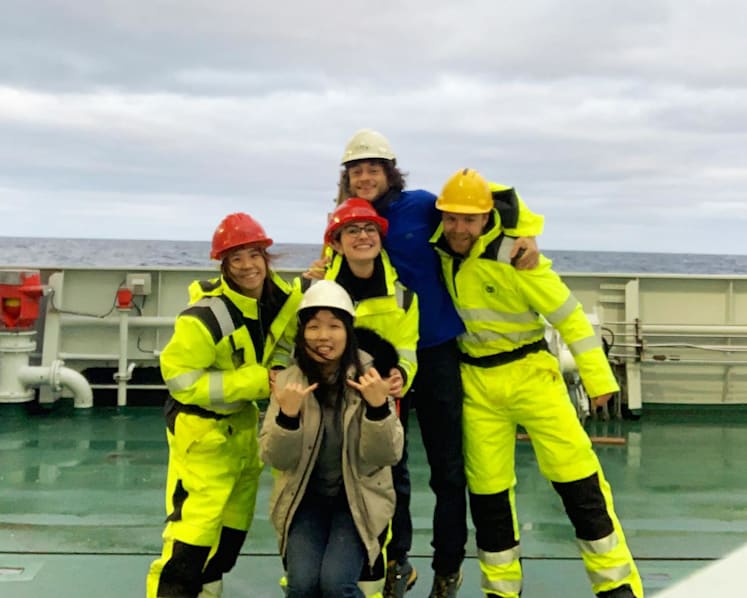
The vessel, an icebreaker capable of travelling into the icy parts of the Arctic Circle, was built with 15 well-equipped labs, a remote-controlled vehicle and round-the-clock live feed from a remotely operated vehicle (ROV) deep beneath the sea that could send back underwater footage in real time.
An ROV is an unmanned remotely operated underwater vehicle, which is distinct from a crewed submersible that is tethered by a mother ship and is lifted out of the water after a dive.
For Ms Yan and Ms Toh, their schedule consisted of two six-hour shifts each day, which began as early as 2am.
Because of how Earth is tilted on its axis as it orbits the Sun, the Arctic regions are bathed in 24 hours of sunlight in those months that they were there, which meant that the Singaporean duo had to adapt to the unusual day-night cycle.
Recalling her first few days of the expedition, Ms Yan told TODAY that even though she was aware of this phenomenon prior to the trip, it was still disorienting to start a night shift and realise that it was actually as bright as day.
"It just feels like it was daytime but it also felt very strange because the sun typically sets at about 7pm in Singapore and you can see it's dark. In the Arctic, I'll wake up at 1am and see that it's still bright," she said, adding that prior to the trip she had worried about not being able to see much at night.
Ms Toh said she also had a bit of difficulty adjusting as she was more of a "night owl" who really depended on the sun setting to help with her change of pace.
"If I've been working in the morning, then when the sun sets, it's time for me to rest. The first half of the trip felt like I could not get proper rest because it was like I haven't gotten off work yet," she said.
LEARNING THE ROPES
After the first few days of adjustment, both said they tried to absorb as much knowledge and information as they could.
They helped the team with sediment samples from the seabed, assisted in basic steps of processing samples and prepared materials for the project's outreach programmes.
Despite getting sea sick initially, Ms Yan said her first expedition experience was an eye opening one as she was learning different things from various experts on board who talked about science all day.
She was also struck by the lab facilities on board that made collecting and analysing samples a relative breeze.
On May 7, the team chanced upon an underwater mud volcano that erupted mud, fluids and gas. At the time, Ms Yan and Ms Toh were helping out in the wet lab organising and processing biology samples.
It turned out that the underwater volcano was the second one to be found within Norwegian waters.
"It was such a great discovery that they had to forgo one last planned site so that we could spend more time at this particular area to collect more sediments and gas samples, and water column data," said Ms Yan.
When asked how she feels about the experience, Ms Yan laughed and said: "I wish it could have been longer."
Ms Toh, who was on her third expedition, was amazed by the efficiency in how the scientists maximised their resources, even when they were faced with constraints or when things did not go according to plan.
The duo will be using their new knowledge and skills to continue their research study on the seabed of Singapore, which aims to help provide a reference point to better understand how Singapore waters change over time.
Learning how to conduct research efficiently would allow them to not be held back by Singapore's climate and instead focus on the more important aspects of research, said Ms Toh.
Ms Yan agreed, adding: "It would be interesting to see how we can adapt some of the techniques and lab skills that we've learnt in the Arctic to the work in Singapore."
CORRECTION: An earlier version of this article stated that Ms Toh Yun Fann is a research assistant at Nanyang Technological University's (NTU) Asian School of the Environment. This is incorrect. She is a research assistant at NTU's Earth Observatory of Singapore. We are sorry for the error.




