







GE2020: PAP’s new candidates for Chua Chu Kang GRC come from ‘less represented’ backgrounds, say their pasts don't define them
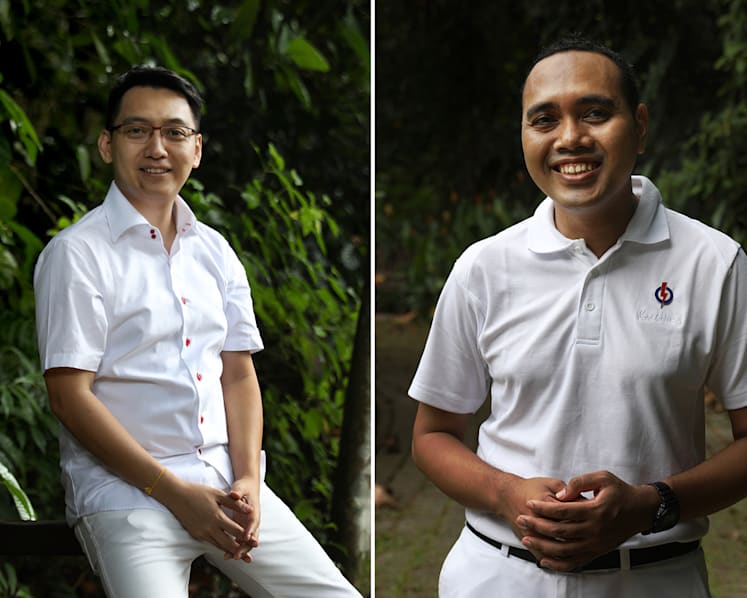
Mr Don Wee (left) and Mr Zhulkarnain Abdul Rahim (right) are now hoping to push for social mobility for the youth.

SINGAPORE — Mr Don Wee spent the first few years of his life living in a rental flat but he never told his wife this. She found out about this only in 2018, after they had been married for 13 years, when he was preparing some documents to present to the People’s Action Party (PAP).
And it was only when Mr Zhulkarnain Abdul Rahim was 19 years old that he slept on his very own bed for the first time, after his family of eight had upgraded from their three-bedroom Housing and Development Board (HDB) flat in Toa Payoh to a maisonette in Chua Chu Kang.
Mr Wee, 43, a senior vice-president at United Overseas Bank, and Mr Zhulkarnain, 39, a lawyer and partner at law firm Dentons Rodyk and Davidson, are two PAP new faces that have been fielded in Chua Chu Kang Group Representation Constituency (GRC).
Given their humble beginnings, both men are now hoping to push for social mobility for the youth. They also believe that there are different pathways to success — much like their own personal journeys.





CHIP ON SHOULDER FOR TAKING 'UNCONVENTIONAL PATH'
For Mr Wee, he described his path as “unconventional”, one that caused him to be “looked down upon” for much of his life.
Having been brought up by his maternal grandparents while his parents took on multiple jobs to support him and his two younger sisters — his father worked as a delivery man and a taxi driver while his mother assembled electronic parts and was a part-time cashier — Mr Wee described his childhood as “quite laissez-faire”.
“Nobody bothered about my studies. It was quite fun but it also meant I was directionless,” said Mr Wee, who studied at Nan Hua High School.
After his O-Levels, he enrolled in Ngee Ann Polytechnic’s diploma in accountancy course. But his parents objected to this; they had wanted him to enter a junior college (JC).
“What was celebrated was going to a JC, then to a local university. By not taking that route, people think that you have no future,” he said.
His disagreement with his parents led him to run away from home and to stay with his aunt for a few days. Mr Wee was determined to take the polytechnic route, as he wanted to “earn money as soon as possible”.
“I wanted to take some pressure off my parents and to supplement my pocket money to buy things like Nike sneakers, which many of my peers took for granted,” he said. During his polytechnic years, he took on part-time retail jobs and worked as an accounts and office assistant.
In the last few months of his National Service (NS) stint, Mr Wee enrolled into a part-time Bachelor’s programme at RMIT University at SIM GE.
As most of his friends went to JCs and Singapore universities, he felt like there was “a chip on my shoulder”.
“But that chip was one that spurred me to get my Chartered Accountant qualification and fulfil my dream of doing a course in a local university,” Mr Wee said. He has since obtained two master’s degrees from the National University of Singapore and the Nanyang Technological University.
Few knew about the journey he took. His colleagues found out only after he made a speech as a PAP candidate on June 24.
Mr Wee did not tell his wife about his growing-up years living in a rental flat either. “There are things in life that you don't feel very proud of,” he said. “I would not have revealed it if I was not standing for election.”
Though he does not often speak about his past, Mr Wee has never shied away from a chance to give back to underprivileged communities.
He has been an active grassroots leader in the West Coast housing estate, where he lives, and he has served for 16 years there after being connected to Mr S Iswaran. Over the years, he has helped disadvantaged youth.
Mr Wee is also on the Visitor's Board of the Institute of Mental Health, where he reviews the welfare of mental health patients — a group he feels has been neglected. In addition, he does pro-bono work with the Office of Public Guardian to serve seniors.
Mr Wee said that he was sounded out in 2011 about the possibility of being fielded in the General Election, but he turned down the offer because his two sons, now aged 14 and 12, were still very young.
He decided to take the plunge now "because it is an extension of my volunteerism, giving me a platform to surface these issues at the highest level".
“It’s a once-in-a-lifetime opportunity," he added. "I do hope that I can benefit people of my own background that have not been well-represented.”
.embed-container { position: relative; padding-bottom: 56.25%; height: 0; overflow: hidden; max-width: 100%; } .embed-container iframe, .embed-container object, .embed-container embed { position: absolute; top: 0; left: 0; width: 100%; height: 100%; }‘YOUR PAST DOES NOT DEFINE WHO YOU ARE’
If Mr Wee’s growing up years were laissez-faire, Mr Zhulkarnain remembers his as “always cosy”.
Living with his parents and five other siblings in a three-bedroom flat, his bed was a mattress in a “little space behind the kitchen near the toilet”.
But his father, the sole breadwinner of the family, worked his way up to become a plant manager in what is now known as Sembcorp and the family moved to a maisonette in Chua Chu Kang when he was 19.
It was a visit to his father’s plant in Sungei Kadut that inspired him.
“I saw how he treated his people, even the guard dog,” Mr Zhulkarnain said. “He said it's not about who works for you, it's about who works with you, and I realised he was a reflection of who I wanted to be.”
Mr Zhulkarnain also recalled a story his mother had told him from 1964, when she found herself in a bus that was forced to stop because of the communal riots.
“There were Chinese, Malays, Indians and a Sikh man on that bus and all they wanted was for the bus to keep moving. In that same way, I believe every Singaporean wants the same thing.
“We are all going in the same direction, we may differ as to how fast we're going, or how slow we're going, which route we take, but we want to reach the same destination,” he said.
“Our politics need to come to the core of what it is to be a Singaporean. That is when I thought to myself, I need to serve,” he added.
As to why he became a lawyer, Mr Zhulkarnain said that he saw it as an honourable profession where he could help others.
“It's a calling, that's why we are called to the Bar. I may not be a doctor, but I can save other lives,” Mr Zhulkarnain said. He has been conducting free legal clinics and doing pro-bono work as an assigned solicitor with the Legal Aid Bureau.
Mr Zhulkarnain also helps run Casa Raudha Women Home, a shelter for vulnerable women and children who are victims of domestic violence.
Most of his efforts are focused on drug abuse, education, youth empowerment and domestic violence.
“It's not a society or racial issue or community issue. If you dig a bit deeper, there is an underlying core, whether it's the socio-economic divide or a particular policy. Those are the things that we need to look at,” he said.
Asked if he sees himself as an inspiration to the youth who might be in a similar position as he was growing up, Mr Zhulkarnain said: “I’ve never thought of myself as a role model for anyone.
“You don’t have to come from ‘humble beginnings’. My history shouldn’t matter. What I'm doing at the present or what I’m going to do in the future should be more important. Your past doesn’t define who you are.”
.embed-container { position: relative; padding-bottom: 56.25%; height: 0; overflow: hidden; max-width: 100%; } .embed-container iframe, .embed-container object, .embed-container embed { position: absolute; top: 0; left: 0; width: 100%; height: 100%; }



