







Govt to study how to refresh political system: Tony Tan
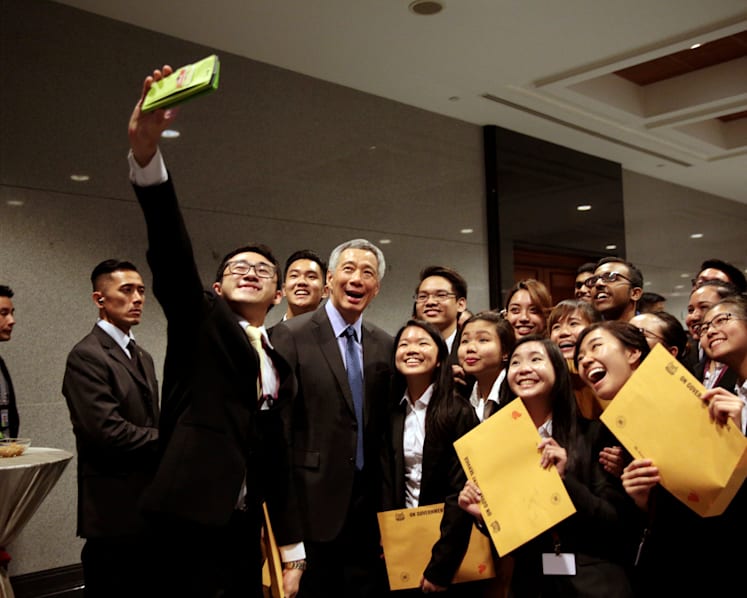
Prime Minister Lee Hsien Loong posing for a wefie with polytechnic students at the reception after the opening of Parliament on Jan 15, 2016. Photo: Jason Quah/TODAY
SINGAPORE — The Government will be studying how to refresh the political system as it begins a new term, said President Tony Tan in his address at the opening of the 13th Parliament today (Jan 15), where he also stressed the need for “good politics” in order for government programmes to succeed.
“Our political system has delivered stability and progress for Singapore. But this system must be refreshed from time to time as circumstances change,” said Dr Tan.
“The Government will study this matter carefully, to see whether and how we should improve our political system so that we can be assured of clean, effective, and accountable government over the long term,” he added.
In his speech, Dr Tan emphasised that “good policies and good politics go together”. “Good politics ensures that we elect governments that develop and deliver on sound policies, strengthen the country and bring people together,” he said. “This was how, for 50 years, we conceived and implemented sound policies to improve the lives of people. We had good politics because our policies benefited everyone, and we had good policies because our politics expanded our common spaces.”





To ensure Singapore’s politics continue to work in the long-term, Dr Tan said the Republic must continue to have “capable and honest political leadership”.
“This will not happen by chance. Every generation must develop the next generation “consciously and systematically”, he said.
New generations of leaders must also step up to plate, and “win anew the people’s trust”. “The right to leadership is not transferable from one generation to the next,” said Dr Tan.
The political system must also be one that allows the Government to “govern effectively and in the interest of all”. Other countries suffer from deep divisions in their societies and are “crippled by political gridlock”. In Singapore, the political system here discourages “narrow interest-based politics” and encourages clear electoral outcomes. “This has served us well,” he said.
The system must also “incorporate appropriate stablilsers and checks and balances”. This includes having opportunities for alternative views to be considered and taken into account, and ensuring that minority communities will not be “shut out or marginalised”.
Dr Tan cited Singapore’s “first-past-the-post” electoral system, the Non-Constituency Members of Parliament (NCMP) scheme and the Group Representation Constituencies (GRC) system as examples of “innovations” that have worked for Singapore.
The NCMP scheme for example ensures that opposition members will always have their views represented in the Parliament, while the Nominated MP scheme allows for non-partisan views to be heard.
The GRC system meanwhile guarantees at least a minimum representation of Malay, Indian and other minority race Members of Parliament.
Another “critical element” of the political system is the office of the President which fosters “resilience and stability”. Although executive power is vested in the Government, the President only holds a second key, with “specific custodial powers”. This helps to ensure major decisions are taken “wisely and prudently”, especially those involving spending the country’s reserves and making important public sector appointments, said Dr Tan, who was elected President in 2011.




