Singapore Heart Foundation sets goal of 1 million trained community first responders over next 5 years
Over the past decade, bystander CPR rates have risen sharply, from 22 per cent in 2011 to 62 per cent in 2022.
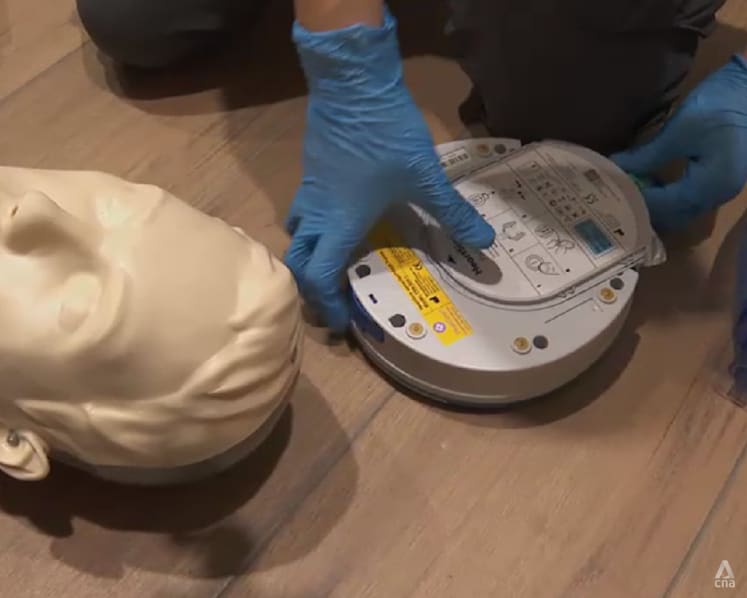
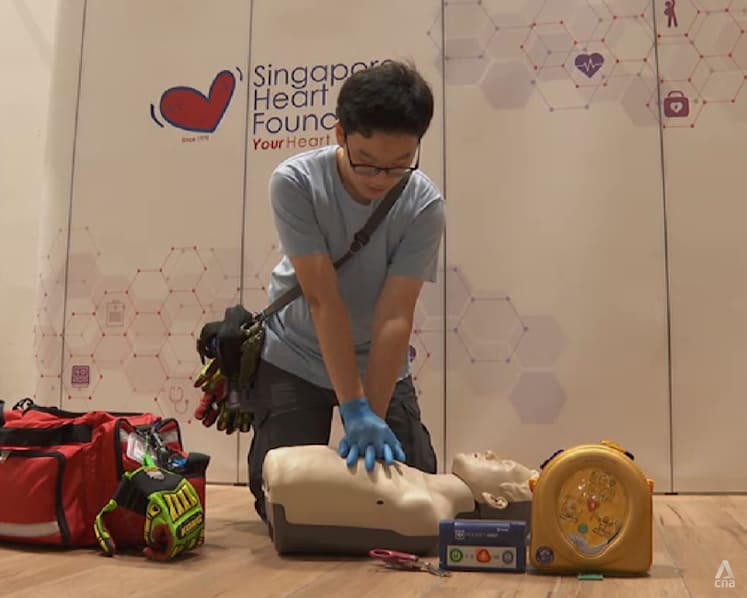
A community first responder demonstrating CPR on a manikin.

This audio is generated by an AI tool.


SINGAPORE: When it comes to saving a life, every second counts. For cardiac arrest cases, the chances of survival drop by 10 per cent for every minute that a victim does not receive cardiopulmonary resuscitation (CPR).
According to the Singapore Heart Foundation (SHF), close to 80 per cent of cardiac arrests here happen at home or in public places.
The number of these out-of-hospital cardiac arrest cases has been going up, reaching a record 4,058 in 2022 – a 12 per cent increase from the previous year, latest data from the social service agency showed.
With such cases expected to continue rising, the foundation is targeting to reach 1 million trained community first responders over the next five years.
“If you train a million, that means almost every household or every other household will have one person trained in CPR,” said SHF CEO Geoffrey Ong.





Currently, there are about 270,000 trained community first responders registered on myResponder, a Singapore Civil Defence Force (SCDF) app which alerts members of the public to nearby fire and medical emergencies.
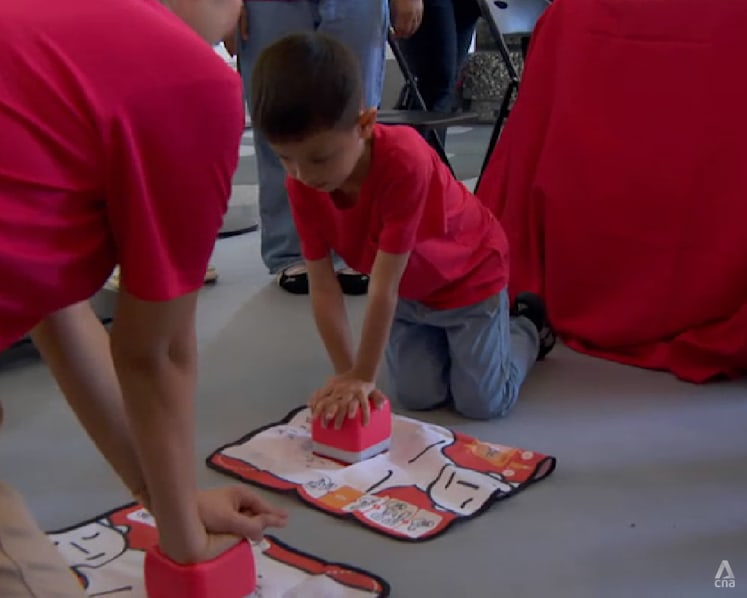
To reach its target, SHF plans to train 170,000 students in institutions of higher learning, and is working with the Ministry of Education to equip another 300,000 teenagers with CPR and automated external defibrillator (AED) training within the five-year time frame.
So far this year, the foundation has trained about 4,500 people and hopes to more than double that to 10,000 by the end of 2026. In October, it will hold its annual free mass event named Project Heart, which aims to train and certify 1,000 people in CPR and AED usage in a single day.
The organisation also plans to partner with skills training providers to roll out training programmes for the public, as well as with corporations to equip more employees at workplaces.
Additionally, it has been growing its pool of instructors by training aspiring healthcare professionals, including paramedic and nursing students who are already certified in CPR and AED skills.
BEING THE FIRST TO RESPOND
Among the most active community first responders is 15-year-old Joshua Hiew, who learned CPR and AED skills in 2024 and has since responded to more than 50 cardiac emergencies on the myResponder app.
“I have a bike that I use when responding to cardiac emergencies, equipped with life-saving tools and strobe lights to alert pedestrians to give way,” he said.
Recalling a recent cardiac arrest case, Joshua said he had to put his nerves aside to focus on helping the victim.
“I felt nervous, but I had to remain calm. I tried my best and we gave the victim as much chance of survival as possible,” he told CNA.
“If no one did anything, the person will pass away.”
For his efforts, Joshua has been conferred three awards by the SCDF in 2025 and 2026.
His contributions reflect a broader shift in Singapore's emergency response landscape. Over the past decade, bystander CPR rates have risen sharply, from 22 per cent in 2011 to 62 per cent in 2022.
Community outreach efforts have also expanded significantly, with the number of such responders growing more than eightfold, from 302 in 2011 to more than 2,515 in 2022.
The data was released during a life saving event aimed at encouraging youths to take up CPR and AED skills held over the weekend.
SHF CALLS FOR MORE AED USAGE
Despite the encouraging increase in the number of community first responders, only around 14 per cent of all cases in 2022 used an AED – a portable lifesaving device that delivers a controlled electric shock to treat cardiac arrest patients.
"A lot of people in the public are not confident of using an AED. They're also afraid to do the wrong thing in case they feel that they might harm the patient,” said Mr Ong.
“But actually, AEDs nowadays are very advanced. When you switch them on, they give you guided instructions.”
However, he pointed out there is also a lack of awareness of where AEDs are located.
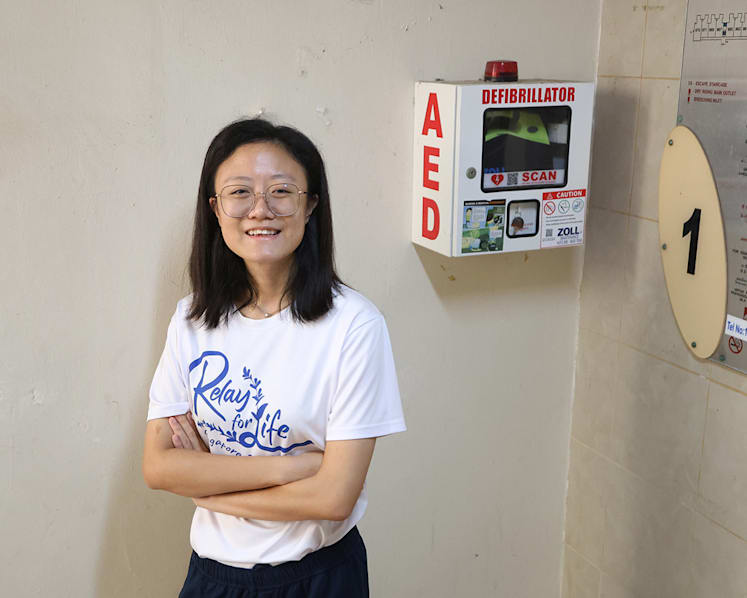
Currently, there are more than 10,000 publicly accessible AEDs that can be found at HDB blocks, train stations, bus interchanges and community facilities. The public can use the myResponder mobile app to search for the nearest available AED within 400m of their location.
MAKING AEDs LIGHTER AND MORE PORTABLE
Researchers are currently studying the next generation of portable AEDs in a bid to make life-saving equipment more accessible.
“This device is only 700g and can easily fit into your car or bicycle, and you can bring it to school or work. It works exactly the same way as the traditional AEDs,” said Professor Marcus Ong, director of Duke-NUS Medical School’s prehospital and emergency research centre.
Prof Ong is leading the research on the feasibility of the public using the portable AED. He cited the possibility of being able to bring it out on family outings or company excursions – just like a first aid kit.
“The aim of this project is to see how the uptake is from our active citizens in terms of being able to use the device (and if) there are any barriers,” he said.
Unlike the professional AEDs that doctors use in hospitals, the portable AED is meant for laypeople.
“There's a small computer on board that will analyse the (cardiac) rhythm and advise you whether to shock. In other words, the decision to shock is made by the computer,” explained Prof Ong.
The study aims to equip 1,000 volunteers with the portable device, with plans to make it more widely available in the future.