High Court sets aside acquittal of pair linked to LTA bribery case over trial judge’s failures
Chief Justice Sundaresh Menon ordered a fresh hearing of the merits of the case based on records of the trial proceedings.
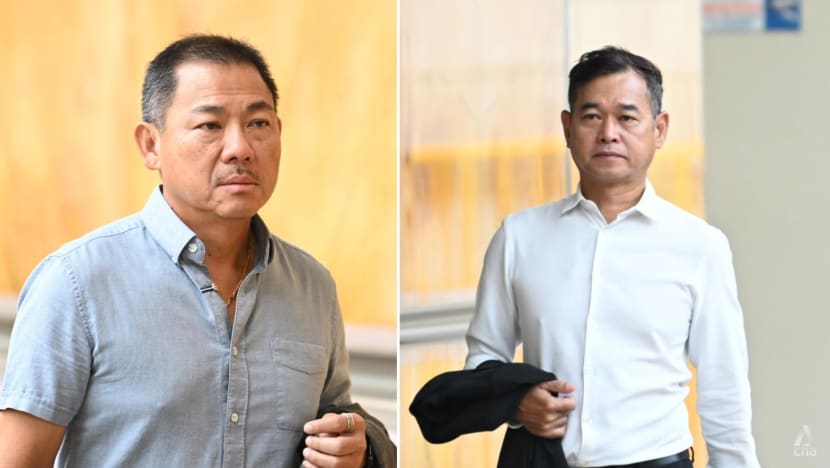
Pek Lian Guan (left) and Pay Teow Heng at the High Court on Jul 22, 2025. (Photos: CNA/Raydza Rahman)

This audio is generated by an AI tool.


SINGAPORE: The High Court set aside the acquittals of two men accused of bribing a Land Transport Authority (LTA) director after finding that the district judge who presided over their trial had failed to engage with the evidence and the prosecution’s case.
In a judgment issued on Monday (Mar 23), Chief Justice Sundaresh Menon found that District Judge Soh Tze Bian had reproduced large portions of the defence's submissions in his judgment and presented them as the reasons for his decision.
Considering the complexity of the trial, Chief Justice Menon did not order a retrial but instead ordered a fresh hearing of the merits of the cases in the form of appeals based on the records of the trial.
The case involves former director of Tiong Seng Contractors, Pay Teow Heng, 58, and former chief executive of listed company Tiong Seng Holdings, Pek Lian Guan, 60.
Pay was accused of giving S$350,000 (US$274,000) to former LTA deputy group director Henry Foo Yung Thye over two occasions in 2017 and 2018 to advance Tiong Seng's business interests with LTA, while Pek was accused of abetting Pay.
Both men were acquitted by Judge Soh in October 2024 following a trial in the State Courts.
But the prosecution appealed against the acquittal, arguing before Chief Justice Menon that Judge Soh had copied the two accused men's submissions to the extent that it appeared that the trial judge had unthinkingly adopted their arguments without considering the prosecution's case.
It urged Chief Justice Menon to consider the matter afresh.
Judge Soh retired last year. Chief Justice Menon noted in his judgment that the trial judge had been subject to similar complaints on at least two other recent incidents.
In September 2023, the lower court judge had been chided by Chief Justice Menon for his "unsatisfactory" judicial practice of lifting large chunks of the prosecution's submissions for his grounds of decision.

SIGNIFICANT DEGREE OF COPYING
Chief Justice Menon agreed with the prosecution that a reasonable suspicion arose given the extent and manner in which trial judge's decision had copied the defence's written submissions.
He said it was "indisputable" that significant sections of Judge Soh's grounds of decision were copied, even in reasoning, structure and stylistic choices.
He found that the judge appeared to have reproduced the submissions as his own analysis.
Chief Justice Menon set out such examples in his judgment where Judge Soh had even adopted the defence's adversarial expression.
"Such a tone and choice of expression, even if some might view it as excessively subjective, might not be remarkable in a party’s advocacy for its position," said Chief Justice Menon.
"But in a judicial decision, where findings are made and expressed, there is an expectation that the court will carefully weigh its choice of words, conscious of their adverse, even dire, effects."
Judge Soh had also suggested dishonesty on the part of the Corrupt Practices Investigation Bureau (CPIB) officers who had recorded Pay and Pek's statements, noted the Chief Justice.
"It is no small thing for a judge to make findings against the CPIB officers in the terms that the district judge did, which could not only have consequences on the officers themselves, but also occasion public disquiet against the CPIB," Chief Justice Menon said.
While the judge was entitled to make such a finding, this had to be justified upon examination of the relevant evidence and explanations. However, this was not done in the present case, said the chief justice.
Chief Justice Menon also found lapses in the judge's reasoning, in particular, his failure to consider the presumption of corruption.
The lower court judge did not mention or address this presumption. "In fact, he did not even state that he had found that the respondents had discharged their burden of proving that the loans were not made with a corrupt intent," said the chief justice.
Judge Soh had also failed to address objective evidence, and simply dismissed it in a single sentence at the end of his decision.
While a judge does not have to address every point put forth, he should generally explain why he chose to disregard it, said Chief Justice Menon.
In this case, Judge Soh did not explain why he chose not to address the objective evidence the prosecution had relied on.
He also found that Judge Soh had not properly considered both sides of the evidence, especially in cases of conflicting accounts.
For example, he failed to consider the CPIB officers’ evidence that the statement-recording process had been conducted properly, against the accused men's insinuations of the officers' dishonesty.
He added that Judge Soh displayed a "fundamental flaw" in his approach by narrowing the field of evidence relevant to the issue of Pay and Pek's state of mind.
He only took into account Foo's evidence and the WhatsApp messages between Pay and Foo, failing to deal with material aspects of the prosecution's case and evidence.
He accordingly set aside in full Judge Soh's decision.
HOW THE MATTER WILL PROCEED
On whether there should be a retrial, Chief Justice Menon considered the fact that the trial in the State Courts had spanned over 40 days across more than two years.
"A retrial of similar scope would subject the parties to a considerable amount of additional expenses and delay through no fault of their own, without any corresponding benefit," he said.
He stated that the appeals should instead be heard as a fresh hearing based on the records of the trial proceedings.
In his judgment, the chief justice also noted that while judicial copying did not invariably result in judgments being set aside, it is "almost always decried as a poor practice for judges to engage in".
He outlined three main reasons why such copying was problematic.
- It can make the losing party feel that they were not given a fair hearing
- It can damage public trust in the courts, as such behaviour may undermine confidence in the integrity of the judicial system
- It can create unnecessary work for appellate courts, which then have to spend additional time and resources to review the decision and its process.
"Each time a matter comes before the court, it is incumbent on each judge and judicial officer to conduct it in a manner that reaffirms the justification for that confidence. And when, occasionally, this standard is not met, it is incumbent on the appellate courts to call it out.
"These appeals, unfortunately, present such a case," Chief Justice Menon said.