







Highlights from PAP, Opposition rallies on last night of campaigning
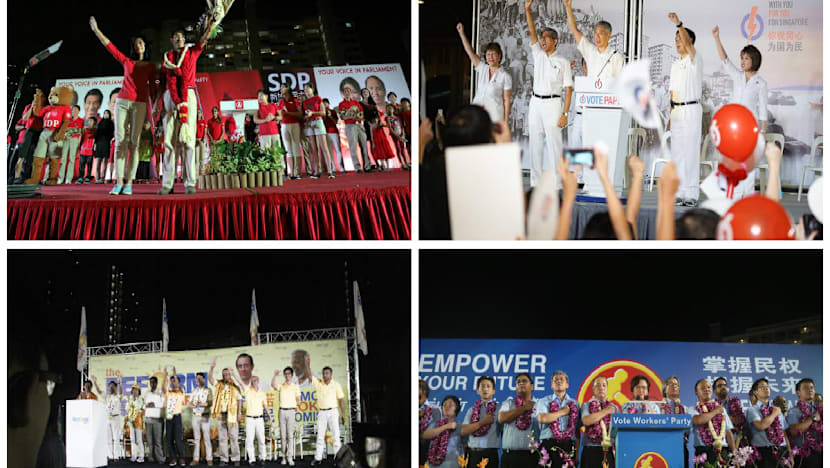
SINGAPORE — On the last night of campaigning, all political parties held rallies across Singapore. Here are the highlights of what was said:
PEOPLE’S ACTION PARTY
PM Lee Hsien Loong
Mr Lee said that the PAP has worked hard over the last 50 years to improve the lives of Singaporeans and has a solid report card. He cautioned Singaporeans that a wrong vote would weaken the Government and lead to a nightmare scenario for Singapore. While the PAP has a report card for past and future achievements which it is very proud of, the opposition parties do not, and seek to only find subjects to rile people, he said. He also said the party has been connecting directly with the people, and have tapped on their feedback and ideas.





Mr Lee said that statements delivered by Opposition politicians are often inconsistent. For instance, he said that Workers’ Party Secretary General Low Thia Kiang said during his rally that the Government’s economic policies were “inhumane”. But when the Budget was tabled in the Parliament, all Mr Low said was that he “welcomes the correction of the Budget”. “When it comes to election rallies, the tiger (WP) comes out.” Mr Lee also attacked the Opposition for claiming credit as an intermediary between the Government and the people, making false promises that they are needed in the Parliament to help convey the people’s concerns to the ruling party. Opposition parties who wish to be an alternative to the PAP, must take people and their jobs seriously, and must show that they are doing this for real, not for wayang, he added.
On Cooling-off Day, Mr Lee urged voters to examine what the parties have promised and to think about their plans, their track records and characters. He called on voters once again to vote for his team, which he said has always had the people’s interest at heart. His party, said Mr Lee, who is its secretary-general, is responsible and plans for the future, unlike the opposition parties that come up with exciting and empty slogans but with no concrete plans on how to go about their proposals or how to find resources for them.
DPM Tharman Shanmugaratnam
Over at the East Coast GRC, Mr Tharman spoke about how the PAP has changed and is no longer top-down, as it rebalances economic policies with active social policies to help Singaporeans across all ages. Economic policy has to go together with active social policies to help those who start with less, he said.
The Government has also changed to help “move people into the future”, said Mr Tharman. Strong leadership today means listening, actively engaging, changing your mind when the situation changes or when you get better ideas from others, continually updating, but leading all along the way, he said.
While he said that the Republic starts from a position of strength, Mr Shanmugaratnam acknowledged that there is still a journey ahead in achieving these shifts. He cited enhanced accessibility to preschool education, the progressive wage model and Workfare as examples of how Government and community action can help every Singaporean develop through life.
Debunking two myths about the Government squirreling away surpluses into reserves, Mr Tharman said today’s generation is already benefitting from surpluses in reserves and investment returns from GIC are also pumped back into the budget for spending. He stressed that this is about ensuring prudent budgeting and a fair system.
NATIONAL SOLIDARITY PARTY
The National Solidarity Party wrapped up its election campaign by reiterating its call for measures that the party says will better serve Singaporeans’ interests, such as free transport for the elderly and National Servicemen, cost-plus pricing for public housing, and free rein over how to use their Central Provident Fund monies, stressing that the Government has not taken care of Singaporeans, and urging voters to put the party in Parliament to speak for them.
Party acting secretary-general Lim Tean also said the Government is not taking care of Singaporeans. “If it was taking care of its own people, we would not be having the problems we are having with the retrenchment of our highly educated middle-class professionals,” he said. “It is their policies which are causing the Singaporean middle income professional who has lost his job frustration and stress….What are the safeguards the government has put in place to protect that Singaporeans’ jobs?”
He also claimed the party was is not xenophobic: “We are not saying we cannot have foreigners in our workplace, none of us would be that xenophobic to make that statement. But we are saying that if you really care for that Singaporean, you will see to it that he doesn’t lose his job, that is how you care for your people.”
PEOPLE’S POWER PARTY
People’s Power Party secretary-general Goh Meng Seng said the People’s Action Party government’s policies started with good intentions but things went awry after implementation because it wanted to milk the system. For instance, the Electronic Road Pricing system was a good way to tackle congestion in some areas, but it flopped because it was implemented in too many places. Home ownership was a good idea, but the runaway prices do not square with the original intent, he added.
REFORM PARTY
Reform Party (RP) secretary-general Kenneth Jeyaretnam hit back at criticisms about its election manifesto. Mr Jeyaretnam addressed Mr Iswaran’s comment that RP’s policies were too ad-hoc, saying that they have been around since 2009, with refined proposals in their 2011 election manifesto. The party also reiterated its message to civil servants not to be afraid to vote for the Opposition, with Ang Mo Kio GRC candidate Osman Sulaiman telling them not to fear being fired. Running mate Roy Ngerng added: “I know of many civil servants and people working in government-linked companies who tell me, thank you for your fight for CPF… Many civil servants are waiting for change, for a new government with the political will to protect Singaporeans.”
SINGAPORE DEMOCRATIC ALLIANCE
Singapore Democratic Alliance chief Desmond Lim said the time to act against the People’s Action Party’s population policies is now. Focusing on the Population White Paper, he questioned if Singapore’s leaders would remain born and bred Singaporeans years down the road. Turning to local issues, Mr Harminder Pal Singh sought to assure voters that the SDA team would be ready to take over the running of the town council if they are elected, given that a shadow town council has been in place for more than a year.
SINGAPORE DEMOCRATIC PARTY
The Singapore Democratic Party (SDP) took the stage tonight to assure voters of a smooth transition should the party’s candidates win seats in Parliament, with SDP vice-chairman John Tan saying the party already has made plans for the handover of town council matters, and that its candidates will run town councils themselves instead of handing operations to a managing agent. “Even as I speak right now we are preparing our part in the transition process already. This Friday I need you to signal to the current Town Council to prepare theirs,” he said. “We’ll hire qualified certified public accountant, for example, to ensure previous council diligently hands over past years’ audited financial statements, management accounts and budget. We’ll also ensure all assets, liabilities, income, expenditures, bank accounts and so forth are detailed.”
Professor Paul Tambyah said the current state affairs showed that more alternative voices are needed in Parliament, pointing out to the audience that Singaporeans are stilled burdened by problems like a stressful education system, high cost of healthcare, and an over-burdened transport system.
SDP chief Chee Soon Juan rounded off the party’s final rally of the election by thanking his volunteers and candidates, saying he has been exhilarated by his return to standing in elections, and that despite there having been more downs than ups, he always knew the rewards would be there, in one form or another. “With everything you’ve seen in the past week….Do you think I can stand toe to toe with the PAP and take them on intellectually? Do you think I can ask the tough questions and show the ministers up, if they give nonsensical answers?” he asked the crowd.
SINGAPORE PEOPLE’S PARTY
Borrowing the People’s Action Party’s line that this election is about the future, Mr Benjamin Pwee argued that voters need to decide on what they want to see going forward by looking at the recent past. The problems that Singaporeans are facing now is because of policy missteps in the past five to 10 years, he added, citing the examples of transport woes. Mr Pwee also reiterated his point that MPs should fight for residents instead of asking them to be understanding when they cannot fulfil requests.
SINGAPOREANS FIRST
SingFirst chief Tan Jee Say said the current batch of PAP leaders have betrayed the ideals that founding Prime Minister Lee Kuan Yew had for the country and Singaporeans should not be afraid of voting for the Opposition. Mr Tan said that Mr Lee, who died in March, had warned of having too many foreign workers but the Government of today is too liberal in letting in many of them. The people’s trust in the Government – another value Mr Lee stood for – has also declined under the current PAP leadership. The principle of meritocracy, which Mr Lee believed in, has also weakened as “politically-connected businesses are most likely to prosper”, Mr Tan said as he referred to The Economist’s Global Cronyism Index.
Castigating Prime Minister Lee Hsien Loong’s track record since taking office in 2004, Mr Tan said Singapore saw its first riots in 40 years, first labour strike in 26 years, various train breakdowns and frequent floods under Mr Lee’s watch. Even if the PAP is out of power, an effective civil service will keep the country going, he said, adding that Town Council management will not be an issue as the opposition has more than 20 years of such experience in Potong Pasir and Hougang.
“Singaporeans should not be afraid, the civil service continues even after politicians have left the scene... Just take my personal example, I had worked for several PAP ministers but I have not been convinced to vote for anyone of them, I have never voted for PAP even though I was working for these PAP ministers,” he said, adding that despite the differences in believes, his career advancement was not compromised.
WORKERS’ PARTY
Over at the Workers’ Party rally, WP chief Low Thia Khiang said the journey towards a more balanced Parliament has just begun and it is crucial to Singapore’s development over the next 50 years that voters send more Opposition members into Parliament. He also traced his own political journey to highlight his efforts to build up the party into what it is today and urged voters to give his candidates a chance to further entrench the Opposition in Parliament. Mr Low introduced all the WP candidates taking part in the elections, apart from the incumbent MPs seeking re-election. But he took more time to introduce the East Coast and Fengshan candidates, listing their credentials and achievements. WP East Coast GRC team leader Gerald Giam declared that East Coast and Fengshan were “at the frontline” of a historic election, at a time when Singapore is at a “tipping point” in terms of its political development.
Party chairman Sylvia Lim also pressed PAP Punggol East candidate Charles Chong to explain his statement in a LianHe Wanbao interview where he said that Punggol East Town Council has a S$1million surplus when it was handed over to the WP. Mr Chong has since issued a press release to state that the S$1 million surplus which he mentioned referred to the surplus for Pasir Ris-Punggol Town Council.
WP candidates for East Coast GRC also said during the final rally of the hustings that the ruling party is no longer the same as before. Mr Leon Perera cited how the ruling party went ahead with policies such as underinvesting in flats, trains and buses after winning 75 per cent of the votes in the 2001 General Election (GE).




