Proposal to group smaller HDB blocks for Home Improvement Programme voting being studied as part of review
"One option we are studying is to group the blocks with fewer units to vote together as one cluster, so that there are sufficient number of households taking part in the voting process," says National Development Minister Chee Hong Tat.

This audio is generated by an AI tool.
SINGAPORE: The Ministry of National Development (MND) is studying an option to group Housing and Development Board (HDB) blocks that have fewer units together to vote as one cluster in Home Improvement Programme (HIP) votes, so that there are enough households taking part in the polls.
In a written parliamentary answer on Wednesday (Jan 14), National Development Minister Chee Hong Tat noted that under the current voting process, blocks with fewer eligible units might be at greater risk of not reaching the 75 per cent threshold in order to proceed with the HIP.
"One option we are studying is to group the blocks with fewer units to vote together as one cluster, so that there are sufficient number of households taking part in the voting process," he said.
The minister added that MND will review the HIP voting process to strike a balance between supporting older estates and respecting flat owners' decisions.





For HIP works to proceed at a block, at least 75 per cent of its eligible Singapore citizen households must vote in favour of the programme, and every vote counts.
Mr Chee was responding to parliamentary questions on the HIP that were filed by MPs Hazlina Abdul Halim (PAP-East Coast) and Ang Wei Neng (PAP-West Coast-Jurong West).
Ms Hazlina had asked if the voting framework would be reviewed after two HDB blocks in Tiong Bahru narrowly missed the voting threshold last November, while Mr Ang wanted to know how many HDB blocks in the past 10 years had failed to hit the 75 per cent threshold.
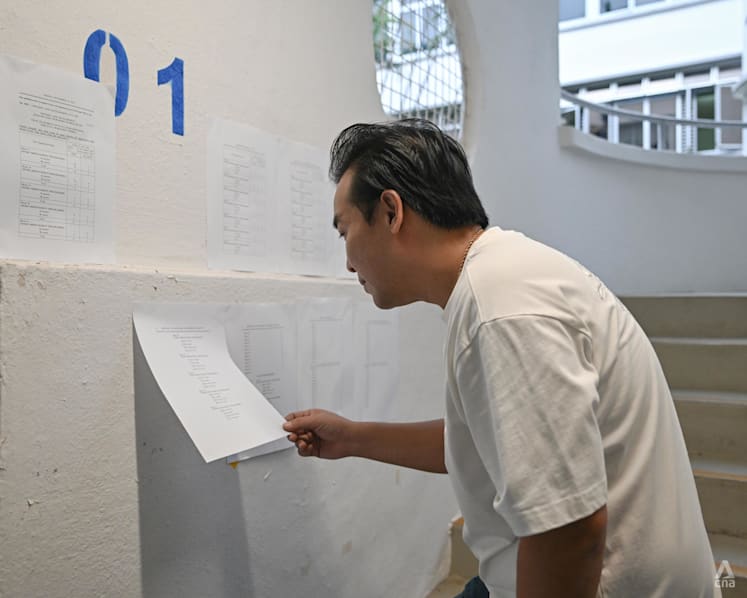
Two out of 29 blocks in Tiong Bahru's Seng Poh estate did not meet the threshold, with one block falling short by two votes and the other by just one.
Mr Chee said on Jan 8, in reference to the Tiong Bahru exercise, that MND and HDB would consult stakeholders on how best to manage the process.
"We need to strike a balance - to determine the best way to design the voting process so that we can achieve a good outcome," he added.
The minister on Wednesday noted that in the past 10 years, six HDB blocks had failed to garner more than 75 per cent of votes from eligible Singapore citizen households to go ahead with the HIP.
Among them were the two blocks in Tiong Bahru, as well as one block at Serangoon Avenue 2 in 2017 and three blocks at Lengkong Tiga in 2023.
"For the four blocks at Serangoon and Lengkong Tiga, HDB received appeals from the flat owners and advisers for a re-poll. After careful review, HDB allowed these blocks to re-poll after about one year from the first poll. All four blocks re-polled successfully for the HIP," said Mr Chee.
What is HIP and why is there a 75 per cent threshold?
The Home Improvement Programme (HIP) helps flat owners to "proactively address common maintenance issues" and provide improvements to enhance the living conditions of older flats, according to HDB.
There are two main components of work under the HIP.
Essential Improvements: These ensure that the basic structural and safety needs of older flats are met, and are fully funded by the government for Singapore citizen households. They include upgrades in common areas and to electrical systems, for example.
Optional Improvements: These are heavily subsidised by the government, with Singapore citizen households paying as little as 5 per cent of the cost, depending on the flat type. Flat owners have the flexibility to choose the Optional Improvement items they would like to include during the upgrading process.
HDB said the threshold is necessary because most essential improvement works - such as replacing waste pipes - take place within flats and affect multiple households.
A straw poll is conducted before HIP polling to gauge initial support.
"If the results of the straw poll show sufficient support from the flat owners, we will then proceed with the official HIP polling," HDB said.
The agency encourages residents to opt in, noting that HIP “enhances the safety and liveability of older homes.
On its part, HDB is also helping home owners understand what HIP entails.
Ahead of polling, HDB provides all benefitting flat owners with an information package comprising a guidebook, answers to frequently asked questions, and a proxy form for those who are unable to vote in person, among other things.
During the polling period, an exhibition and a mock-up unit are set up for residents to view the HIP improvement items, such as the main door grille gate designs and the upgraded toilet.