







Islamic teachers must be accredited from January 2017
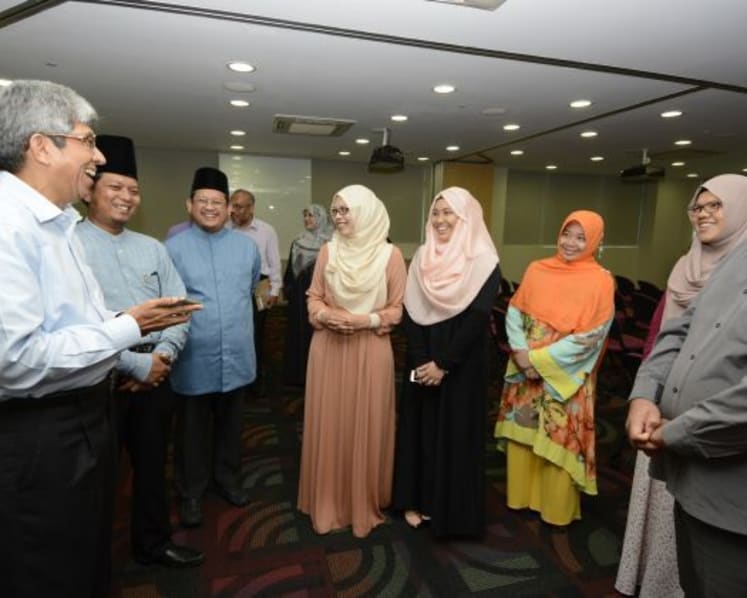
Dr Yaacob Ibrahim, Minister for Communications and Information, engaging with religious teachers at the AAEDP dialogue session on March 31, 2016. Photo: MUIS




SINGAPORE — The Government plans to make the accreditation scheme for Islamic religious teachers compulsory from Jan 1 next year, with a transition period of around one year, Minister-in-charge of Muslim Affairs Yaacob Ibrahim said on Sunday (Aug 21).
The hope is that every religious teacher (or asatizah) here will be part of the Asatizah Recognition Scheme (ARS), said Dr Yaacob. He added that the Islamic Religious Council of Singapore (Muis) will work with the various providers within the madrasah system or mosques to see what courses can be run to help those who do not have the necessary qualifications to meet the criteria.
Currently, 20 per cent of asatizah are not under ARS, including some asatizah who may have started teaching classes 20 to 30 years ago and do not meet the academic qualifications criteria.
“We want to be as flexible and as inclusive as possible. At the end of the day ... I want to be able to work with every asatizah so that they can have an opportunity to be registered and to be part of the ARS,” said Dr Yaacob on the sidelines of the National Day Rally on Sunday.





The ARS, which has been around for a decade, recognises teachers and scholars who meet the minimum standards of qualification to preach and teach Islamic religious knowledge, and is run by the Singapore Islamic Scholars & Religious Teachers Association (Pergas).
Those educated abroad must attend a professional development course before they get registered to ensure that they understand contemporary issues in the local context.
Plans to make the ARS compulsory were floated by Dr Yaacob earlier this month, and several Malay-Muslim leaders have voiced support for the move to ensure religious teachings are not divisive and will not seed extremist ideologies.
Mufti Dr Mohamed Fatris Bakaram noted that it is timely to enhance the system given the rising interest in religion here and “the issues that we’re facing globally and locally”.
He added: “There must not be any gap where people who are not qualified (can) take advantage of the system, claiming that it’s just a voluntary initiative.
“But I think it’s best for the society at large, and for Muslims especially, for them to only be guided in their faith by those who are properly guided, who are well-trained.”
In his speech, Prime Minister Lee Hsien Loong also backed the move, noting that foreign preachers who do not understand Singapore’s multiracial context could cause the country serious problems.
He noted that the same religion is practised in different ways in different societies, and those who preach exclusivist and intolerant practices and doctrines cannot be allowed in Singapore or it would threaten religious harmony here.
“If religious groups ... take an exclusivist approach, and discourage interaction (and) contact with others, we will deepen our fault lines ... It would be a very different, a very troubled Singapore,” said Mr Lee.
In fact, some religious leaders have sounded the alarm to the authorities about foreign preachers who bring with them exclusivist and intolerant teachings, he added.
In his Malay speech, Mr Lee said: “They preach separation between believers and non-believers. They condemn those who practise other faiths, and sometimes even those who practise the same faith, but in different ways. They advocate practices and customs that would cause grave harm in Singapore.”
Mr Lee also lauded local religious and community leaders for their “courageous” stands in refuting extremist views. “They lead by example, they guide their flocks, their communities to stand together. They also understand that ours is a multiracial society; there has to be give and take ... We have to respect one another’s religions. We cannot treat other groups as infidels,” he said.
Stressing that it was “fundamental” that all religions in Singapore practise their faiths in its multiracial and multireligious context, Mr Lee noted that it is “only in Singapore” where individuals of various faiths celebrate festivals with one another.
He cited his experience at Al Islah Mosque during Ramadan, when non-Muslim residents joined Muslims in breaking fast and learning more about Islam.




