







Justice behind closed doors is no justice at all: British judge
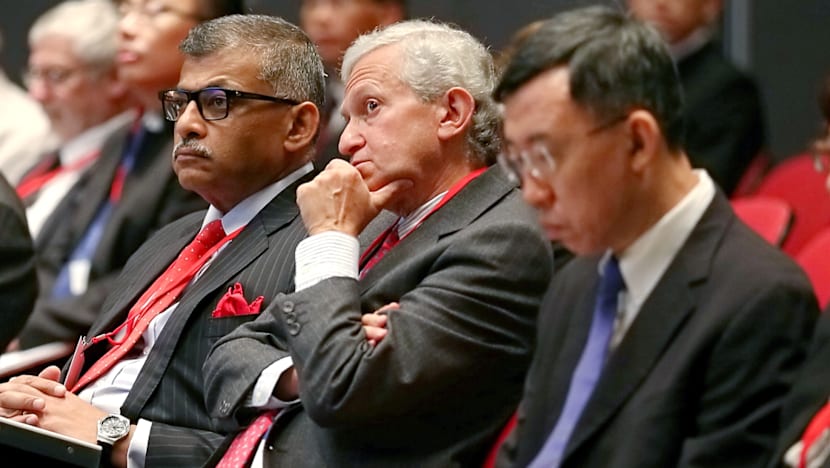
(Centre) Sir Geoffrey Vos, Chancellor of the High Court of England and Wales, seen sitting beside Chief Justice Sundaresh Menon during the opening of the Sentencing Conference 2017 - Review, Rehabilitation, Reintegration, at the Supreme Court on Thursday (Oct 26). Photo: Nuria Ling/TODAY


SINGAPORE — Court hearings should almost always be open to the public to promote confidence in judges and the impartiality of the judicial process, said a veteran British judge at the Sentencing Conference held at the Supreme Court on Thursday (Oct 26).
“Justice taking place behind closed doors is no justice at all because it is not subject to any appropriate public scrutiny,” said Sir Geoffrey Vos, a Chancellor of the High Court of England and Wales.
Judges should ensure cases are decided in public in an open and transparent manner, and reasons for their decisions should be published in full and made widely available, he said in a lecture titled “Perspectives on Open Justice: Anonymity and Confidentiality”.
Amid a growing number of exceptions made in various jurisdictions — for cases that concern national security or involve children, for instance — Judge Vos stressed the decision to hold a private hearing should be “applied restrictively”.





Societies have generally accepted that family court cases be held in private, for instance. “Of course, where children are concerned, that’s appropriate. But in many cases, privacy in family proceedings is neither necessary nor appropriate,” he said.
As with any other judicial process, adoption applications or care proceedings in family justice cases need to be scrutinised by the public, he said.
In the age of the Internet and social media, however, the courts may receive more requests to protect the anonymity of parties.
A case Judge Vos heard in the United Kingdom last year involved two brothers who beat and tortured another pair of younger boys. He granted the brothers’ applications to keep their identities anonymous for the rest of their lives after taking into account comments on the Internet, as he felt they risked being physically harmed if their identities were revealed.
“The new situation created by widely available, ever present public comments on the Internet is likely to require careful consideration by the courts in future cases,” he said.




