







Some preschoolers, more primary school students to receive personalised health plans
Preschoolers in Kindergarten 1 and Kindergarten 2, as well as Primary 4 and Primary 5 students, will soon receive the health plans as part of an expanded initiative to encourage healthy habits in children.
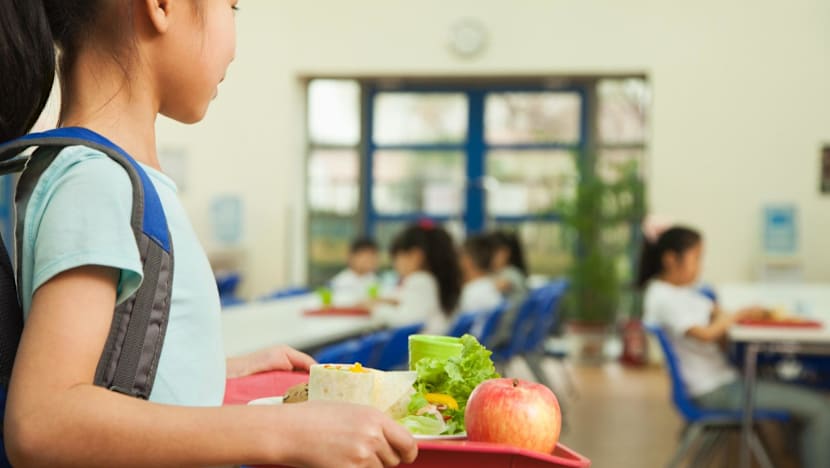
A student holding a tray with food. (Photo: iStock)

This audio is generated by an AI tool.


SINGAPORE: Some preschoolers and more primary school students will receive personalised health plans as part of an expanded initiative to encourage healthy habits in children.
Launched last year, the Health Plan initiative was first rolled out to Primary 1 to Primary 3 students.
Under the initiative, students receive personalised health plans that include lifestyle change recommendations, school health screening results, vaccination reports and referrals to public healthcare institutions when needed.
The initiative will now be expanded to all Kindergarten 1, Kindergarten 2, Primary 4 and Primary 5 students from January, said the Ministry of Health (MOH), the Ministry of Education (MOE) and the Ministry of Social and Family Development (MSF) on Wednesday (Jan 21).





"Primary 6 students will continue to be supported through the school curriculum, enabling them to learn about lifestyle choices to sustain healthy habits," they added in a factsheet about the expansion.
.jpg?itok=kiUEGJo1)
ROLL-OUT IN PRESCHOOLS
About 1,800 preschools are expected to have the initiative implemented by the end of this year, said the ministries.
It was piloted in six preschools in July 2025, reaching approximately 840 students.
“Parents and preschool operators gave positive feedback, validating the approach and supporting a nationwide rollout to all K1 and K2 children,” said the ministries.
“The preschool years are a critical period as preferences and habits are formed during this period, and become the foundation for lifelong health,” they said.
“Research, including findings from the Growing Up in Singapore Towards healthy Outcomes study, shows that healthy behaviours are best cultivated early.”
The initiative will be rolled out in preschools in phases from January.
The students’ personalised health plans will be aligned to their interests and habits based on insights from the annual school health screening conducted in preschools, said the ministries.
A lifestyle questionnaire completed by parents at the start of the year will also be used for the plans’ creation.
“To support learning at home, parents will be given activity sheets to engage their children and reinforce healthy habits at home,” said MOH, MOE and MSF.
“Preschools will also receive a toolkit with resources to promote healthy habits within the school environment.”

EXPANSION IN PRIMARY SCHOOLS
The initiative’s expansion to Primary 4 and Primary 5 students, which was announced during the MOH Committee of Supply debate last year, will also take place from January as part of health screening in schools.
About 80,000 Primary 4 and Primary 5 students will benefit from the initiative this year, said MOH, MOE and MSF.
“This will build on the efforts in helping students adopt healthy behaviours as they progress through the years,” they said.
From 2027, schools will also use the health plans Primary 6 students received in their earlier schooling years, as well as additional resources for educators, to facilitate discussion with them on their lifestyle choices to sustain healthy habits.
This will complement current practices of reiterating health messages through the school curriculum, including during physical education and character and citizenship education classes, said the ministries.
Launched in January 2025 as part of the Grow Well SG national health promotion strategy, the Health Plan initiative saw about 114,000 primary school students receive health plans last year.
The plans provided focus on four key areas: being active, eating healthy, limiting screen use and getting enough sleep.




