







Khaw raises bar for rail reliability, sets new target
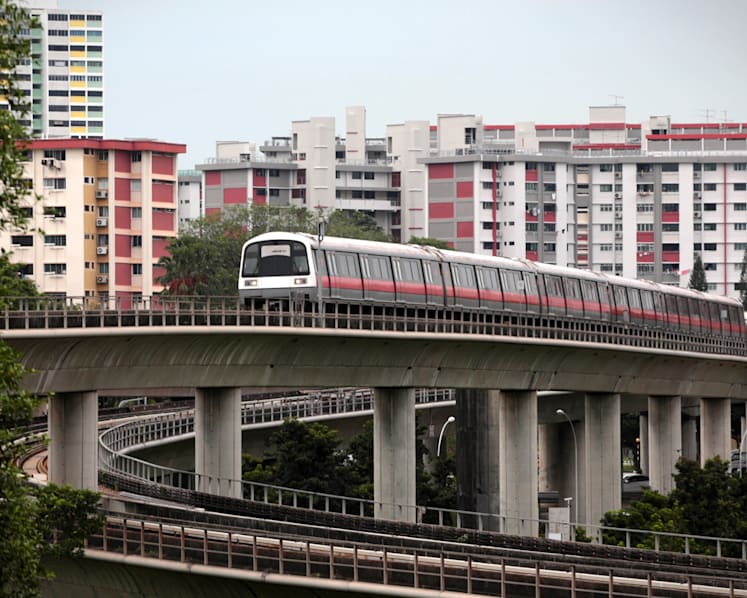
Last year, the Government had set the goal of 800,000 train-km by the end of this decade. TODAY file photo


SINGAPORE — Rail operators have loftier rail reliability standards to live up to by 2020, with Transport Minister Khaw Boon Wan on Thursday (July 27) setting a new target to improve rail reliability by seven times compared with 2015.
Last year, the Government had set the goal of 800,000 train-km by the end of this decade.
The bar has been raised to one million train-km, measured as mean kilometres between failure (MKBF), or the average distance the trains can travel before hitting delays of more than five minutes.
The new target, which transport analysts said would be a rare feat achieved by metro networks around the world, comes on the back of an improvement in the reliability of Singapore’s MRT network, based on the Government’s preliminary data: Overall train frequency between delays of more than five minutes has risen nearly three times from 133,000km in 2015 to almost 400,000km as of the first half of this year.





However, the data does not take into account the delays due to the testing of the new signalling system on the North-South Line (NSL), said Mr Khaw, who was speaking at the Fourth Joint Forum on Infrastructure Maintenance.
“The purpose of the MKBF is to measure and track the performance of our maintenance from year to year, and also in relation to other metros’ MKBF,” a Ministry of Transport spokesperson said in response to
TODAY’s queries.
“The re-signalling project and its associated delays are a one-in-30-year event. Hence, it is excluded from the MKBF computation.”
The spokesperson added that including the faults caused by errors in communications-based train control would have made the MKBF data “non-comparable, and would be the wrong approach”.
On the new MKBF target, Mr Khaw pointed out that the previous goal was benchmarked against the Taipei Metro’s performance of clocking 800,000 train-km. But it has since “upped the game” to achieve 1 million train-km last year, he said.
Operators and the Land Transport Authority (LTA) should work towards this “best-in-class performance”, he added.
The preliminary data on Singapore’s rail network also showed that the number of major delays exceeding 30 minutes – another indicator used to measure rail reliability apart from the MKBF – has also gone down from 10 in the first half of 2016 to three over the same period this year.
Since taking over the transport portfolio in October 2015, Mr Khaw has been setting targets for rail reliability. Last year’s figure of 174,000 train-km fell short of the 200,000 train-km target which he had set.
The goal for next year is to reach the 400,000 train-km mark, he said. Although the rail network’s recent performance in terms of reliability was “satisfactory”, Mr Khaw said: “This is not yet the steady state we are hoping for, but versus what we had inherited two years ago, I think this is maybe C+. Next year we should go for B. The following year, certainly before election, must be an A.” Mr Khaw was referring to the next General Election, which must be held by January 2021.
Since last year, Mr Khaw has cited Taipei Metro as another role model that Singapore should emulate when it comes to rail reliability standards. In 2015, he used Hong Kong’s Mass Transit Railway as the benchmark.
Run by Taipei Rapid Transit Corporation, Taipei Metro started operations in 1996. Its five main lines support a daily ridership of over 2 million. Singapore’s MRT network has five main lines, and a daily ridership of 3.1 million as of last year.
Touching on the re-signalling project on the NSL, Mr Khaw urged commuters to be patient as train delays were bound to happen as teething problems surface as part of the testing of the new signalling system.
“Overall, the experience has actually been less traumatic than what we had feared,” he said. He noted that the major disruption on June 28 was due to a mistake made by the engineering team from Thales, which is the supplier of the new system. An incompatible radio was connected to the system, which caused a sudden congestion on the network, resulting in all trains on the NSL and Tuas West Extension line to lose radio communications. As result, there were train delays for more than two hours. “Such an error will not happen again,” said Mr Khaw.
He was confident that the new signalling system on the NSL should stabilise before the end of the year. “if there are no surprises”. Once this happens, more new trains will be added on the NSL progressively during the peak periods.
Speaking to TODAY, several commuters, who have been affected by recent delays including those due to the testing of the new signalling system, said they do not feel that reliability has improved.
Still, transport analysts were optimistic that the target of 1 million train-km was achievable, given that some of the lines have exceeded the 500,000 train-km mark. The North-East Line, for example, clocked 978,000 train-km in the first half of this year.
Dr Park Byung Joon from the Singapore University of Social Sciences noted that the Government and train operators have invested a lot of resources in upgrading the rail infrastructure. “There will naturally be an improvement in performance,” he said.
On how the statistical improvements did not seem to be borne out in commuters’ experience, Dr Park suggested that apart from having targets for the MKBF, goals should also be set for the number of delays exceeding 30 minutes. This indicator, he added, should be further split into different categories such as the number of delays exceeding 10 and 15 minutes.
Nevertheless, Professor Lee Der-Horng from the National University of Singapore pointed out that the MKBF is a “more objective index” adopted by operators around the world. “MKBF is the overall measurement of the performance for a particular line but commuter’s experience is usually partial and may only reflect a slice (or slices) of one line or multiple lines,” he said.




