







Landmark decision behind slashing of former CHC leaders’ jail terms
TODAY file photo


SINGAPORE — In a landmark split ruling, two of the three judges who presided over the appeal by the former City Harvest Church (CHC) leaders arrived at a different reading of the law on criminal breach of trust (CBT) when it comes to offenders holding appointments in a company or an organisation, departing from the prevailing interpretation which has been in place for some four decades.
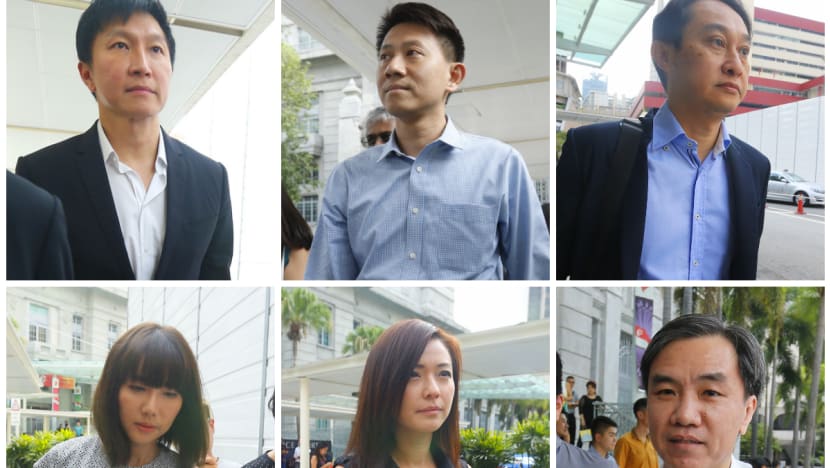
Church founder Kong Hee, his former second-in-command Tan Ye Peng, former church board member John Lam, former church investment manager Chew Eng Han, and former church finance managers Serina Wee and Sharon Tan were initially convicted of an aggravated CBT charge under Section 409 which covers CBT “by public servant, or by banker, merchant, or agent”, and draws a heavier maximum punishment.
They were found guilty on Friday (April 7) of a CBT simpliciter - or the charge in a simple degree - under Section 406 of the Penal Code, and their sentences were significantly reduced.
In the written judgement, Judge of Appeal Chao Hick Tin and Justice Woo Bih Li found that the interpretation that Section 409 “refers to professional agents rather than casual agents is borne out by the language of the section”.





“This expression, in itself, reflects that the agent contemplated by the section is a person who is carrying on a business as an agent. It could not conceivably encompass a person who has been appointed the treasurer of a society and by virtue of that appointment is holding onto the funds of the society,” the judges said.
Until now, the existing position in Singapore has been based on a High Court decision in a case involving Tay Choo Wah and the Public Prosecutor, which was heard between 1974 and 1976. The ruling then found that directors who misappropriate the property of a company or organisation they are entrusted with are liable for a more serious offence under Section 409 of the Penal Code.
To fulfil this section of the law, the judges noted that the accused must be “in the business of an agent”. This, they said, must refer to a professional agent, one who claims to offer his agency services to the community at large and from which he makes his living.
The judges pointed out that the former CHC leaders were not liable under Section 409 as they were not considered professional agents even though some were directors or members of the CHC management board.
Stressing that their findings were not bounded by the High Court decision on the Tay Choo Wah case, the judges said that the court was also not persuaded that the precedent case should be followed simply because it has been applied in rulings here for the past 40 years. “If an interpretation of a statutory provision is erroneous, especially where the provision imposes criminal liability, it must be corrected notwithstanding how entrenched it may have become,” the judges said.
However, Justice Chan Seng Onn held a different view: When directors are entrusted with the property, it is done so in accordance with their role and office. He said that he did not see how a director’s dealings with the entrusted property could be considered a “casual role”, as opposed to a professional agent.
Thus, directors of a company or an organisation fall within the class of persons under Section 409 and should be liable for a more aggravated CBT offence.
For the former CHC leaders who were entrusted with the control of the church’s property due to the positions they hold, they would be liable under Section 409, Justice Chan said.
The judge also held a different view from Justice Chao and Justice Woo on the mitigating factors considered by the court. Unlike what the other two judges had found – that there was no personal gain on the leaders’ part – he said the impugned transactions in question involved “elements of benefit” to Kong and his wife, Ho Yeow Sun.
Justice Chan said it was clear that Ms Ho had obtained a direct financial benefit when the misappropriated funds were used to fund her music career. She was also contractually entitled to a substantial financial benefit when she signed an artiste management agreement with Xtron. Likewise, Kong would have benefitted indirectly through Ms Ho’s income and when his family did not have to fund her music career, he added.




