







Laptops, phones, cars that never overheat? That could be a reality with this new discovery
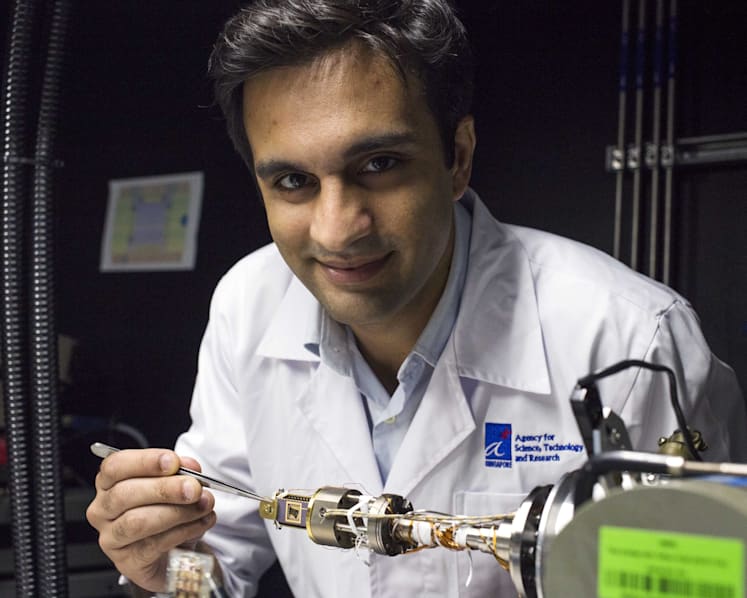
Dr Kedar Hippalgaonkar pointing at a sample in his cryostat, which is an experimental set-up where electrical and optical measurements are done at high vacuum, and down to -260 degree Celsius. Photo: Wong Pei Ting


SINGAPORE — A Singaporean scientist is part of a new discovery that could herald a future of motor vehicles or electronic devices that would never heat up with use. Just imagine: laptops, phones and cars that stay cool forever, regardless how long they have been switched on.
The Republic’s Agency for Science, Technology and Research (A*Star) said on Tuesday (March 21) that their scientist, Dr Kedar Hippalgaonkar, and his co-inventors have found a metal called vanadium dioxide that can conduct electricity without conducting heat.
This property makes it the first material in the world to defy a 164-year-old law of physics – the Wiedemann-Franz law – as its electrons conduct heat 10 times less than what’s expected.
The law states that good conductors of electricity are also good conductors of heat, but vanadium dioxide – an orange compound that turns yellowish-green at a higher temperature – proves an exception: Electrons in a nanobeam of the material move “in unison like a liquid” instead of moving as individual particles as they do in other metals like copper or iron at 67 degrees Celsius, the study found.





This would theoretically mean that any device the metal coats will never go beyond the cap temperature of 67 degrees Celsius.
This useful attribute of the metal can be tuned by adding impurities like tungsten to improve the temperature control property to “room temperature and lower”, said Dr Hippalgaonkar, who spoke to TODAY on Wednesday. He has been studying the material since 2013 in a collaboration with scientists representing institutions in South Korea, China, Saudi Arabia and the US.
With the metal acting like a “natural thermal switch”, the overheating problem in batteries and electronic device may become a thing of the past, the 32-year-old scientist of A*Star’s Institute of Materials Research and Engineering said.
The findings were published in the Jan 27 issue of scientific journal Science.
Vanadium dioxide is a non-toxic and abundant metal and in this study is “100 times thinner than a strand of hair”, said Dr Hippalgaonkar. With further tuning, it could replace bismuth telluride, a rare metal found in China that is “at least 10 to 100 times more expensive”, in applications like thermoelectric devices that can convert waste heat into power, he noted.
Now that the exception to the Wiedemann-Franz law is discovered, Dr Hippalgaonkar will proceed to discover more metals with the same property where electrons flow like liquid.
“We are searching for other materials that are larger in size – not just nanostructures – where we can have a larger range of temperature control. Those might be closer to real-world applications,” he said.




