







Lawyers, MPs urge mandatory jail sentences for drink-driving
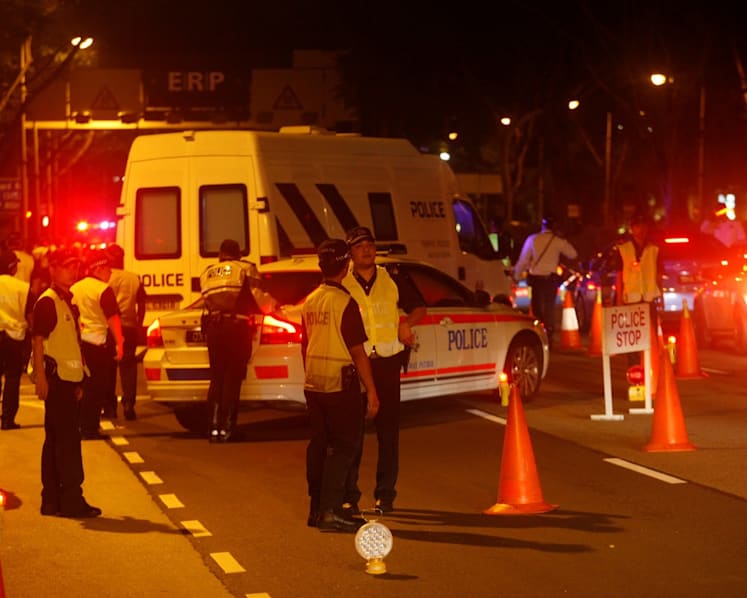
Traffic Police enforcement operations against drink driving on Dec 3, 2015. Photo: Singapore Police Force


SINGAPORE — Making jail a mandatory punishment, impounding the vehicles of offenders and holding passengers partially responsible are some possible ways to clamp down on the drink-driving problem, said lawyers and Members of Parliament (MPs).
They were commenting on the announcement last week that the Government is looking at stiffening penalties for tipsy drivers who get behind the wheel and end up killing or hurting people — for the first time since the laws were changed in 1996.
Currently, the maximum penalty for drink-driving over the legal limit of 0.8mg/ml (80mg of alcohol for 100ml of blood) is a S$5,000 fine or six months’ jail on a first conviction, and 12 months’ jail on a subsequent conviction. Those convicted will also be banned from driving for at least 12 months. The legal limit here is comparable to Canada, the United Kingdom and the United States, while countries like Australia and Hong Kong have stricter limits (0.5mg/ml).
Some lawyers and MPs suggested mandating jail for convicted drink drivers, even if they are first-time offenders. The custodial terms can range from two to four weeks in cases where there is minimal damage to public property, and up to five years where errant driving has led to injury or death, they said.





“If we change the current fines and driving bans to a custodial term, it will be far more deterrent. People don’t think much when they are disqualified for a while,” said lawyer Amolat Singh.
Mr Eugene Thuraisingam, who agreed with sending drink drivers to jail if they cause injury or death, added: “There can be no excuse for doing something inherently dangerous and prohibited which results in the maiming or killing of another.”
Another idea is to penalise passengers of drivers who are drunk, said Mr Josephus Tan. In Japan, for instance, passengers and those who serve alcohol to drivers could suffer the same consequences as a drink-driving offender, he noted. Impounding the vehicle is another possibility, said Mr Tan, noting that there are already laws to forfeit property used in committing crimes such as drug trafficking.
But many felt that increasing punishments alone would not weed out the problem. Softer measures such as tie-ups with eateries and ride-hailing platforms could work better, they felt.
Mr Sunil Sudheesan, president of the Association of Criminal Lawyers of Singapore, suggested making patrons surrender their car keys when they drink and take a breathalyser test before they can retrieve their keys.
MP Desmond Choo (Tampines GRC), a member of the Home Affairs Government Parliamentary Committee (GPC), urged the Government to explore working with Grab and Uber to make drive-home services cheaper and more convenient.
Criminal lawyer Ramesh Tiwary said: “Merely making sentences stiffer is not the solution. After all, people continue to bring huge amounts of drugs into Singapore even though sentences are so harsh. I believe greater education and awareness are necessary.”
While he supports a tougher enforcement regime, Nee Soon MP Louis Ng, also a member of the Home Affairs GPC, said: “I hope we don’t always rely on laws and penalties to shape our behaviours and morals ... I hope all of us can realise that innocent lives may be lost as a result of such behaviours.”
Drink-driving arrests and accidents have been trending downwards in the past few years, although the number of fatalities has kept steady. From January to September this year, the number of arrests stood at 1,540, a 13 per cent dip compared with the same period last year. There were 103 accidents involving drink drivers, resulting in three fatalities and 153 injuries.
A 23-year-old driver who wanted to be known only as Daryl said there is little that will entirely deter him from driving after drinks. He added: “I don’t think there is anything that will make me completely stop. If I feel I can drive, I will drive. If I’m too drunk, I will call a valet. I think I know my own limits.” KELLY NG




