







Legal experts divided on how to spell out sub judice boundaries
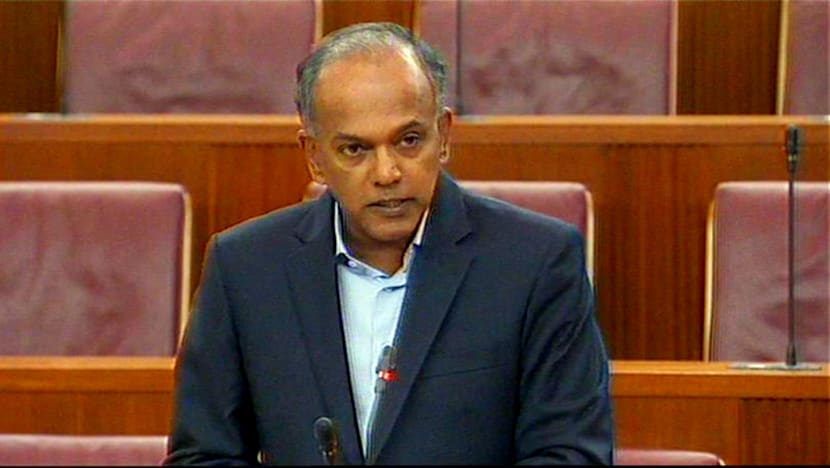
Law and Home Affairs Minister K Shanmugam had said the authorities will relook laws to see how legitimate discussions on general principles and approaches prior to a hearing can be done with care. Photo: Channel NewsAsia


SINGAPORE — With increasing public discussion on social media about news, there is a greater risk for sub judice to be committed and it is timely to study how to make sure the public does not fall foul of the law, said lawyers.
However, they were divided on whether there is a need for legislative tweaks to spell out the boundaries of sub judice or if publishing a set of guidelines for members of the public would suffice.
The lawyers were responding to Law and Home Affairs Minister K Shanmugam’s ministerial statement in Parliament on Tuesday on the Benjamin Lim case, where he said allegations had been spread by some parties — including socio-political website The Online Citizen — to blemish the police. Benjamin, 14, had fallen to his death at his block on Jan 26 after he was taken in for police questioning on an alleged offence.
The minister had also said the authorities will relook laws to see how legitimate discussions on general principles and approaches prior to a hearing can be done with care.





Sub judice refers to public discussions of a case under judicial consideration that may affect or prejudice the outcome of the legal proceedings. The principle falls within contempt of court under common law here, as opposed to being written into the statutes. The United Kingdom, in contrast, enacted a Contempt of Court Act in 1981 that statutorily defined what constitutes an offence.
Commenting on Mr Shanmugam’s remarks about the issue of sub judice, lawyer Hri Kumar said enacting legislation on contempt of court could help make sub judice principles clearer to the public. “By having it in legislation ... those who frame the legislation will sit down and draw out clearer rules. Then those rules will be debated in Parliament and discussed,” said the Senior Counsel at Drew & Napier.
“Not only will that make the law clear, this entire (parliamentary) process will also serve as a mechanism to educate the public,” added the former Member of Parliament.
Last year, Mr Sui Yi Siong, a legal associate at Harry Elias Partnership, wrote a commentary published in the Law Gazette on the relevance of sub judice contempt of court. Noting that sub judice contempt is an area of law that was developed in the context of jury trials, which was abolished in Singapore in 1969, he questioned whether it was still relevant today.
He told TODAY that enacting legislation on sub judice has the advantage of certainty.
But Mr Edmond Pereira felt that public discussion of a case might still affect witnesses in a trial, who might then come in with “perceived notions and understanding”.
“It doesn’t matter if the judge is professional — he should know he’s impartial, should be able to reason, rationalise. But because of the impression gathered by other members of the public — who collectively form a source of information or evidence — (witnesses could) give information based on what they have heard or perceived and what they have read. There can be an influence,” he added.
Lawyer Amolat Singh said sub judice should remain under common law so that it can be flexibly applied in different scenarios and evolving situations. “If you define something, then there will be people who study the legal limits and then they push the envelope and come so close to the line without crossing the line,” he said.
Mr Singh felt that publishing a set of guidelines that spell out the out-of-bounds markers for sub judice contempt would suffice.
He added that sub judice principles remain relevant because the prevalence of social media has “created a bigger minefield” for people to commit contempt of court, where people do not always pause and think about what they say on such platforms.
Singapore Management University law don Eugene Tan does not think there is a way to “achieve the level of clarity that would be amenable to the understanding of the layman”.
He added that it is difficult to be “prescriptive” as there are too many permutations on how one can commit sub judice contempt of court. “(But) the sub judice principle or rule is not meant to curb freedom of expression, it’s just to ensure that a hearing is not unfairly prejudiced by the goings-on in the public domain,” he said.
There have been warnings against sub judice contempt here in recent years. In February last year, the Attorney-General’s Chambers (AGC) issued a reminder warning against comments on the Internet, which may flout the rules, following the arrest of three Singaporeans for various offences during a Thaipusam procession.
In 2013, the AGC also warned local film-maker Lee Seng Lynn for committing contempt of court after she released video interviews with two bus drivers who were charged with organising an illegal bus strike the previous year.




