







Less than 1% of acute respiratory infection patients had Covid-19 from swab tests done July to mid-August
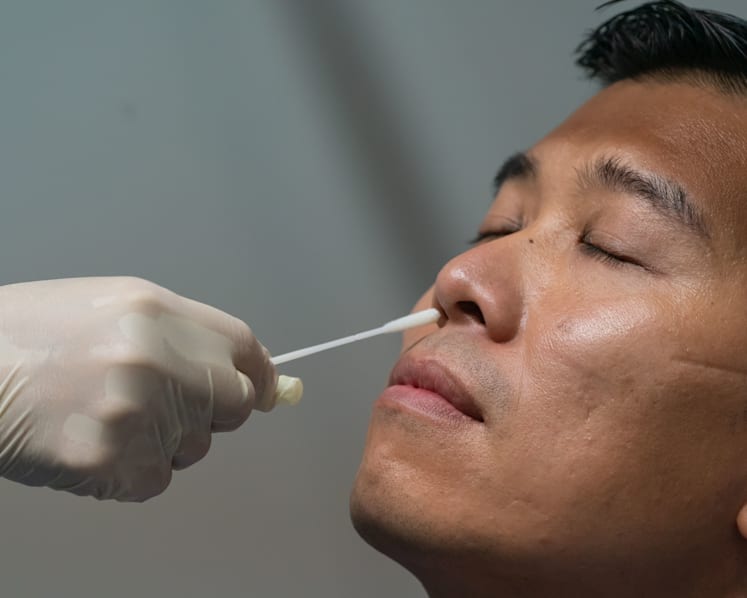
A man undergoing a swab test. Health Minister Gan Kim Yong said that the Ministry of Health's testing strategy for Covid-19 is focused on active case finding as well as targeted surveillance on identified groups.


- From July to mid-August, 76 per cent of acute respiratory infection patients were tested for Covid-19
- Aljunied GRC MP Gerald Giam asked in Parliament what percentage of people who have prolonged exposure to Covid-19 patients have been tested for the disease
- Mr Gan Kim Yong said more than 200,000 workers staying at dormitories and from high-risk sectors are under regular routine testing
SINGAPORE — From July 1 to Aug 16, less than 1 per cent of patients who were diagnosed with acute respiratory infection and had to do a swab test for Covid-19 tested positive for the infection, Minister for Health Gan Kim Yong said on Friday (Sept 4). This indicates that the community prevalence of the coronavirus here is low, he added.
Mr Gan was responding to questions from Member of Parliament (MP) Gerald Giam, who asked what is the percentage of patients that have been tested for Covid-19 after presenting symptoms of acute respiratory infection at General Practitioner (GP) clinics or polyclinics.





In his written reply, Mr Gan wrote that from July 1 to Aug 16, 76 per cent of patients aged 13 and older who were diagnosed with acute respiratory infection at the polyclinics and Public Health Preparedness Clinics were tested for the coronavirus.
This is part of the targeted surveillance testing in the community by the Ministry of Health (MOH), where polymerase chain reaction (PCR) testing — the main test used to diagnose Covid-19 — is provided for people aged 13 and older who present symptoms of acute respiratory infection at first visit to a doctor.
Mr Giam, who is the MP for Aljunied Group Representation Constituency (GRC), also asked what percentage of people who have prolonged exposure to Covid-19 patients have been tested for the disease.
He wanted to know as well how many people have been randomly tested for the coronavirus, were diagnosed as a result of random testing and whether MOH has plans to step up random testing for Covid-19 in the community.
In response, Mr Gan said that MOH’s testing strategy is “focused on active case finding as well as targeted surveillance on identified groups”.
“Such testing is based on a holistic and concerted strategy to detect and ring-fence active infections as early as possible to prevent further transmission.”
For example, surveillance testing is done for groups that have been identified as more vulnerable or have higher risk of exposure to the disease.
The authorities have been conducting Rostered Routine Testing on targeted groups such as migrant workers living in dormitories, workers who have returned to work in the construction, marine and process sectors, and workers supporting frontline Covid-19 operations.
As of now, more than 200,000 individuals from these groups are tested every two weeks, Mr Gan said, and in the last two-week cycle, about 200 people tested positive for Covid-19 as a result of these tests.
The majority of these cases are likely to be past infections, Mr Gan added.
MOH has also conducted specialised testing operations for groups where there is a higher risk of transmitting the infection. For example, tests were carried out for the households and visitors of Block 111 on Tampines Street 11 after nine new Covid-19 infections were discovered in June in two separate households living in the same block.
Covid-19 testing was also carried out for the bus drivers and staff members working at public bus depots and interchanges.
The ministry will offer one-time Covid-19 testing for community groups such as private-hire car drivers, food delivery personnel, key vendors servicing migrant worker dormitories and some stallholders at hawker centres, markets and food-and-beverage establishments.
As Singapore gradually relaxes its border controls, the authorities will also continue to test incoming travellers when they arrive or during their stay-home notice period, Mr Gan said.




