







‘Stay... stand up for what you believe in’: Janil Puthucheary tells LGBTQ youths thinking of leaving Singapore
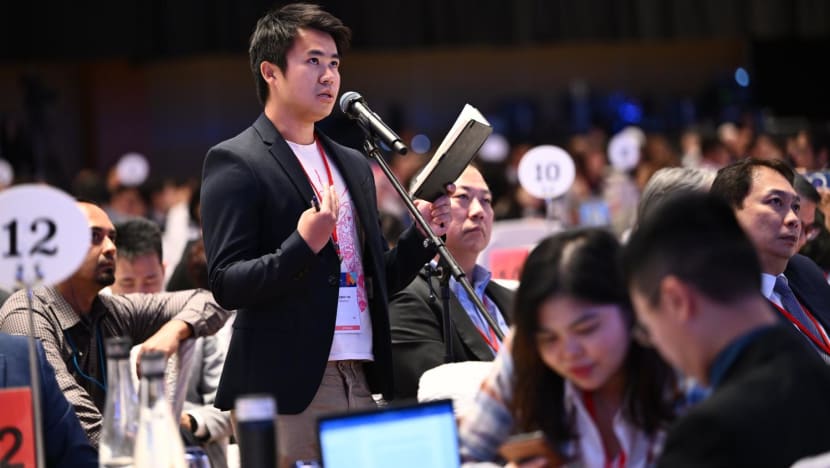
Pink Dot SG spokesperson Clement Tan speaking at the Singapore Perspectives 2024 conference on Jan 29, 2024, held by the Institute of Policy Studies at the Sands Expo and Convention Centre.




SINGAPORE — Despite Singaporeans having differing views on lesbian, gay, bisexual, transgender and queer (LGBTQ) matters, Dr Janil Puthucheary has urged young people who are LGBTQ to remain in Singapore and to “stand up for what you believe in”.
The Senior Minister of State for Communications and Information and for Health was responding to a question posed by Pink Dot SG spokesperson Clement Tan at the youth-themed Singapore Perspectives 2024 conference on Monday (Jan 29), held by the Institute of Policy Studies (IPS) at the Sands Expo and Convention Centre.
Mr Tan had asked Dr Puthucheary what his message was to Singapore’s LGBTQ youth who “do not believe that there is a future for them here” because of certain “barriers to inclusion” — which include home ownership and family formation.
“My message is stay, fight, stand up for what you believe in — in a way that brings inclusion, brings every Singaporean with you on that journey, and to make our society better for your community,” Dr Puthucheary said.





He acknowledged that not all Singaporeans agree on what a “better” society entails, but he said that the country does “need to have discourse and engagement about how we move forward”.
“If you leave, you take your ideas and your views with you. That's not going to help your cause,” he added.
In posing his question to Dr Puthucheary, Mr Tan had mentioned a personal anecdote where his mother had “counselled” him that he needed to emigrate from Singapore in order to have a happy future.
Dr Puthucheary referred to that anecdote in his response.
“When your mum pulled you aside and told you that, neither you nor her, nor me nor many other people would imagine that last year, we would have repealed (Section) 377A (of the Penal Code).
“Our society changes — just as our aspirations change. Our view on how we might deal with people in society who have different views from us will also change.
“If you want to make a difference, leaving is not going to help you,” he said, adding that Mr Tan and the Pink Dot community had “successfully" spoken up about LGBTQ issues.
The hour-long dialogue, moderated by IPS' senior research fellow Kalpana Vignehsa, came at the end of three IPS panel discussions on Monday that tackled youth perspectives on work, family and politics.
The dialogue was supposed to be attended by Minister for National Development Desmond Lee, who was absent due to illness.
DEFINITION OF ‘FAMILY’ CAN BE EXPANDED
In an earlier panel discussion on youth and family moderated by IPS' senior research fellow Tan Poh Lin, some panellists said that Singapore can be more flexible in defining "family", as the population ages and households shrink.
Assistant Professor Shannon Ang who is a sociology lecturer at Nanyang Technological University said: “We can expand the idea of a family both in terms of our assumptions of who lives together, and who constitutes a family — whether it’s single parents, companions, same-sex couples and friends even."
Families For Life's council member Yuvan Mohan said that establishing a stronger community of care beyond family ties is needed since the average resident household has decreased in size over the decades — resulting in an increased level of responsibility for each individual.
In addition, Asst Prof Ang said: “Families are intricately linked to inequality. Families with more resources can pass on their privileges and they can navigate challenges easier than those without.”
This means that relying on the traditional family unit for care responsibilities results in some people getting “left out” and having to “bear greater burdens”.
An expanded idea of the family would allow the “risks and resources” families have to be “better pooled together”, he added.
In contrast to the ideal of a small nuclear family, which keeps individuals “trapped and curved inwards”, a broader definition of the family that can even include friends would help in sharing the load.
Asst Prof Ang cited an example of a case in South Korea, where an older person adopted her best friend so that they would be eligible to sign medical forms for each other.
“In other countries, friendships are becoming more important for older adults. As older people have fewer children, they rely on their friends to fulfil their needs,” he said.




