







Luxury car dealers still braving rocky ride
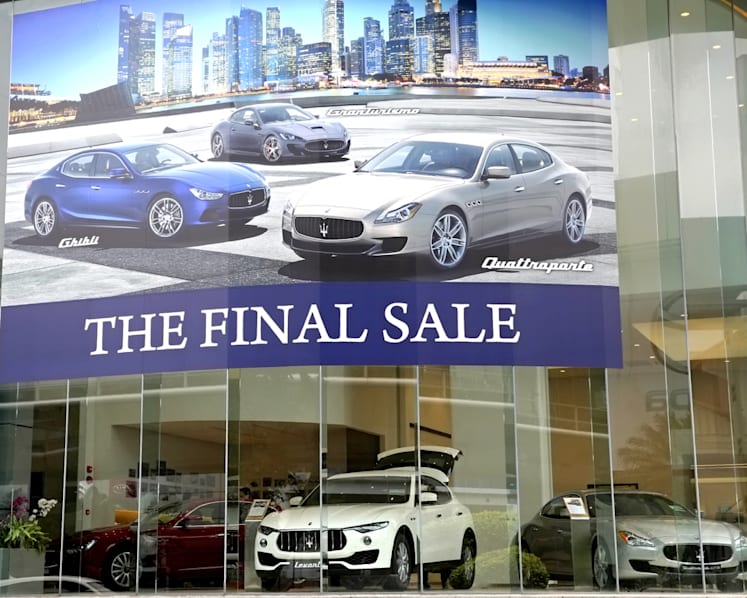
Hong Seh Motors showroom. They are the Maserati dealer in Singapore. Photo: Nuria Ling/TODAY


SINGAPORE — Luxury car dealers have had a rough time in the past few years, with some running losses in consecutive years — even when their sales volumes have held steady.
The niche segment came under the spotlight after the outgoing distributor for Maserati pruned prices to clear its stock, citing the high rent for luxurious showrooms, skyrocketing Certificate of Entitlement (COE) prices and higher taxes imposed in recent years as among the factors for its exit. TODAY reported earlier this week that Hong Seh slashed prices by as much as S$51,000 to S$95,000 for some models.
At EuroSports Global — the parent company of EuroSports Auto, which represents high-end manufacturers such as Lamborghini and Alfa Romeo — sales of automobiles dipped 9.8 per cent to S$24.81 million in the six months to the end of September last year, compared with S$27.52 million over the same period in 2015.
Its latest half-year financial statement, published in November last year, showed that the drop in new-car sales, for instance, was due mainly to fewer Lamborghini models sold. Ten new units were sold in the six months to the end of September, compared with 15 over the same period the year before.





While EuroSports’ sales of pre-owned cars also dipped S$1.05 million over the same period, the number of such units sold had actually risen, from 15 to 23. The group said this was “mainly due to the lowering of (the) sales margin to attract customers and ... reduce inventory.”
At Wearnes Automotive, which represents brands such as Bentley and Aston Martin, sales have remained steady, though.
Its managing director of the prestige division, Mr Pang Cheong Yan, told TODAY that 14 Aston Martin cars were sold last year, an increase from five in 2015, and four in 2014. Wearnes took over as Aston Martin’s distributor in October 2015.
Bentley, meanwhile, “maintained its lead in the luxury segment, with the highest percentage of cars registered year-on-year”, ranging between 37 per cent and 48 per cent over the last half a decade, Mr Pang said, without disclosing specifically the number of units sold.
Asked if Aston Martin and Bentley were running losses, Mr Pang would only say that the luxury-car sector was “highly competitive and cyclical in nature” with low volumes, and new products tended to help grow volumes for the short term.
He noted that sales in the “high luxury and supercar segment” peaked in 2012, with 333 units sold. Sales slowed by more than half last year to 143 units.
Besides the slow economy hitting such discretionary purchases, higher taxes and loan caps imposed in recent years have dented sales.
For instance, the Government announced in 2013 revisions to the Additional Registration Fee (ARF) system, levying a 100-per-cent rate on the first S$20,000 of a car’s open market value (OMV); 140-per cent for the subsequent S$30,000; and 180-per cent for the remaining OMV.
Commenting on the state of the luxury car segment, economist Walter Theseira said dealers were reluctant to slash prices even if sales have slowed because doing so “destroys brand value”.
“A high-end car is valuable precisely because it signals the wealth of the owner very convincingly ... A sufficiently wealthy luxury-car owner may not mind that costs have gone up with the new taxes — a luxury car is no use as a status symbol if the merely wealthy can afford to own it, as opposed to the fabulously wealthy,” said the senior lecturer at the Singapore University of Social Sciences.
Dealers, he noted, sell very few cars and have high fixed costs, owing to the need to maintain showrooms and offer high levels of service. And while the margins on each car is high, this does not always mean huge profits, because of the need to pump “huge investments” into branding and advertising, Dr Theseira added.
A private banker serving high-net-worth clients, who declined to be named, said the buyers of such vehicles may not merely be the extremely wealthy but regular businesspeople who may be hit in the pocket amid the economic slowdown.
“Some ... may hold back on all these purchases,” she said.




