







Marker unveiled at site of Singapore’s first NS camp
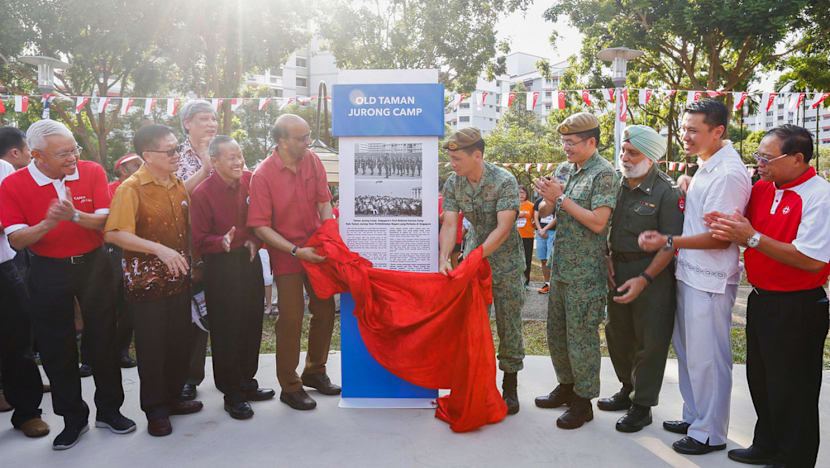
DPM Tharman unveiling the heritage marker at Taman Jurong Greens yesterday. The marker pays homage to pioneering national servicemen and NS’ beginnings. Photo: Najeer Yusof


SINGAPORE — There was pin-drop silence as Mr Albel Singh and his fellow conscripts rode in a three-tonne truck from Kallang to Taman Jurong Camp in 1967. They were on a journey none in Singapore had taken before.
As the first Singaporeans conscripted into National Service (NS), they were apprehensive.
“Everybody was so quiet (and) didn’t want to speak,” recalled now-retired Lieutenant-Colonel (LTC) Singh, 68, who started out as a recruit in the 3rd Singapore Infantry Regiment.
“It was only when we came (to the camp), and the instructors started asking us to fall in, that reality set in.”





Memories of the food they were served in Taman Jurong Camp, Singapore’s first NS camp — converted from one-room Jurong Town Corporation flats — also remain vivid.
“(It) wasn’t great at all. The vegetables ... (were) just boiled, and sometimes you found even sand inside,” said LTC (Ret) Singh, general manager of the Singapore Khalsa Association.
Yesterday, a heritage marker was unveiled on the camp’s original site at Taman Jurong Greens in Yung An Road during a National Day observance ceremony.
The marker, now part of the Jurong Heritage Trail, pays homage to pioneering national servicemen and NS’ beginnings. Speaking at the event, Deputy Prime Minister Tharman Shanmugaratnam said Taman Jurong Camp played a “special role” in the history of NS.
“Young men, different races, different social backgrounds ... thrown together at the deep end, but you melded together and emerged two years later ready to defend the country,” said Mr Tharman, also a Member of Parliament for Jurong Group Representation Constituency.
The camp was also home to the first intake of artillery servicemen in 1968 and the nation’s first artillery battalion.
Mr Tharman said the dedication of generations of NSmen has brought Singapore peace, prosperity and a respected defence force: “We owe it most to the brave, pioneer batch of NSmen, their officers and their families.”
Recalling the “spartan” conditions at Taman Jurong Camp, Mr Liew Pak Kon, 68, another pioneering serviceman, said: “You had a bed, a locker, a tray (and) plate ... Now, you have sports facilities, swimming pools (in camps).”
Even cleaning the toilet was challenging back then, said LTC (Ret) Singh, who shared one with his “buddy”, a farmer with no formal education. They had to communicate via sign language to get things done.
This commingling of people from different walks of life was what made NS so “intriguing”, he added. And the discipline instilled in all of them is etched in the NS pioneers’ memory.
“I still remember my regimental sergeant major disciplining the officers,” said Mr Liew. To him, the marker is a recognition of their contributions. “I’m glad that we’re being remembered,” added the businessman.




