







Mobile cranes to be equipped with ‘black boxes’ to improve safety
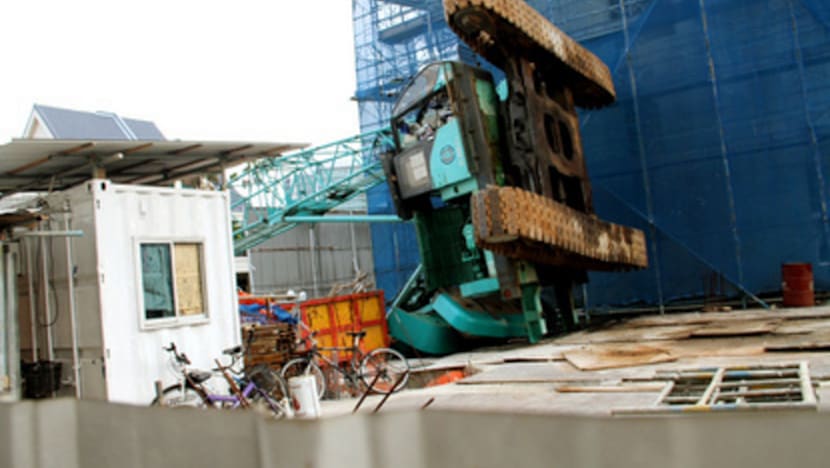
A toppled-over crane at a worksite along Pheng Geck Avenue, Potong Pasir, in February. TODAY FILE PHOTO
SINGAPORE — With worksite accidents involving cranes not abating, the Government is requiring all existing and new mobile cranes on worksites to be installed with data loggers to prevent accidents, beginning in August.
This follows a two-year study by the Ministry of Manpower (MOM), the National Crane Safety Taskforce and crane industry partners on the use of these “black boxes”, as well as a four-month pilot last year.
The data loggers, which cost on average S$13,000 each, record information such as the weight of the load it carries, the operating lifting radius, the angle at which the cranes are parked and whether the status of the safety devices has been activated or bypassed. These data can be retrieved by crane owners and occupiers, who can then adjust operations accordingly to improve safety.
Last year, three deaths and 12 injuries resulted from crane accidents. In the first three months this year, 10 crane-related accidents have already been reported. In February, a crane at a condominium worksite in Potong Pasir toppled over, narrowly missing the front door of a house. This was followed by a similar incident at Sunview Drive in Jurong a month later.





An enforcement operation held from March 16 to April 2 found 147 crane-related Workplace Safety and Health Act contraventions. Two hundred and thirty-six fines and Notices of Non-Compliance were issued and two worksites were ordered to stop all work for more than 10 days to rectify safety lapses.
Speaking at the ProBE Plus Forum yesterday, Mr Mohamed Abdul Akbar, chairman of the National Crane Safety Taskforce, said common unsafe practices include failing to ensure safety devices are working, and a disregard for safe lifting procedures.
“For example, crane operators were relying on safety devices to alert them of an overloading instead of ensuring that the lifting operation was conducted according to the lifting plan,” he said. “This is a perfect recipe for a disaster if the safety device malfunctions.”
The study, Mr Mohamed said, found that owners and occupiers were able to monitor the performance of crane operation and improve planning for lifting operations. The data loggers also shaped the behaviour of crane operators by encouraging them to be more safety conscious.
Existing cranes must be retrofitted by August 2018. A data logger can cost between S$10,000 to S$50,000. To help companies defray the costs, the Workplace Safety and Health Council has launched a co-funding scheme that will subsidise up to 50 per cent of the cost, up to a maximum of S$5,000 per mobile crane. Construction companies typically rent cranes from crane companies.
Kok Heng Engineering operations manager Alan Chan, whose company rents out cranes, said: “The funding scheme really helps and will save us a lot of money. But we do have some concerns. For example, we might not be able to cover additional costs like maintenance. If the data logger spoils, the maintenance cost will not be covered under the scheme. So, in some way, there are still additional costs ... we still need to spend.”
He also noted that a data logger would not be able to prevent lapses in safety elsewhere on construction sites.
Major workplace injuries in the construction industry rose last year to 202 cases, from 176 in 2013, said the 2014 Workplace Safety and Health Statistics Report released earlier this month. It remained the top contributor to overall workplace fatalities, with 27 cases out of 60 reported cases last year.
Mr Chan said encouraging workplace safety is a challenge given that workers come from a variety of countries. “The way they understand safety is very different from how we understand it here,” he said. For example, some workers do not know how to place a ladder in a way that will not fall, he said, adding that employers must continue to educate and train workers, and not wait till accidents happen to take action.
Mr Mohamed, who is also managing director of Nan Guan Construction, said: “While there may be awareness of the measures, it is not easy to cultivate a mindset that all accidents are presentable. This requires extensive collaboration between all stakeholders and everyone must play a part.”




