







More air-traffic controllers needed as number of flights soars
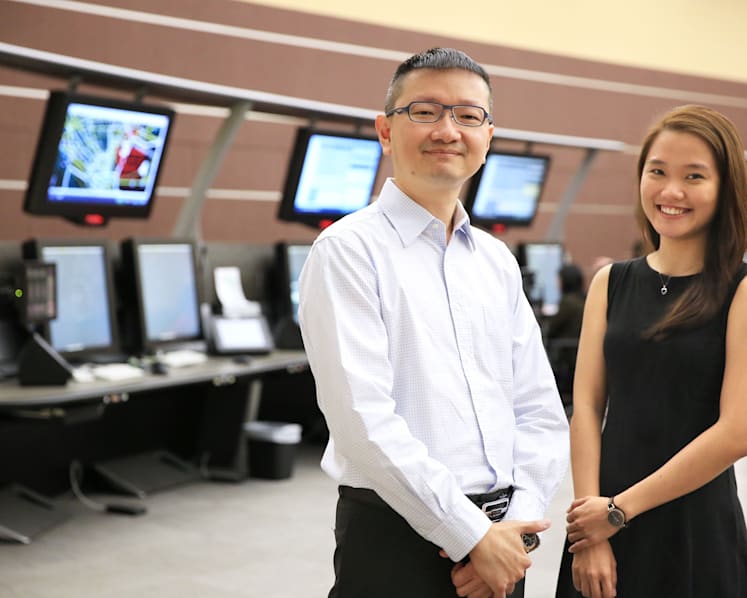
Mr Harrison Lim (left), 43, Head (Air Traffic Control Training & Development), Civil Aviation Authority of Singapore and Ms Yeo Siew Woon, 24, Air Traffic Control Officer, Civil Aviation Authority of Singapore, taken in LORADS ( Long Range Radar and Display System) III - Area Control Centre, CAAS on Sept 5, 2016. Photo: Koh Mui Fong


SINGAPORE — The rate of hiring of air-traffic controllers by the Civil Aviation Authority of Singapore (CAAS) has doubled in the past two years to cope with the unabating surge in air-traffic volume, and the increased recruitment is set to continue in the next few years.
In 2014 and last year, the aviation body took on 80 air-traffic controllers each year, up from 40 in 2010, a CAAS spokesperson told TODAY. Its target is to expand the pool further from nearly 400 now to about 600 by 2020.
The urgency is palpable, given that two new airport terminals will open at Changi Airport in the coming years. By 2025, more than a million flights a year are projected to zip through the Singapore “flight information region” (airspace managed by Singapore’s air-traffic controllers), a leap from the more-than-650,000 air-traffic movements recorded last year.
Air-traffic controllers will have to handle more aircraft movements in and out of Changi Airport every hour, from about 68 now to more than 100 flights “in the coming years”, CAAS said, adding that enhanced training for air-traffic controllers is on the cards.





Recruits, who must have tertiary qualifications, take three-and-a-half to four years to earn their stripes as fully fledged air-traffic controllers.
In addition to being skilled in maximising limited runway space and airspace, they would have to build “greater mental dexterity” to juggle more traffic. The stepped-up training will also focus on stress and fatigue management.
CAAS had recently put in place three specialised streams in air-traffic management — aerodrome, approach and area — to equip controllers with “greater proficiency” in tackling challenges.
Those in the aerodrome stream, for instance, manage air traffic at the Changi and Seletar airports from the control towers, which includes giving take-off and landing clearance.
Air-traffic controllers here vary widely in age, from 21 to 67 years old, and they clock in shifts of about nine hours daily. After every two hours at their positions, they take a half-hour break — a cycle that is repeated throughout their shift.
Recruits undergo rigorous training during a course to acquire basic aviation knowledge on a range of topics, such as interpreting meteorological reports.
They are then trained in one of the three streams to learn, for example, how to respond to emergencies and to keep a safe distance between airplanes through theory and practical sessions in a simulator.
After that, it is on-the-job training in a live operating environment, under a qualified instructor’s supervision.
Typically, about a quarter of the trainees do not make the cut, although the attrition rate varies from course to course, depending on the trainees’ aptitude, the CAAS said.
Air-traffic controllers come from educational backgrounds as diverse as marketing and engineering.
Mr Harrison Lim, 43, CAAS’ head of air-traffic-control training and development, holds a diploma in mechanical engineering.
After two decades on the job, the air-traffic controller said that to maintain focus at all times and to not be distracted by issues, including family matters, were among the most challenging facets of the job.
“This is of utmost importance as the safety of the flying public is in our hands.”
Challenging scenarios that they face daily include ever-changing weather. This, Mr Lim said, may cause flights to deviate from their planned routes, which could put them in the direct path of other planes.
Emergency situations also pile “tremendous pressure” on air-traffic controllers as they provide all possible avenues of help, including directing the aircraft to the airport safely in the fastest possible time. In such cases, managing traffic and coordinating immediately with other control units are needed.
Ms Yeo Siew Woon, 24, another air-traffic controller, had gleaned insights into the profession at a job fair during her final year at Nanyang Technological University.
Relishing the opportunity to “learn something new”, the business marketing graduate joined CAAS last June after she learnt that its comprehensive training programme allowed her to apply for the job regardless of her field of study.
“It’s a wonderful feeling to know that even though we come from different backgrounds, we collectively work towards the same goal to ensure that traffic in the air is controlled in a safe, orderly and efficient manner,” she said.




