More emergency-horn buttons on Bionix, skills upgrading for medics among measures after NS deaths
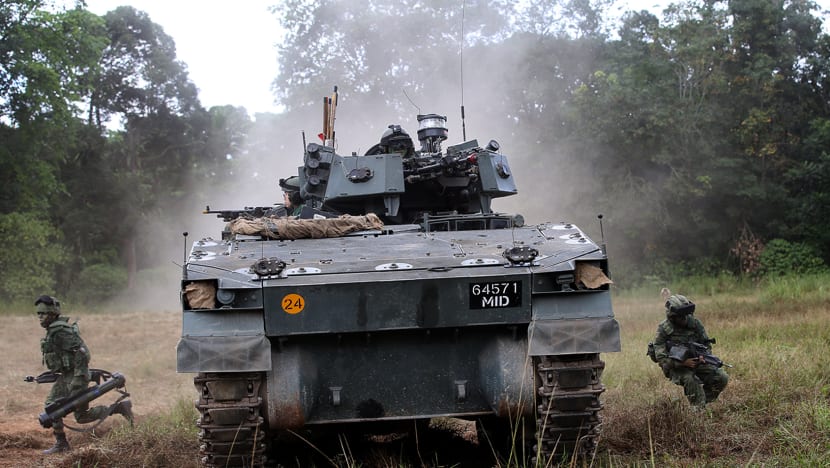
The Singapore Armed Forces (SAF) will roll out a raft of safety measures in an effort to prevent a repeat of training deaths.


SINGAPORE — On the heels of a string of National Service training deaths, the Singapore Armed Forces (SAF) will roll out a raft of safety measures in an effort to prevent a repeat, Defence Minister Ng Eng Hen told Parliament on Monday (Feb 11).
These include installing extra emergency-horn buttons and rear-view cameras on the Bionix armoured vehicle, and enabling medics to upgrade their skills in resuscitation and handling emergencies.
In November, full-time national serviceman Liu Kai was killed after a Bionix backed into the Land Rover he was driving during a mission exercise in Singapore.
A Committee of Inquiry (COI) found that despite repeated orders from a specialist — who was guiding the vehicle from the rear — to stop reversing, the driver of the Bionix continued to do so.





Two months later, actor Aloysius Pang died while on reservist duty in New Zealand after he was crushed between a lowered gun barrel and the cabin of a howitzer — an artillery gun mounted on an armoured chassis.
Here are the key safety measures being rolled out at a glance:
MORE EMERGENCY-HORN BUTTONS ON THE BIONIX
The SAF has added two emergency-horn buttons to the rear crew compartment of its training fleet of Bionix vehicles. These are on top of the existing button in the front of the vehicle.
When sounded, the emergency horn requires the driver to stop the vehicle immediately.
The extra buttons allow rear guides — whose job is to guide the vehicle from the rear — to sound the alarm in unsafe situations while the vehicle is reversing, should an intercom device fail. The intercom device via the Combat Vehicle Crew helmet set is the Bionix rear guide’s sole means of communicating with other crew members on board.
REAR-VIEW CAMERAS, EQUIPMENT TO TACKLE BLIND SPOTS
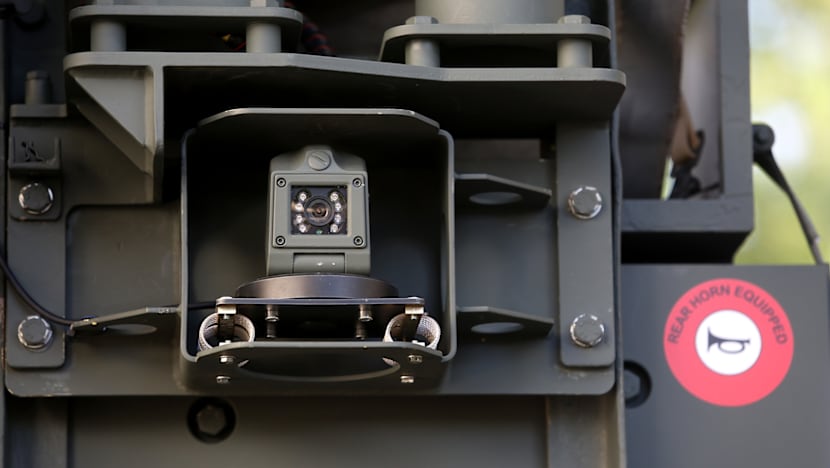
From next month, the SAF will progressively install rear-view cameras on its training fleet of Bionix vehicles. They will allow the driver to see what is behind them during reversing.
The system will offer a live video feed of the vehicle’s rear, and can operate in an environment with low light. Installation will be completed by next year.
The SAF will also progressively roll out rear-view cameras and mirrors on board all heavy vehicles, such as five-tonne trucks, to reduce blind spots.
SAFETY SESSIONS FOR ALL HIGH-RISK EXERCISES
The Army will carry out table-top safety sessions for all high-risk exercises before they kick off. Previously, these were done only for live-firing exercises. The table-top safety exercises — a detailed walk-through before an activity goes ahead — will allow personnel to familiarise themselves with emergency measures and evacuation plans, among other things.
MORE EXPERIENCED REGULAR TRAINERS
The SAF has deployed more experienced regular trainers on the ground to supervise national servicemen.
CLEARANCE DURING REVERSING
Trainers will no longer travel in Land Rovers — as the trainer did in the incident involving Liu — but will join troops in the combat vehicles during high-risk training, in cases where vehicles have to reverse.
Drivers will be allowed to reverse only with the clearance of rear guides. This will apply to all reversing manoeuvres, including extrication drills to get away from a simulated enemy encounter.
UPGRADING RESUSCITATION SKILLS
From next month, medics will upgrade their skills in resuscitation and handling emergencies through attachments to hospital emergency departments or ambulances.
OTHER MEASURES
The SAF earlier announced that it would set up a new Inspector-General Office to support the Chief of Defence Force, Lieutenant-General Melvyn Ong.
It will be set up in the first half of this year, and will focus on high-risk training and checks on safety culture in its first year, said the Ministry of Defence.
The SAF’s Chief of Staff (Joint Staff), Brigadier-General Kelvin Khong, will concurrently be the Inspector-General.
Dr Ng described the dual function as “synergistic”, as the Chief of Staff (Joint Staff) has an overview of operations and, as the Inspector-General, has the authority to ensure that safety-first habits and processes are infused into all levels of training.
The Inspector-General will report to LG Ong and the Permanent Secretary for Defence Chan Yeng Kit, and his office will have “full authority” to carry out independent audits and inspections in the SAF, among other responsibilities.
Unit commanders who fail to meet standards and commit safety lapses will have these taken into account in their performance reviews. Dr Ng stressed that such commanders would be deemed to have performed unsatisfactorily even if no accident has occurred.
The SAF will also deploy more safety officers to help units and supervise training activities.
Units will also be subject to more safety audits.