







Move to Punggol expected to bump up falling intake for Yusof Ishak Secondary School
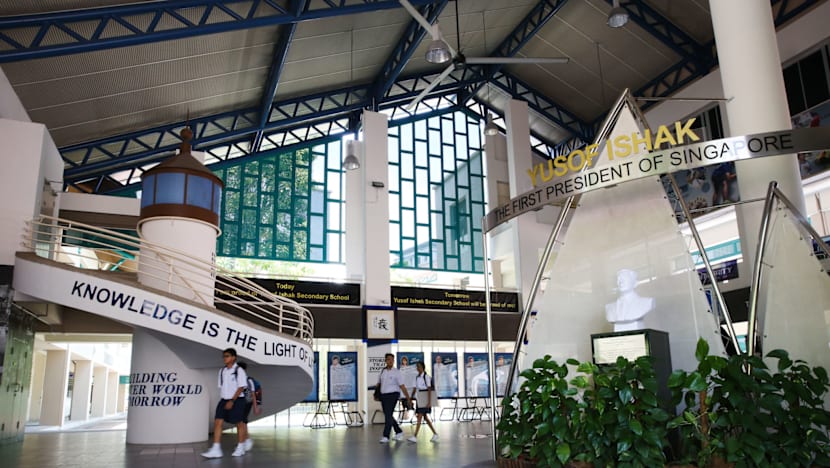
Following the announcement of its move to Punggol in 2021, all Yusof Ishak Secondary School students were given letters for their parents, to inform them of the relocation. A separate briefing session will be arranged for all the parents on Sept 21, 2018.
SINGAPORE — Within a mere five years, the student population at Yusof Ishak Secondary School shrank from around 800 students in 2013 to about 400 this year.
On Thursday (Sept 13), the students were told that they will be the last cohort at the school’s Bukit Batok campus, as it will be moving to the newer estate of Punggol come 2021.
The 53-year-old school will stop admitting new Secondary 1 students next year and in 2020 at its present premises — in order to start welcoming a fresh batch of students over at its new campus in 2021.
Eventually, the school projects that the total student population will increase at a steady rate to hit about 1,300 by 2024 after the move to Punggol Central.





The day before, principal Maureen Lee had already announced the news to the teaching staff members.
The Ministry of Education (MOE) told TODAY that it will ensure there are sufficient teachers in both campuses in 2021 “so that the teaching and learning of students will not be affected”.
For students now studying at the Bukit Batok campus who want an early transfer out of the school before the move, MOE said that their parents may approach the schools of their choice directly to make the request. These schools will then advise the parents on the outcome and transfer procedures.
A “small number” of Secondary 5 Normal (Academic) students will be transferred to other secondary schools within the Bukit Batok area in 2022, in a way that they can continue with their existing subject combinations, it added.
This is because the school will “find it challenging to offer the range of subject combinations, educational programmes and co-curricular activities (CCAs)”.
Right now, the school has eight students in the Sec 5 Normal (Academic) stream and the numbers vary every year.
To make up for the shortfall with no new intake for two years, students in various CCAs will start to partner their peers from the neighbouring schools.
Madam Lee told TODAY: “We are looking at a plan for collaboration with secondary schools in the neighbourhood… one of our performing arts groups (may) collaborate with a school in the neighbourhood. They may even participate in the Singapore Youth Festival as a combined team.
“For the sports (CCAs), I am also looking at possible collaborations with neighbouring schools with the same sports, for them to practise together and even compete as a combined team.”
Sec 1 student Isaac Ng, 13, who plays badminton as a CCA, is disappointed that he will not have any juniors for the sport. “But at the same time, I am quite happy that I'll be able to work with my team now on the future tournaments, and be able to coach them on how to be a better school player,” he said.
The teamwork with other schools will allow students to be "future-ready", Mdm Lee said. "They will learn social skills and how they can relate with their peers from another school, so I see benefits."
In the coming months, the principal will engage the students from the different levels, especially the batch that is Sec 1 now and will be in Sec 4 come 2021. They will be at the Bukit Batok campus while the new Sec 1 cohort will be at the Punggol campus.
Another group will be the Sec 1 Normal Academic students now, who Mdm Lee said “may have to look for a school if they want to continue on to Sec 5” after 2021.
Following Thursday’s announcement, all students were given letters for their parents, to inform them of the relocation. A separate briefing session will be arranged for all the parents next Friday.
OPTIONS FOR TEACHERS
Mdm Lee, 52, who has 14 years of experience as a school principal — first at Kranji Secondary School, then Anglican High before assuming her current post in December last year — will also be meeting the teachers one-on-one to hear their feedback.
She said: “We understand there could be some staff who would find that the distance (from Bukit Batok to Punggol) will be a bit of a concern. So they will be given a choice to be redeployed… or even move on to the (MOE) headquarters. So there will be continuing conversations with them for the next few months."
Mr Lau Chu Beng, 47, a physics teacher who has been with the school for the past nine years, said: “We did not anticipate (this), but we see the benefits and rationale. We welcome the decision to relocate, and my plan is to continue teaching at the Punggol side.”
Ms Sandra Marie Vincent, who has been teaching English and literature for six years, is excited about the possibilities for the school, but undecided about her future.
“We just got the news (yesterday), so we will need some time to process the information,” she said.
MORE PERSONALISED LESSON PLANS
At the school this year, there are six classes of Sec 1 students. Ng Wenxuan, 13, said that there are only 17 pupils in her class. “I am not very concerned about my academics as (my teachers) have reassured me that (with fewer students) I will get individualised attention from my teachers,” she said.
“The Sec 4 (cohort in 2021) will most likely get a more personalised programme, because the teachers will be able to give individual attention and will be able to craft the lessons in a more personalised way,” she added.
Mdm Lee also said that teachers can give these students “greater time and attention” and there could be “more customisation” of its learning programmes.
PRESERVING SCHOOL’S ‘ESTABLISHED HISTORY’
In response to media queries, MOE said that it decided to relocate Yusof Ishak Secondary School to Punggol so as to preserve the established history and rich culture of the school, and its contribution to the teaching fraternity through the Centre for Teaching and Learning Excellence, which is situated within its grounds.
The centre was set up in 2015 to support the professional development of MOE teachers.
Associate Professor Jason Tan from the National Institute of Education said: “Yusof Ishak Secondary School was named after the first president of Singapore and therefore, its continued existence holds a symbolic meaning for all Singaporeans.
“This was probably a key motivation behind the decision not to merge the school with another school in Bukit Batok, but to give it a chance for continued renewal in an area with a surrounding pool of secondary school students.”
Dr Timothy Chan, director of SIM Global Education’s academic division, also said that it was probably the best option to continue the legacy of the school, “which has a track record of excellence in its teaching and learning”, instead of closing it and building a new school elsewhere.
Yusof Ishak Secondary School was first established in 1965 as Jubilee Integrated Secondary School, before taking its current name after the first President of Singapore in 1966. It was opened by Singapore’s founding Prime Minister Lee Kuan Yew that same year.
In 1998, the school moved from its original location along Jubilee Road off West Coast Road to Bukit Batok.
SHIFTING RESOURCES
The school will be among some 60 others that MOE has relocated since 2000 — with a number that has moved more than 10km from their original site, the ministry said.
“The last time a school was relocated permanently was in 2010. River Valley High School was relocated from Jurong East to Jurong West,” a spokesperson from MOE said.
Dr Chan said that he was not surprised the ministry is relocating its resources to Punggol and other districts with a growing demand for education.
There are now three secondary schools in Punggol, and Yusof Ishak Secondary will make four by 2021.
“The demographics in Singapore, such as resident population by area and age, are changing. Newer estates such as Punggol has a growing population of younger residents,” he said.
“It is also prudent not to waste resources in relatively mature areas, where the projected demand for schools will be well met with the remaining schools.”
The relocation of the school is bittersweet for Sengkang resident Eva Marie Khairon, who was from the class of 2005.
The 31-year-old freelance music educator grew up in Bukit Batok, but now that she lives in Sengkang, she reckons that her children may just have better chances of attending her alma mater.
Ms Munirah Mansoor, 31, a civil servant, was from the class of 2003. She said: “If (the relocation) benefits the school, why not? I also see it as Punggol ‘benefitting’ from the relocation as there will be an established and reputable school there, rather than a totally new school with a blank resume.




