







MRT tunnel flooding: No lapse in oversight by LTA which had ‘prioritised review of critical assets’
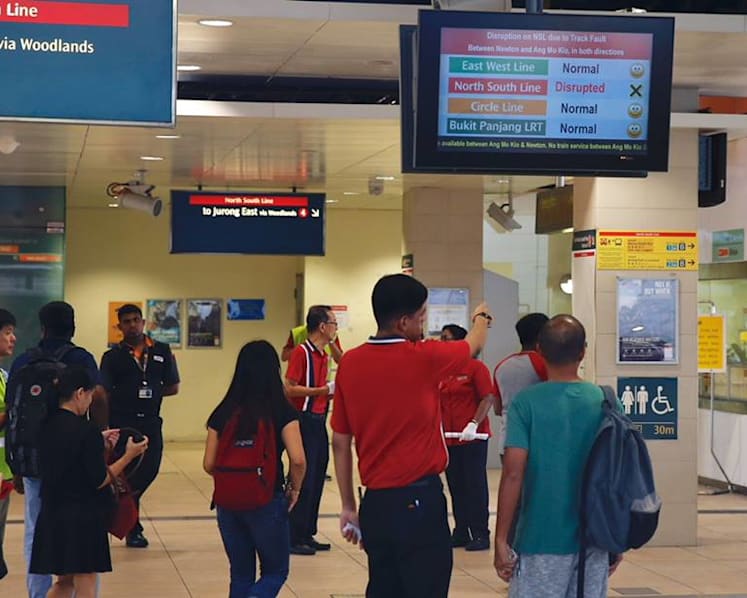
SMRT staff at Bishan MRT station giving commuters advice on alternative travel routes on Oct 8 due to train services between Newton and Ang Mo Kio stations being disrupted as the tunnels were flooded. Photo: Najeer Yusof/TODAY


SINGAPORE – The Land Transport Authority (LTA) had prioritised reviewing the condition of critical operating assets - such as the trains and the signalling system - over other assets, including the Bishan pump system which was at fault for the flooding incident last month.
The rest of the assets were scheduled to be assessed from later this year, in a review conducted as part of the LTA’s acquisition of rail operating assets under the New Rail Financing Framework last year, Transport Minister Khaw Boon Wan told the House on Tuesday (Nov 7) as Parliament held an inquest into the Oct 7 flooding incident at Bishan MRT station which caused severe train disruptions.
Responding to a raft of questions filed by several Members of Parliament, Mr Khaw elaborated in a ministerial statement on his written answer to Parliament a day earlier where he said there had been no lapse in oversight by the LTA.
Workers' Party Non-Constituency Member of Parliament (MP) Dennis Tan, for example, questioned the LTA's oversight over the inspection, repair or replacement of equipment. Bukit Batok MP Murali Pillai also asked how the LTA balanced its regulatory role with its role as system owner working with operators as a team to resolve problems.





In his statement, Mr Khaw said the LTA played three "distinct roles" as regulator, developer and asset owner for the rail network. "Although these roles are separate, they are all geared towards achieving our vision for a well-connected, reliable and efficient rail network," he said.
As regulator, LTA sets operating and maintenance performance standards. It also conducts regular audits of operators' maintenance regime and on-site inspections to ensure that standards are met.
A risk-based approach is adopted to prioritise resources, said Mr Khaw. Critical areas where failure could have severe impact – such as the signaling system – are given the greatest attention in terms of audit and regulatory focus.
"The anti-flooding systems are considered less risky compared to other core railway systems, because the constructs are simpler, easier to maintain and have ample engineering buffers," Mr Khaw said.
In a meeting with MRT on Sept 29, a week before the flooding incident, the LTA had emphasised the maintenance of the pump systems, and SMRT had agreed to collate a list of pumps requiring replacement that would be handed to the LTA.
"There have been no shortcomings or lapses in oversight by LTA staff in the present regulatory framework," said Mr Khaw. "However, no regulatory oversight can fully guard against intentional efforts to hide mistakes and negligence."
After Mr Khaw’s speech, Tampines GRC MP Cheng Li Hui asked about imposing penalties on SMRT, in light of the revelation that employees had falsified maintenance records.
Last month, Mr Khaw had said that he would like to move away from the “old system of penalties and fines, which had led to an adversarial relationship between regulator and operator. “I worry that if we continue or if re-start this adversarial relationship, I think the war is lost,” he said on Monday.
He reiterated that he would like to preserve the “one-team” relationship going forward or “at least until we can stabilise our situation and replace all the old assets”.
“I’m not against imposing penalties or providing incentives for extraordinary performance. I’m always for it, but there is a time to do a certain thing. To me, the North-South and East-West Lines are in transition. We’re far from stabilising,” he said.
Stability would only be reached after the trains are able to travel one million kilometres between delays of more than five minutes, he added. At that point, an incentive-penalty system could be reintroduced to encourage strong performance and discourage shoddy work.
On the LTA’s role as a developer, Mr Khaw said in his ministerial statement the agency ensures that transport infrastructure is designed with the right specifications. "In this case, the design and construction of our MRT infrastructure have incorporated ample flood-resistant specifications and redundancies," he said.
For instance, station entrances are built at least one metre above prevailing flood levels, and there are ample pump capacity and holding tanks. These specifications are more stringent than those for other building developments, he pointed out.
Flood barriers have been installed at older MRT station entrances, including those at the Tanjong Pagar and Orchard stations. These measures are reviewed from time to time with national water agency PUB to account for climate change and unforeseen weather events.
Mr Khaw also talked about the "fourth and unspoken role" for LTA, which he had emphasised since he took over the transport portfolio in 2015:
"That is to cultivate a relationship between LTA and the rail operators founded on trust and constructive collaboration towards a common mission of providing reliable rail transport as an essential public service."
This was critical now, with the two oldest lines – the North-South and East-West Lines – undergoing extensive renewals. A relationship of trust at all levels is needed for information and ideas to be "openly, candidly and freely" shared, he said.
"This helps LTA perform its role as a regulator more effectively as its investigations into any disruptions must always be fair-minded and thorough – having considered all factors like the age of the assets, the effects of weather, design and other extenuating circumstances," said Mr Khaw.
He reiterated that penalties will be imposed where warranted, but they also have to be calibrated reasonably for fairness and accountability. He said: "Such a regulator-regulatee relationship engenders both respect and trust, and is critical in our journey towards higher rail reliability."
Mr Khaw also announced that Dr Richard Kwok, ST Kinetics' executive vice-president and chief technology officer, would join SMRT on Dec 18 as head of the SMRT's augmented audit team and co-head of the Joint Readiness Inspection team between the LTA and SMRT. This was at the request of SMRT chairman Seah Moon Ming.




