







NS medical grading system to change from October 2027 enlistment
Instead of a single Physical Employment Standard (PES) status, those who enlist from October 2027 will receive three sets of information on their medical fitness.
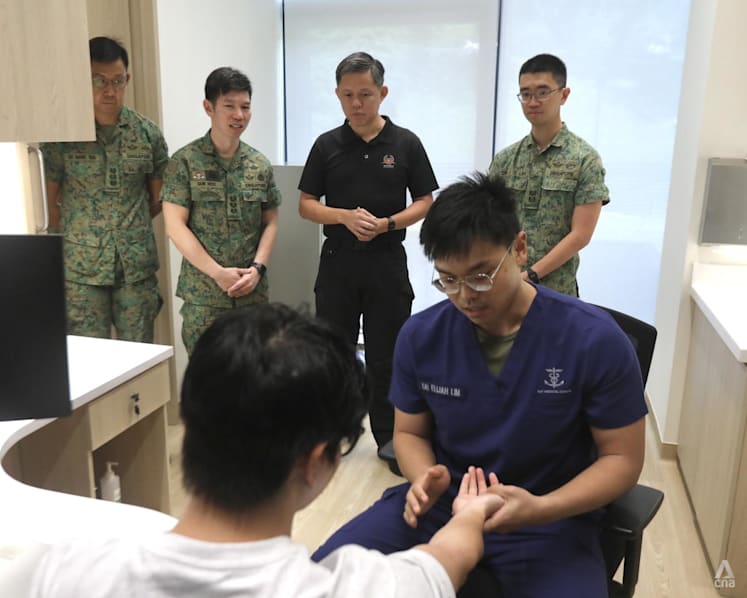
Minister for Defence Chan Chun Sing observing a National Service pre-enlistee undergoing a medical examination at the Medical Classification Centre (MCC) in the Central Manpower Base on Apr 13, 2026. (Photo: CNA/Mak Jia Kee)

This audio is generated by an AI tool.


SINGAPORE: The way national servicemen are medically classified will change next year, with cohorts enlisting from October 2027 no longer assigned a Physical Employment Standard (PES) status.
Under the PES system, which has been in place since the 1970s, pre-enlistees across the Singapore Armed Forces (SAF), the Singapore Civil Defence Force (SCDF) and the Singapore Police Force (SPF) are assigned a single PES status from A to F, which determines their vocation during NS. It is based on traditional definitions of operational fitness.
Those assigned PES A - the highest standard - are deemed fit for all field activities, including frontline duties and direct combat.
Those in PES C may perform combat service support roles, such as being signal operators, and assume some combat support positions, including air force technicians.





Soldiers in PES E are fit only for combat service support roles, including cyber specialists, and service vocations, such as being administrative support assistants.
The updated medical classification system will be more precise, the Ministry of Defence (MINDEF) and Ministry of Home Affairs (MHA) said in a joint media release on Monday (Apr 13).
Rather than a broad PES status, pre-enlistees will receive three sets of information - their medical fitness for service, medical exemptions and eligibility for an eight-week reduction in NS duration.
"The refresh is part of broader efforts undertaken across the years to enable servicemen to contribute more effectively to national service," the ministries said.
"As the security and defence landscape continues to evolve, the SAF and the Home Team now have a greater variety of roles to meet their expanded spectrum of operations."
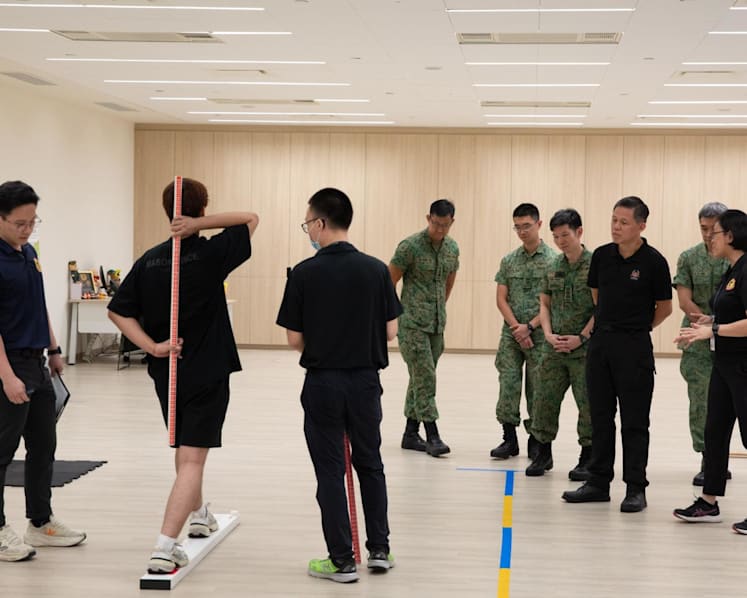
The refreshed medical classification system will enable about 1,200 servicemen to be deployed annually to vocations and roles they would previously have been ineligible for, said MINDEF and MHA. "This will hence offer servicemen more opportunities to pursue and fulfil their aspirations in NS," they added.
A MINDEF spokesperson added that many of these roles no longer rely on traditional notions of physical or operational fitness.
For instance, with the establishment of the Digital and Intelligence Service in the SAF, new roles such as cyber operators are now required. The Home Team has also introduced new roles such as cybercrime operators and operations specialists, many of which are filled by full-time national servicemen (NSFs).
According to a parliamentary reply in 2013, then Defence Minister Ng Eng Hen said 27 per cent of enlistees were PES A, 58 per cent PES B, 8 per cent PES C and 7 per cent PES E, with 2.5 per cent assigned to clerical and administrative roles.
Since 2021, the SAF has redesigned 2,000 roles across 25 vocations, including combat medics, infantry platform operators and army technicians. This has allowed more than 1,800 NSFs to be deployed in a wider range of operational roles that they were previously not eligible for.
KEY CHANGES
First, pre-enlistees will be informed if they are medically fit or unfit for service. Those who are medically fit will be enlisted to serve NS, while those who are not will be exempted.
The second set of information covers specific medical exemptions, which will determine their eligibility for activities during NS and vocations. These exemptions will be based on their medical conditions and functional abilities.
In addition, pre-enlistees will be told if they are eligible for an eight-week reduction in their full-time NS duration. Eligible pre-enlistees must attain 61 points or more in their pre-enlistee Individual Physical Proficiency Test (IPPT) to be granted the reduction.
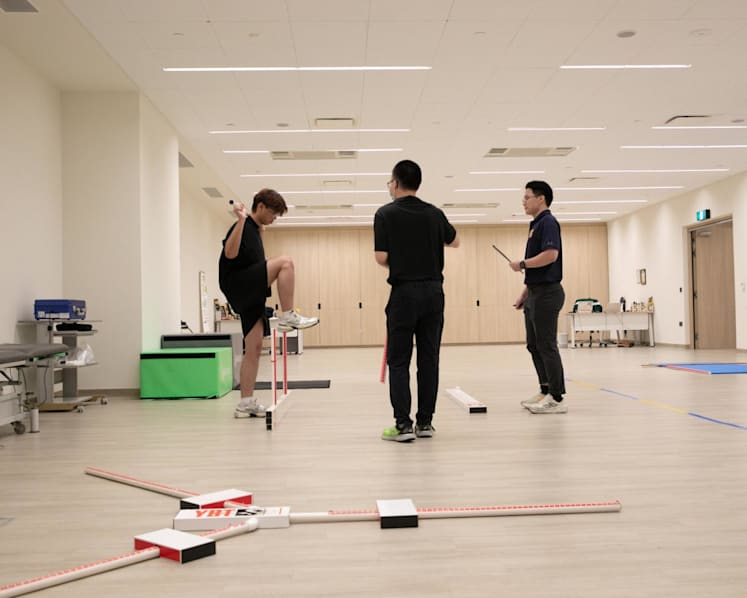
HOW THIS AFFECTS BASIC TRAINING
Those enlisting to SAF's Basic Military Training (BMT) from October 2027 will be assigned to one of three programmes based on their medical exemptions. The same applies to those enlisting in SCDF's Basic Rescue Training and SPF's Police Officers Basic Course from November 2027.
With a more precise medical classification system, servicemen with certain medical conditions may be eligible for more training activities and vocations, said MINDEF and MHA.
For instance, a pre-enlistee who has fully recovered from a torn anterior cruciate ligament will be assessed to have no medical exemptions under the updated system.
He will be eligible for more combat and combat support vocations, such as commando and naval diver in the SAF, as well as more frontline and frontline support roles in the Home Team, such as ground response officer and firefighter.
In another example, an individual with mild hearing loss will be exempt from loud environments but is eligible for vocations such as guardsman and naval warfare system operator in the SAF, as well as emergency medical technician and community engagement officer in the Home Team.
Under the current system, both would have been assigned PES B2 and be ineligible for Standard Obstacle Course training.
With the changing nature of warfare, the concepts of combat-fit, non-combat fit and frontline units have been superseded by technologies and warfighting concepts, said Defence Minister Chan Chun Sing.
Combat fitness today was not just about the "usual muscular activities" as technology has enabled people to do more and do better, he told reporters after a visit to the Central Manpower Base Medical Classification Centre in Bukit Gombak.
"All these allow our people to fulfill their potential and actually allow them to do what they are most suited for," he added.
Addressing the time it took for the refreshed system to come into effect since the announcement to review it in 2021, Mr Chan said the ministry and SAF took the time over the years to map the directory of vocations and their physical requirements.
To evaluate if training and administrative activities can be conducted effectively without relying on PES grades, SAF conducted ground trials in 2023 and 2024 in BMT and across other units.
The trials found that commanders and trainers were confident in using medical exemptions to guide training participation and conduct training safely, said MINDEF.
The ministry will conduct further trials in BMT and other units from now until the October 2027 enlistment of the first batch of SAF pre-enlistees graded under the updated medical classification system.
The review was also not done independently within the SAF - it involved specialists and consultants beyond the armed forces.
"Over the last few years, with the experiences that we have gained, we are now very confident that this system is much more robust. This system is much more able to allow our NSmen to make a better contribution," said Mr Chan.
He added: "It has taken a bit of time because of the robust process that we want to assure ourselves that the safety of our enlistees and NSmen is never compromised."

MINDEF and MHA also said that servicemen have been seeking opportunities to contribute meaningfully and effectively during their time in NS.
"Many pre-enlistees submit appeals to review their PES status before they enlist into NS. In 2025, three out of four appeals by pre-enlistees to review their PES status were requests for upgrades," they added.
FIRST BATCH OF PRE-ENLISTEES
SAF pre-enlistees enlisting in October 2027 and Home Team pre-enlistees enlisting in November 2027 will be the first cohort to be medically graded under the updated system.
These enlistees will undergo medical screening from the end of June 2026. They can view their medical fitness results on the OneNS app about two months after their medical screening appointment.
The older PES system will continue to apply to cohorts that enlisted before these dates, while the updated system will apply to all regulars, both existing and future regular servicemen, from 2028.
"Safety has and will remain a key priority for all training and deployment in the SAF and the Home Team," said MINDEF and MHA.
"Training will be guided by a standardised list of medical exemptions, and commanders and trainers will have clear training guidelines on activities servicemen can and cannot perform."
MANPOWER CONCERNS?
Mr Chan told reporters that the refresh of the system was not to meet current or future manpower requirements.
"We do this in order to allow our NSmen to best fulfil their potential ... We run a conscript system. For us in the MINDEF and SAF, we know the number of people that will come in to serve 18 years before their time," he said.
The defence minister added: "We cut our coat according to the cloth that we have."
With intake numbers known to SAF and MINDEF in advance, Mr Chan said that operational concepts can be designed and personnel deployment can be planned ahead of time.
"So it is not about meeting the here and now requirements. And I think no serious, professional armed forces will say that just because the manpower fluctuates every year, therefore we have to change our fighting concept, because all those take time," he said.




