







New laws will allow ICA officers to act swiftly before police arrive: Josephine Teo
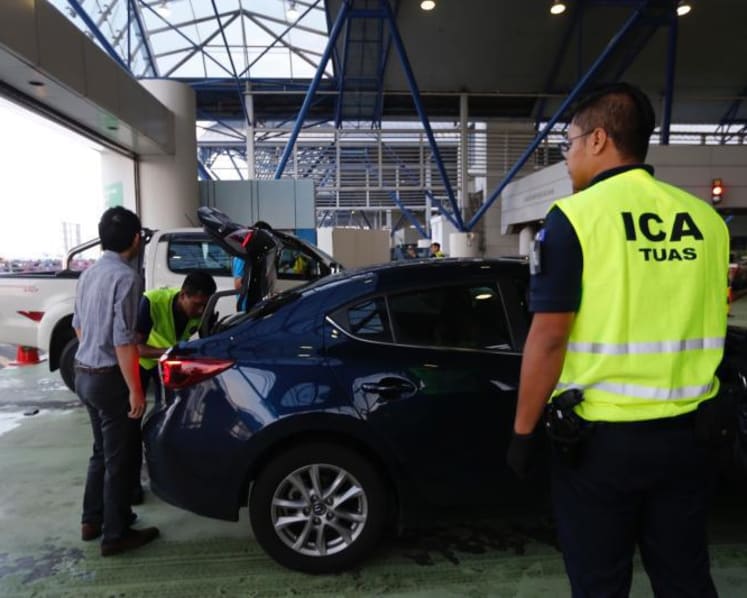
The ICA officers will be first responders, acting swiftly to mitigate security incidents while waiting for the police’s arrival. Photo: Najeer Yusof/TODAY


SINGAPORE — Immigration officers with protective security duties at land, air and sea checkpoints will be able to carry out searches and arrest suspected individuals within, or in the vicinity of the checkpoints, after changes to the Immigration Act were passed in Parliament on Monday (Jan 8).
The amendments will enable the authorities to deal with crime and security incidents more efficiently.
But the enhanced powers do not mean officers from the Immigration and Checkpoints Authority (ICA) are expected to carry out the roles and functions of police officers, said Second Minister for Home Affairs Josephine Teo.
The ICA officers will be first responders, acting swiftly to mitigate security incidents while waiting for the police’s arrival, she said during the debate.





“Once the police officers arrive at the scene, there is a clear understanding that they will take over management and investigation of the incident, including the recording of statements from the arrested person and working with the Attorney-General’s Chambers to prosecute the person in court,” said Mrs Teo.
The new law enhances the Integrated Checkpoints Command system, set up in 2015 to optimise Home Team resources deployed at checkpoints including Changi Airport, Woodlands Checkpoint and the Marina Bay Cruise Centre.
The ICA officers will undergo training to perform their new duties, said Mrs Teo in response to questions from Members of Parliament such as Mr Patrick Tay (West Coast) and Dr Fatimah Lateef (Marine Parade).
Mr Tay, who was among seven MPs who took part in the debate, highlighted the difference in the training regimen of immigration and police officers.
A direct-entry sergeant at the ICA, for instance, would undergo a 16-week non-residential ICA basic course at the Home Team Academy, while a police officer of the same rank would undergo six months of residential training which includes lessons in criminal law and community policing.
Training for empowered ICA officers will be designed “specifically for them to be first responders than full-fledged police officers”, said Mrs Teo. The ICA and police have developed relevant courses covering areas such as legislative provisions, management of protective security incidents, interview skills and search techniques.
ICA officers will also join the police for relevant courses including public security first responder training, where officers are given tactical movement training to augment existing competencies in firearms.
More than 900 ICA officers have undergone the training so far.
Mr Tay and Nominated MP K Thanaletchimi asked if ICA officers’ salaries would be enhanced.
The starting monthly salary for an ICA direct-entry sergeant with a Higher Nitec, Nitec or GCE O-level qualifications would range from S$1,670 to S$1,880, while a police officer of similar rank and qualifications would get between S$1,820 and S$2,170 per month, said Mr Tay.
Mrs Teo said they would be “reasonably remunerated”.
The Ministry of Home Affairs (MHA) regularly reviews the salaries of Home Team officers to ensure they remain competitive, taking into account the jobs’ demands, risks as well as specialised skills requirements, she said.
Responding to Nee Soon MP Louis Ng, who questioned the need for ICA officers to detain a person for up to 24 hours following an arrest, Mrs Teo said this was to cater to circumstances where the “police needs more time to take over custody of the person”, especially when they are engaged in major emergencies.
Under the amendments, the ICA will also be allowed to collect personal identifiers such as photographs, fingerprints and passport details of travellers in transit at Changi Airport, if necessary. Currently, information is only obtained from travellers when they enter or exit the immigration gantries.
Tampines MP Desmond Choo asked how inconvenience of security screening to passengers in transit would be minimised. Mrs Teo said field trials were conducted to test the measures.
“We are also working with Changi Airport Group on protocols to clear passengers with very short connecting time,” she said, adding the minimum connecting duration in most instances will remain unchanged.
Holland-Bukit Timah MP Christopher De Souza highlighted the need to safeguard the data collected of passengers.
Although the information collected could be shared among the various law enforcement agencies to deter threats, Mrs Teo said strict procedures are in place “governing the sharing of information and safekeeping of data”.
Meanwhile, maximum penalties for breaches under the Immigration Act will also be increased – from the current six months’ imprisonment term and a fine of S$1,000, to a maximum jail term of two years and fine not exceeding S$3,000.




