







New quick-reaction police teams in Orchard, areas with high footfall to deter terror threats
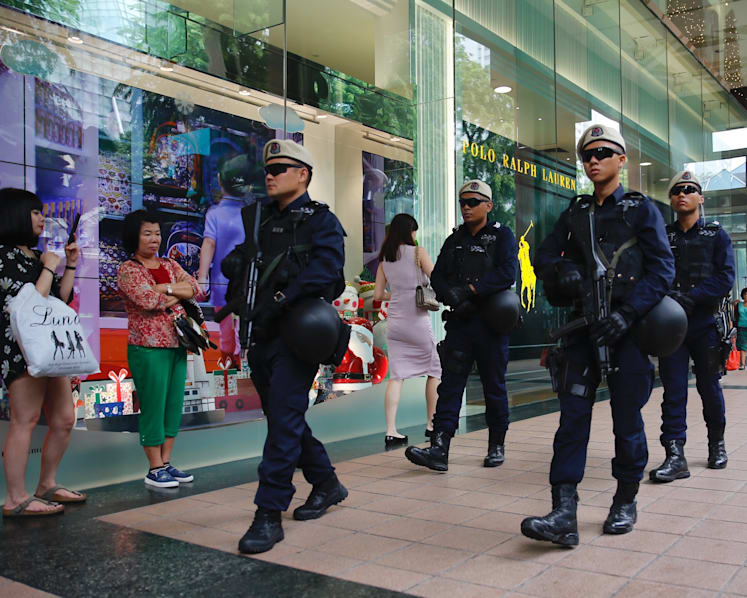
New quick-reaction police teams have been doing the rounds in areas with high footfall such as the Orchard Road shopping belt since the start of this month. Photo: Najeer Yusof/TODAY


SINGAPORE — In a fillip to the Republic’s counter-terrorism efforts, new quick-reaction police teams have been doing the rounds in areas with high footfall — such as the Orchard Road shopping belt and Marina Bay — since the start of this month.
These groups, called in-situ reaction teams, are deployed in teams of four and are made up largely of full-time national servicemen, who work alongside a police regular.
Assistant Commissioner (AC) Manimaran Pushpanatan, commander of the police’s Protective Security Command, which oversees the in-situ reaction teams, shared that the servicemen were chosen through a stringent process on attributes such as good psychomotor skills and the ability to withstand stressful situations.
They were put through a rigorous three-week course, where they were trained in special tactics, such as how to respond to a knife attack. The team members are also more proficient in handling high-powered weapons to take down threats, he said.





Donning brown berets and a ballistic-resistant vest, the responders are armed with an HK-MP5 sub-machine gun and a Taurus M85 pistol.
Businesses, such as the Takashimaya department store, are also lending a hand by setting aside space for the officers to rest during their shift.
Citing operational sensitivities, the police declined to be drawn into the specifics, such as the locations the in-situ teams are based in, as well as the total pool of responders, although AC Pushpanatan said the teams were being built up.
The new teams are a “proactive response” to an evolving threat.
Unlike other counter-terrorism forces, such as the police’s emergency response teams — which cover a larger operational area and take a while to arrive on the scene — the in-situ reaction teams are based in key areas with high human traffic. This allows them to respond to threats swiftly.
Noting the shifting threat environment, AC Pushpanatan said gone are the days when police divisional officers dealing with a threat would be despatched to negotiate, and had “one hour or so before something takes place”. Things now escalate in a matter of minutes, as terrorists go on a killing rampage, he said.
Recent terror events, such as the attack in New York City in October that killed eight people after a man drove a truck through a crowd, have underlined a “different modus operandi” for terrorists, the police said.
Besides responding to public security incidents, the teams, which will also carry out patrols to deter attacks, will complement the police’s emergency response teams and the rapid deployment troops that comprise mostly regulars.
Full-time national serviceman, Special Constable Sergeant Jared Chang, 19, said he volunteered for the role and responders went through training scenarios which covered various ways in which terrorists could attack.
At times, “surprise elements”, such as hostages who pretended to be hurt but later pulled out a gun, are infused into the programme, said the young man, who has done the rounds along Orchard Road and Marina Bay since the start of this month.
Fellow serviceman, SC Sergeant Khidhir Kamir, 23, said of his deployments along Orchard Road thus far: “The work is very tiring. But we won’t let that overcome (us) because we know we’ve a job to do. We’ve to keep the public safe. So, at the end of the day, when we come back, we know we’ve done our job.”




