







New SAF unit to fight terror
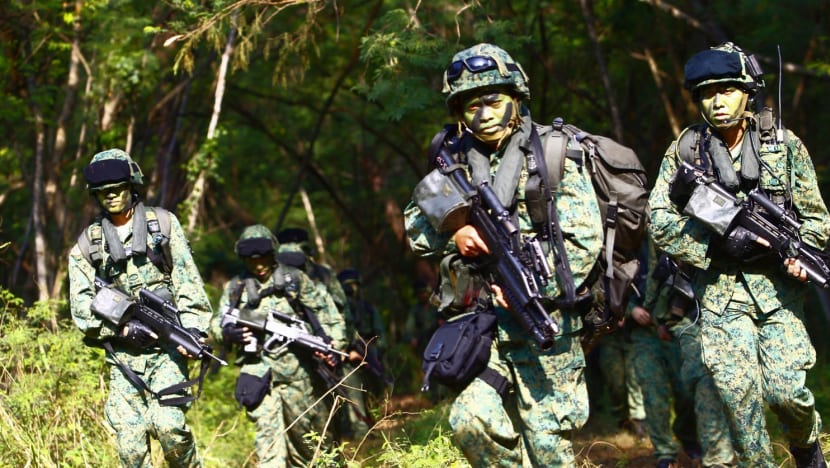
TODAY file photo.


SINGAPORE — With the threat of terror attacks rising to its highest level in recent years, the Singapore Armed Forces (SAF) will form a new specialist unit to boost the Republic’s ability to respond swiftly to a range of contingencies, announced Defence Minister Ng Eng Hen.
Comprising career soldiers trained in niche capabilities — such as cordon and search, rules of engagement, spotting signs of whether a person harbours ill-intent — the Army Deployment Force’s (ADF) chief mandate is to assist the Special Operations Task Force to take out terrorists and rescue hostages.
“The basic task for the ADF is the rapid response element, because speed is important in counter-terrorism. It is really not quite like conventional missions where you have time ... This you have to respond in minutes,” said Dr Ng in an interview ahead of the annual SAF Day today.
While the Ministry of Home Affairs (MHA) remains the primary responders in the event of a terrorist attack, there are situations where the SAF will be activated, said Dr Ng. He cited the Paris attacks last November where terrorists split up into three teams to hit at least six locations.





“Our responsibility is to be ready. And we cannot plan and say, well let me start planning when I think you are going to call me,” Dr Ng said.
In the event of a terrorist attack where multiple parts of the Republic are under siege, officers from the ADF — which will be inaugurated on July 12 — armed with assault weapons and armoured vehicles will be deployed to contain armed assailants while the Special Operations Task Force closes in to subdue them.
The battalion-sized squad may also be deployed to support other SAF task forces and Home Team agencies during civil contingencies, humanitarian assistance and disaster relief missions, and peace support operations.
Depending on the scenario, ADF officers will have different uniforms and bear the appropriate equipment. For domestic security operations, for instance, they will be armed with pistols and tasers. Those deployed to relief missions will help set up Water Purification Units and temporary shelters.
Noting that terrorism, and increasingly, home-grown terrorists, is a threat that will continue to confront Singapore for at least the next two decades, Dr Ng also announced a new National Security Centre that will coordinate responses by the ministries of Defence and Home Affairs.
Set up by the Defence Science and Technology Agency, the centre will process and analyse data drawn from around the island — such as security cameras or police officers — to detect anomalies such as suspicious behaviour or the sudden dispersion of crowds.
The centre will also connect the SAF and national security agencies to share information seamlessly.
Dr Ng noted that it is hard for countries to guard against attacks by “lone wolves” who have been self-radicalised, citing the recent case in Orlando, Florida, where a 29-year-old man fatally shot 49 people at a gay nightclub.
Although there have been reports of the Islamic State (IS) losing ground in Iraq and Syria, Dr Ng cautioned that returning IS fighters can heighten terror threats in their home countries.
The setting up of the ADF and National Security Centre follow other counter-terror capabilities unveiled during the Ministry of Defence’s Committee of Supply debate.
Despite these, Dr Ng warned that Singapore will never be foolproof in its counter-terrorism efforts because the enemy is always on its toes to charge at “weak spots”. Quoting former Coordinating Minister for National Security S Jayakumar, he said: “Security agencies will always have to succeed, but terrorist elements only need to succeed once.”
Besides restructuring to step up its game to combat terrorism, the SAF will also enhance counter-terror collaborations with the international community. Joint patrols in the Sulu Sea by Malaysia, Indonesia and the Philippines is a good example of such collaborations, said Dr Ng, adding that the Republic will join if it were invited.
Among other security challenges Dr Ng sketched out during the 75-minute interview include growing nationalism and anti-globalisation sentiment.
“There is a resurgence of what political analysts call ‘far-right’ ... There is that desire for identity and some anti-globalisation sentiments for countries who want to be even more assertive to protect not only their markets, but their borders,” he said.
Another security challenge is the manpower crunch because of Singapore’s low birth rate. By 2030, the pool of soldiers is expected to drop by one-third and the SAF will have to do more with less, said Dr Ng. “The SAF will have to work smart and not only hard. You will have to rely and use technology as a critical enabler to be able to respond adequately,” he said. ADDITIONAL REPORTING BY KENNETH CHENG




