







No major changes to foreign manpower policy: Josephine Teo
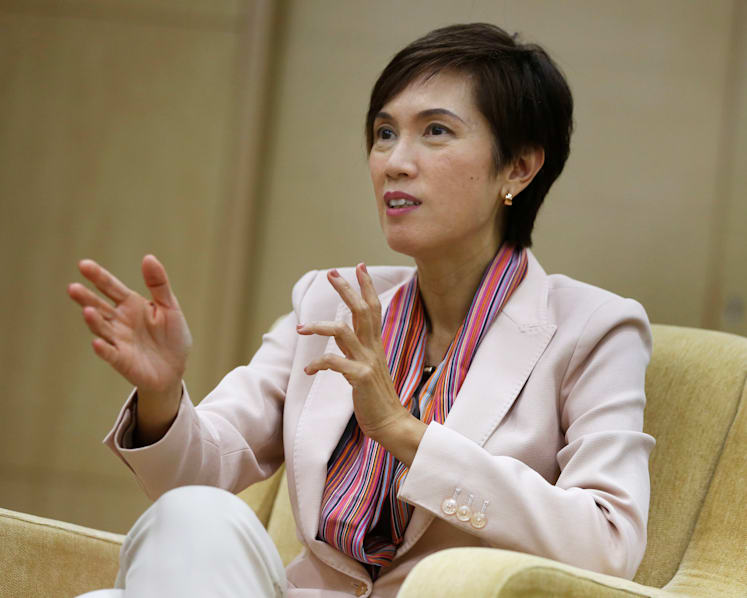
Second Minister for Manpower Josephine Teo stressed that Singapore needs to stay the course and show “resolve” to wean off its reliance on foreign workers, in order to become a “more efficient economy”. Photo: Raj Nadarajan/TODAY


SINGAPORE — There will not be major changes to the Government’s foreign manpower policy but adjustments can be made from “time to time” depending on economic conditions, said Second Minister for Manpower Josephine Teo.
Calls have been growing in recent weeks for Singapore to relook its position on the foreign manpower issue in the face of a severe demographics slowdown.
Last month, Monetary Authority of Singapore chief Ravi Menon, for example, devoted much of his speech at a high-profile conference on the topic, making an impassioned plea for Singapore to “reframe our question on foreign workers”, given the limited scope in raising birth rates and labour force participation rate.
Speaking to TODAY in a one-hour interview on manpower issues, Mrs Teo stressed that the Republic needs to stay the course and show “resolve” to wean off its reliance on foreign workers, in order to become a “more efficient economy”.





“We have to continue the journey we’ve started… Productivity growth is just beginning to show encouraging results. You don’t start-stop — this is not the way to show resolve. The way to show resolve is to persist, even if it is difficult,” she said. “Because you know that in the medium to long term, that’s what you need and it will benefit us.”
The Government started tightening its immigration and foreign manpower policies after the “watershed” 2011 General Election, which saw the population’s angst towards foreigners reach its nadir. A Population White Paper published in 2013 also prompted a public backlash.
Since then, the Government has said, on several occasions, that there would not be a U-turn, despite requests from businesses.
“I keep explaining (to businesses) that if they keep hoping that the Ministry of Manpower (MOM) can revisit our policies on foreign workers ... to give higher quota — that’s not possible. We’ve reached the point of no return,” Manpower Minister Lim Swee Say told the media in 2015. “Please don’t keep asking me to relax our foreign worker policy. That’s not part of the outcome,” he added.
TODAY’s Big Read last week examined the issue, and looked at whether Singapore and Singaporeans are ready for a rethink. Many experts said the main issues that led to the 2011 backlash — namely fierce competition for jobs, inadequate housing and transport infrastructure — have largely been addressed.
During the interview, Mrs Teo, who was promoted to a full minister last May, reiterated that the Government’s stance is not “purely driven by political considerations”.
She said: “Our foreign manpower policies have to be considered in light of what is a sustainable population in Singapore — so that has to be the perspective to adopt.”
The instinct must be to reduce manpower reliance in “every sector (and) every kind of business” if this benefits companies and the economy in the medium to longer term, she added.
“People want to see their income grow. And over the medium to long term, income growth is almost always founded upon productivity improvements,” she said. “And you cannot be very productive if you are always relying on more people to get the job done. So, that must be our instinct.”
Noting the feedback from businesses on the need for stability in foreign manpower policies, Mrs Teo said “minor adjustments” can be made.
For example, when the Government raised the qualifying salary from S$3,300 to S$3,600 for Employment Pass applications last year, it used wages for locals as a reference to gauge the quality of foreign workers whom employers are hiring.
Productiviy has long been the Singapore economy’s Achilles’ heel. Between 2012 and 2016, productivity growth ranged from -0.2 per cent to 1 per cent. However, it was expected to grow by at least 3 per cent last year.
While it has been a long, hard slog to raise productivity, Mrs Teo was adamant that the Republic does not throw in the towel and take the easy out by letting in large numbers of foreigners to boost economic growth.
“In practically every sector, we know of different countries, cities that can do better. So, what are we saying? We can’t do what they have done? Or is there something inherently inferior in Singapore? Whether it’s the businesses or the people? That cannot be the case,” she said. “We must not believe that we have stopped learning… There will always be something that we can learn.”
She believes that “quite a lot of businesses have come round” to the idea that they need to improve productivity. She likened the effort to how Singapore’s entrepreneurial scene has flourished despite initial scepticism.
She said: “When I think back, 20 plus years ago, when I was a young officer in the Economic Development Board of Singapore… everyone said, ‘Give up! Singaporeans will never take risks. They will never become entrepreneurial.’ I am so glad so many young people are proving them wrong. It’s not unusual anymore for people when they graduate from universities or from polytechnic to think, ‘I want to be an entrepreneur’.”




