







No running away from raising productivity levels: Lim Swee Say
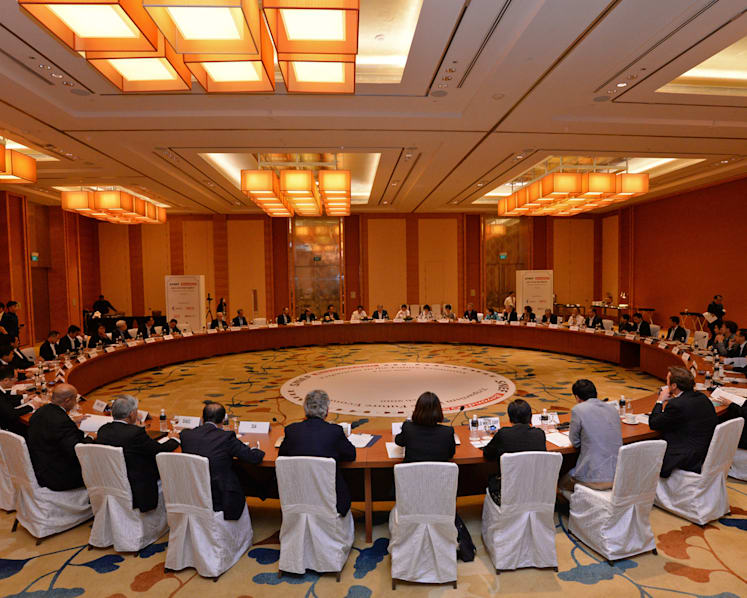
CEOs of companies from various industries in attendance of the inaugural SNEF Beyond SG50 CEO Roundtable with Minister of Manpower, Mr Lim Swee Say, and NTUC Sec-Gen, Mr Chan Chun Sing. TODAY photo: Robin Choo


SINGAPORE — To avoid ending up with less than ideal outcomes for the Singapore economy amid the slower growth in the local workforce, companies will need to focus on raising productivity levels, said Manpower Minister Lim Swee Say today (Feb 2) at a closed-door roundtable discussion.
However, participating companies at the session felt that more flexibility in labour practices can be exercised when it comes to firms with strong economic linkages and are focused on building a core Singaporean workforce.
Delivering his opening remarks at the discussion organised by the Singapore National Employers Federation (SNEF), Mr Lim noted that the economy is restructuring itself to one that is “manpower-lean”, with a slowdown in both the growth of the local and foreign manpower workforce.
But apart from the growth of the total workforce, economic growth is also dependent on productivity levels.





“So what would be a good outcome? There’s only one, which is that yes, let’s maintain our strategy towards a manpower-lean economy but at the same time, die die must find a way to improve our productivity,” said Mr Lim.
The Ministry of Manpower will not make a U-turn on its foreign manpower policy by taking in a larger number of foreign workers to make up for the slowdown in the growth of the local workforce, he added.
If the authorities were to do that, not only will productivity levels likely remain low, eventually, locals might become the minority among the total workforce here.
“That to me, that will be a very ugly outcome,” Mr Lim said.
Likewise, if the Government maintains its manpower-lean strategy but is unable to improve productivity levels, the Singapore economy will be headed for “a prolonged period of low growth”.
Today’s roundtable discussion was attended by 50 chief executive officers from across various sectors, including ExxonMobil, Shell, Tung Lok and Toshiba.
Giving a wrap-up of the discussion, SNEF president Robert Yap noted that the issue of having more flexibility in labour practices was brought up during the one-and-a-half hour session.
For instance, if Singaporeans are unable to take up certain jobs or lack the skills to do so, the authorities could allow firms to hire more foreign talent to fill the gaps — provided that these firms set out a clear plan to have their foreign talent transfer these skills and knowledge to the local workforce.
“If the business is important for ... the Singapore economy, you want to attract them, you don’t want to let the business to go away and yet, the skills (of the local workforce) are not there. So, the minister can be flexible and allow them come in but they (the business) must have a very clear plan on how ... to train the Singaporean core to take over,” Dr Yap added.
Likewise, if firms are focused on building up the Singaporean core, there could be more room for flexibility in the labour market, such as in the areas of legislation, wages and productivity levels.
Also present at the session was labour chief Chan Chun Sing. In his opening remarks, he cited concerns about how the nature of jobs and employment contracts between businesses and employees have changed.
The labour movement will have to keep pace with these changes and take care of the diverse range of workers.
Increasingly, they will also have to deal with the management of expectations or the kind of jobs the next generation of workers – who are more educated – will find meaningful, said Mr Chan.
“There (are) tremendous opportunities because of the higher baseline education but yet there (are) also tremendous challenges in the way that we have to meet such aspirations, not just in terms of pay but also the meaning of the job and so on and so forth,” he added.




