





‘Normal’ for Asean countries to have different views on China’s growing influence
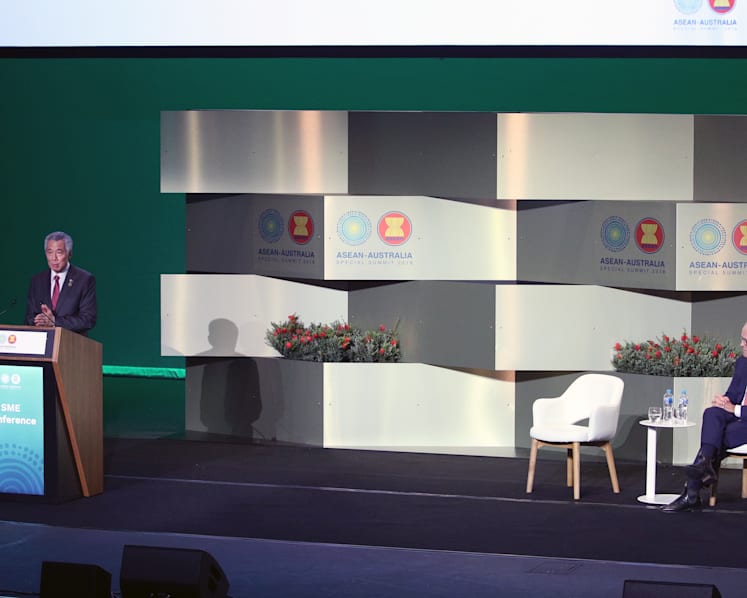
Photo: MCI


SYDNEY — Rejecting a suggestion from an Australian journalist that China is “dividing Asean”, Prime Minister Lee Hsien Loong said it was “normal” for members of the regional bloc to have different views on the shift in the global strategic balance towards China.
“There’s a range of different perspectives and responses to this shift in the balance among the different Association of South-east Asian Nations (Asean) countries, which is not surprising because the different Asean countries have different interests of their own and see the world differently,” Mr Lee said at a press conference with his Australian counterpart Malcolm Turnbull on Friday (March 6), after a bilateral meeting with Mr Turnbull in Sydney. Singapore is Asean chair this year.
Mr Lee was responding to a question by a reporter from The Australian newspaper on whether the group was being split by the Asian giant.
“If you’re a landlocked state on China’s borders, you see the world differently from an archipelagic state, which is further away and which does business not only with one major partner, but with many different partners,” said Mr Lee, noting that this was one but not the only factor leading the regional grouping’s member states to hold different views. He added: “This is the reality of the way the world is, particularly in an association of sovereign countries.”





On Singapore’s part, it does not view the world in “black-and-white terms”, said Mr Lee. The Republic does business with all the major powers, including the United States and China whose influence has been growing in tandem with its economy, strength and interests in the region and beyond, he noted.
Mr Lee pointed out that in Australia’s case, even in a Commonwealth of non-sovereign states, there is a diversity of views between someone “on the eastern seaboard like New South Wales (an Australian state) and somebody on the western coast, like Western Australia”.
Addressing the reporter, Mr Lee said: “Therefore, I would not accept your framing of the question. I think these are issues Asean has to deal with and we’ll have to do our best to manage all these tensions and these pressures.”
China has had its share of run-ins with Asean member states, not least over the South China Sea dispute. It asserts sovereignty over much of the strategic waterway, amid rival claims from several South-east Asian countries — including four Asean members Malaysia, Brunei, Vietnam and the Philippines. Singapore and Australia are non-claimant states.
Tensions have eased somewhat in the past year amid regular exchanges between Asean member states and China, while negotiations on a code of conduct in the strategic waterway have also begun.